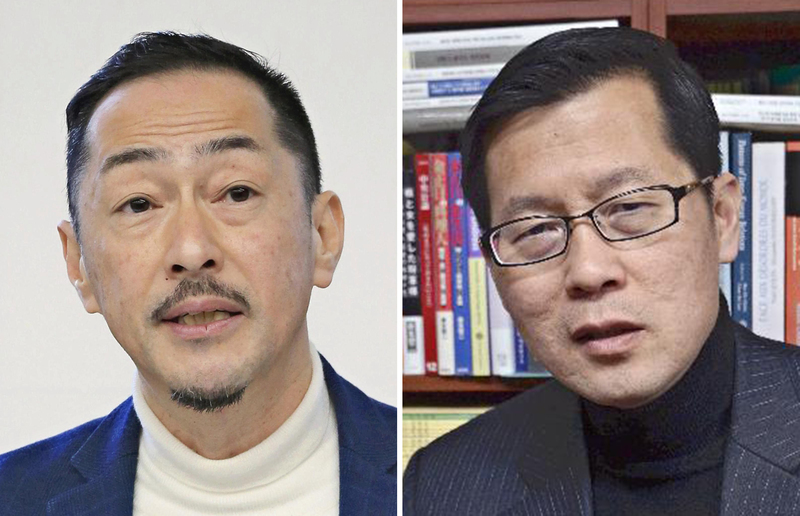
The leaders of the United States and North Korea are expected to hold summit talks on the latter's nuclear and missile development. Will the meeting help resolve the greatest source of instability in East Asia? The Yomiuri Shimbun asked Japanese and South Korean experts about the prospects for a resolution. The following are excerpts from the interviews.
(From The Yomiuri Shimbun, March 10, 2018)
Slim hope for N. Korean concessions
With North Korea open to dialogue, there's no question that economic sanctions against Pyongyang have worked to some extent. The country seems to have been driven into a corner. I believe the Pyeongchang Winter Olympics were a golden opportunity for North Korea, as it succeeded in initially wooing South Korea before reaching out to the United States.
At the same time, South Korea's relationship with the United States has not been great, and its relations with Beijing have soured over the deployment of the Terminal High Altitude Area Defense, a cutting-edge missile defense system. Its ties with Japan have also deteriorated because of the comfort women issue. North Korea presented the only opportunity for South Korea to score a victory, a situation that Pyongyang used to its advantage.
It would be reasonable to hold a summit meeting after North Korea takes concrete steps toward abandoning its missile and nuclear programs. However, discussing the issue after the summit would be like putting the cart before the horse. A meeting between the U.S. president and the North Korean leader would be a final step. This will all amount to nothing unless tangible results are obtained.
We could very well see a recurrence of previous instances [in which North Korea promised to halt its nuclear and missile development but never followed through]. The administration of U.S. President Donald Trump could also become a lame duck after the November midterm elections. I don't think North Korea would meaningfully compromise with an administration with an uncertain future.
The most dangerous outcome would be a temporary, expedient agreement between the United States and North Korea that involves Seoul and neglects Japan's national security. I hope Prime Minister Shinzo Abe pushes for close cooperation between Japan and the United States. If Washington were to lift sanctions, only the issue of Japanese nationals abducted by North Korea would possibly remain.
Japan should not ease sanctions unless Pyongyang compromises in a concrete and visible manner. I hope this will serve as an opportunity to unreservedly debate defense issues such as possessing the ability to strike enemy bases and expanding the defense budget.
(This interview was conducted by Yomiuri Shimbun Staff Writer Teizo Toyokawa.)
Koji Murata
Professor at Doshisha University
Murata, 53, specializes in U.S. foreign policy and security issues. His published books include "Dai-toryo no Zasetsu" (Failure of a president), which won the Suntory Prize for Social Sciences and Humanities. He served as president of Doshisha University from 2013 to 2016.
Entry into military facilities key
With the interests of Kim Jong Un, chairman of the Workers' Party of Korea, and U.S. President Donald Trump currently aligned, it is very possible that talks could yield some sort of agreement.
Trump can expect a significant diplomatic victory before the November midterm elections. Negotiations could potentially prevent North Korea from fully developing an intercontinental ballistic missile, as it has yet to perfect the atmospheric reentry technology needed to strike the U.S. mainland.
Last November, North Korea declared the completion of its nuclear capabilities while problems concerning the reentry technology remained unresolved. Pyongyang might have taken such a step to maximize its bargaining power without crossing any red lines, which would result in a U.S. military assault.
If the U.S.-North Korea summit meeting actually takes place, Kim would seek the incremental lifting of sanctions, friendly relations with the United States and an eventual end to joint U.S.-South Korean military drills. North Korea could abandon its ICBMs should Trump accept these requests. Though North Korea would retain short- and intermediate-range missiles capable of hitting Japan and South Korea, including its Scud and Rodong missiles, its relinquishment of ICBMs would remove the direct threat to the U.S. mainland. The U.S. nuclear umbrella would also be maintained to protect Japan and South Korea from North Korean attacks.
North Korea would have little difficulty accepting inspections of its Yongbyong nuclear facilities as a measure against further development of nuclear weapons. Pyongyang's existing nuclear arsenal poses a greater problem. Its stockpile would be incrementally reduced, but this could only be verified by permitting adequate inspections of its military facilities. This will likely become a focal point.
After the first inter-Korea summit meeting with former South Korean President Kim Dae Jung in June 2000, Kim Jong Il, the father of Kim Jong Un, tried to meet then U.S. President Bill Clinton, and held leadership talks with Japan in 2002.
If Kim Jong Un succeeds with inter-Korean summit talks in April and U.S.-North Korea summit talks to be held by May, he will likely pursue diplomacy with Japan afterward.
(This interview was conducted by Yomiuri Shimbun Seoul Correspondent Yujiro Okabe.)
Cheong Seong Chang
Director of the Unification Strategy Studies Program at the Sejong Institute
Cheong, 52, has a doctorate in politics from the University of Paris X. He assumed his current position in April 2015. An expert on North Korean politics, Cheong also serves as a member of the South Korean Unification Ministry's Policy Advisory Committee.
Read more from The Japan News at https://japannews.yomiuri.co.jp/