President Barack Obama sits with his eyes on history. He's looking back in time, and perhaps he wishes things could be as clear now as they were then.
There was no ambiguity about what was at stake on 1 December 1955. Rosa Parks was riding the bus in Montgomery, Alabama, when she was told to give up her seat to make room for a white man. She refused and, under the American south's notorious "Jim Crow" laws, she was immediately arrested. The campaign that grew out of her defiance made a leader of Martin Luther King, a household name of Rosa Parks and ended racial segregation on buses. It is widely seen as the start of the civil rights movement's transformation of the US.
That's what Obama seems to be remembering as he sits on the same bus Rosa Parks boarded, now a treasure of the Henry Ford Museum near Detroit. Yet in modern America nothing is sacred. No sooner had he posted this photograph on Twitter to mark the 58th anniversary of Parks's protest than commentators were accusing him of "narcissism" for identifying with her courage.
That criticism is blatantly spurious. He does not look in the photograph as if he is claiming to be a reincarnation of Parks – rather as if he is meditating on her example. Meanwhile, the Republican party was mocked for a tweet praising Parks for her "role in ending racism", as if America today were an egalitarian utopia.
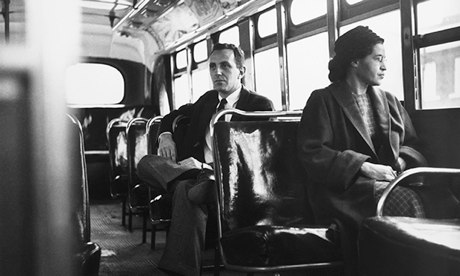
And perhaps this is what's on the president's mind as he sits there. Clearly, the fact that an African-American president can sit on that bus is in many ways the fulfillment of the "dream" the civil rights movement dared to believe in. Yet across America, cities are still divided, not by law but economics, into black and white districts. Massive racial inequalities haunt that battered old bus. Obama's presidency, like the success of other individuals, appears not to change the overall texture of highly visible injustice that still scars a nation built partly on slavery. The president spoke out after Trayvon Martin was shot dead but this did not stop a Florida jury acquitting the man who killed this unarmed black teenager.
And then there's the trivialistation of modern American politics, drained of meaning by trash TV and reduced to gossip by social media. What Obama might be thinking, is that back in 1955 you could change the world by boarding a bus. In 2013, it seems hard to change anything even when your seat is in the Oval Office.