

Trump Media & Technology Group Corp. (DJT), the company behind Truth Social, has landed in hot water, and this time, the controversy is about who gets to see President Donald Trump's posts first. The company recently launched a service called Truth API, which gives paying customers, including financial firms, faster access to posts from high-profile Truth Social accounts such as President Donald Trump's. The service reportedly costs as much as $100,000 a month, and more than 10 customers have already signed up.
At first glance, it might sound like just another data subscription service. But there is a catch. Trump's posts can move global markets, particularly when he comments on tariffs, trade, geopolitical issues, government policy or other economic issues. And the recent lawsuit, filed by The Intercept and the Freedom of the Press Foundation, argues that selling faster access to Trump's posts could give wealthy investors and trading firms an unfair advantage over everyone else.
The plaintiffs are also challenging Truth Social's six-hour exclusivity arrangement for Trump's posts, arguing that information coming from the president should not effectively be placed behind a paywall. Against this backdrop, let’s take a closer look at DJT stock and break down what this legal battle is really all about, and why investors should care.
About Trump Media Stock
Trump Media & Technology Group, or TMTG, is a media and technology company with a rather unusual story. Founded in 2021 and headquartered in Sarasota, Florida, the company set out to build an alternative to the major social-media platforms, particularly what it views as the growing influence and content restrictions of Big Tech. Its goal was to give users a platform centered on free expression and fewer restrictions.
Its flagship platform, Truth Social, launched in 2022 and quickly became the face of the business, largely because it serves as Donald Trump’s primary social-media platform. But TMTG is looking to be much more than just the company behind Truth Social. The company has been steadily expanding its Truth-branded ecosystem into areas such as streaming, financial services and digital assets. Its offerings include Truth+, a TV streaming platform focused on family-friendly live TV channels and on-demand content, and Truth. Fi, its financial-services and fintech brand incorporating America First investment vehicles.
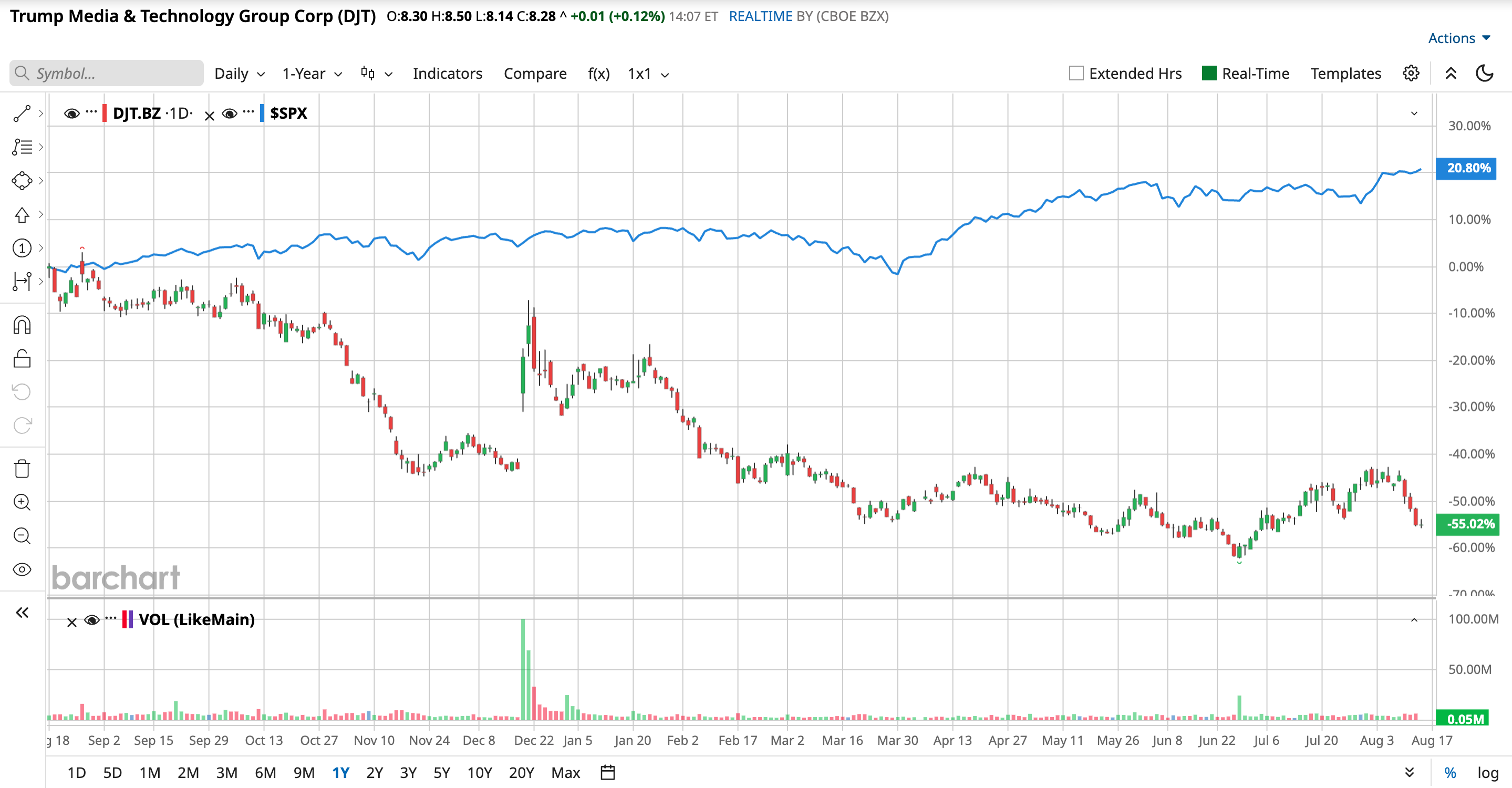
Currently valued at a market capitalization of about $2.29 billion, Trump Media & Technology Group has seen its stock take a steep tumble, despite having one of the world’s most recognizable figures, Donald Trump, as its largest shareholder. Shares have plunged 54.31% over the past year and are down another 38% so far in 2026, with the stock now trading in the single digits. After touching a 52-week high of $18.97 in August 2025, DJT has taken a sharp turn south.
The stock has since plunged 56.5% from that peak, highlighting just how dramatically investor sentiment has shifted around Trump Media. A combination of weak financial performance and the company’s rocky push into crypto has left investors increasingly uneasy. Instead of being reassured by Trump Media’s ambitious expansion plans, investors appear to be focusing on the company’s losses, limited revenue, and exposure to volatile assets, sending many of them toward the exits.
What Exactly Is Truth API?
Truth API is essentially a paid, real-time data feed for Truth Social. Instead of relying on people to constantly monitor the platform, institutional customers can receive posts from influential accounts directly through the service in a format that can be processed quickly by computers and trading systems.
Trump Media launched the service in August after announcing it in July, describing it as a new business-to-business data product and a potential recurring source of revenue. The company said the service is particularly useful for organizations where even a small delay in receiving information can matter, including high-frequency and algorithmic trading firms. Trump Media has been trying to turn Truth Social's enormous political visibility into actual revenue, and Truth API is one attempt to do exactly that.
But Why Has Truth API Become a Legal Issue Now?
The controversy around Truth API moved from the business world to the courtroom on Aug. 12, when The Intercept and the Freedom of the Press Foundation filed a lawsuit against the arrangement. At the heart of their argument is a simple but loaded question. Should President Trump, who is also Trump Media’s largest shareholder, be able to make money by selling faster access to information coming directly from him, especially when that information could matter to the public and financial markets?
The market reaction was swift, with DJT shares plunging 7.2% on Aug. 12 as investors digested the lawsuit and its potential implications. Filed in U.S. District Court in Manhattan, the lawsuit points to Trump’s habit of using Truth Social to announce or comment on major developments involving government policy, military actions, and other government decisions. These posts can sometimes move financial markets, which makes even a small head start potentially valuable to investors and trading firms. The plaintiffs didn't mince words about their objections.
The lawsuit calls the arrangement “extraordinary, corrupt, and unconstitutional,” arguing that there is “no legitimate interest” in allowing the president to profit from selling government information. The complaint also alleges that Truth API violates the First and Fifth Amendments of the U.S. Constitution by giving paying subscribers preferential access to Trump’s public announcements for what it calls “unreasonable sums.”
The lawsuit goes even further, calling the arrangement “profoundly corrupt” and arguing that the president could personally benefit from providing “market-moving” government information to customers willing and able to pay. The plaintiffs also highlight an unusual feature of Trump’s Truth Social activity. His posts often have no immediate corresponding announcement from the White House. In their view, that means Trump’s posts can sometimes be the only immediate source of official government news, making the issue of paid early access even more consequential.
Trump Media’s Q2 Earnings Snapshot
Just before the lawsuit made headlines, Trump Media delivered another closely watched earnings report on Aug. 10, and the numbers gave Wall Street little reason to celebrate. Shares fell 8% following the results, as investors digested a quarter in which the company’s revenue grew sharply but remained tiny compared with its losses.
The company generated $1.7 million in revenue during the second quarter of fiscal 2026, an impressive 89% jump from $0.9 million a year earlier. The increase came from a mix of advertising services tied to a barter agreement, subscriptions to the Truth+ streaming service, and management fees from Truth.Fi exchange-traded fund offerings. Still, despite the strong percentage growth, the top line remained very small in absolute terms.
The bigger headline was the bottom line. Trump Media reported a $238.1 million net loss, compared with a $20 million loss in the year-ago quarter. The company said much of the loss came from non-cash items, including $190.4 million in unrealized losses on digital assets and equity securities, along with $11.7 million in accreted interest and $8.1 million in stock-based compensation.
That doesn’t mean the company burned through $238 million in cash. However, the numbers still highlight how heavily Trump Media’s financial results can be influenced by movements in its investment portfolio, particularly digital assets. Meanwhile, cash used in operating activities stood at $13.7 million, including $25.6 million in legal expenses related to legacy litigation.
Despite the hefty loss, Trump Media ended the quarter with $2 billion in total assets, of which roughly $1.9 billion consisted of financial assets, including cash, short-term investments, equity securities, digital assets and related holdings. For investors, however, the stark contrast between $1.7 million in quarterly revenue and a $238.1 million net loss was hard to overlook.
Final Thoughts
For DJT stock, the latest developments highlight a tug-of-war between big ambitions and weak fundamentals. Truth API could open up a fresh revenue stream by monetizing the enormous influence of Trump’s posts, but the lawsuit brings another layer of legal uncertainty to an already complicated story. Meanwhile, the company’s latest earnings have done little to ease concerns about its financial performance. With shares already down sharply, DJT remains a highly volatile and speculative investment, where headlines, sentiment and Trump’s influence can matter just as much as the numbers.