A coronavirus vaccine, which the government considers essential for ending the pandemic, will be available in Japan as early as next week. What kind of vaccine is it and how can we get it? There are many unknowns and uncertainties, but here is a summary of the information available as of early February.
Q: When and how will vaccinations proceed?
A: Health-care workers and elderly get priority
-- First group this month
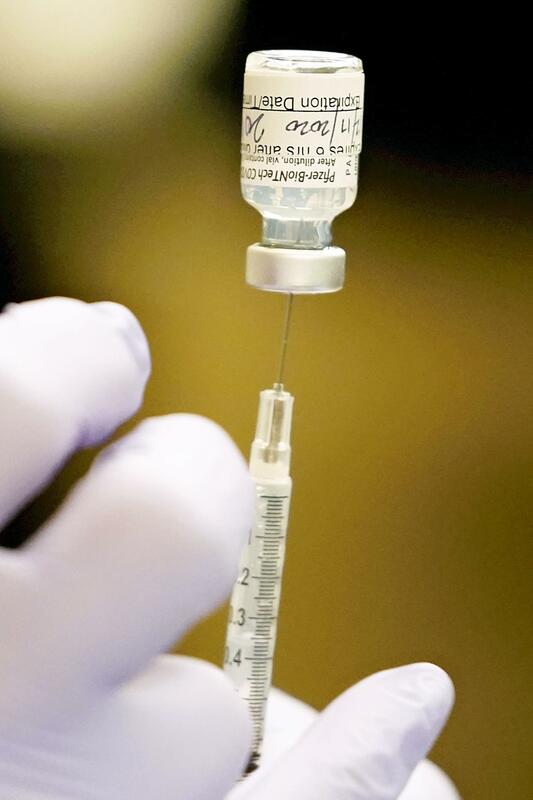
For U.S. drugmaker Pfizer Inc.'s vaccine, which is currently under review for approval in Japan, there is not enough clinical trial data on people aged 15 or younger. Therefore, vaccinations will target those 16 and older for the time being.
The rollout is divided into three major stages. Priority is being given to those who are at a high risk of infection and those who may become seriously ill if infected.
The first priority group is health care workers, who are at particularly high risk of infection. This group includes those who have a lot of contact with COVID-19 patients, such as paramedics, Self-Defense Forces personnel and public health center staff. The first round of vaccinations for this group is expected to begin in mid-February.
The second group is elderly people, meaning those who will be 65 or older by the end of March next year. This is the generation at highest risk of becoming seriously ill if exposed to the coronavirus. There is a special provision that allows staff members of elderly care facilities to be vaccinated together with the elderly when the elderly are inoculated at these facilities.
The government plans to proceed with nationwide vaccinations for the second group from April onward, and complete the program in about three months.
By the end of the vaccination period for the second group, the government will start sending out relevant information to those aged 16 to 64. Then, priority vaccinations will be given to people in the third group, which includes the remaining employees of elderly care facilities, and to those 64 and younger who have underlying health issues such as heart disease.
Although the underlying health issues are divided into different categories, a doctor's certificate is not required and people can be vaccinated just by reporting what their health issues are. It is desirable to make sure that the vaccine is administered to these people before healthy people since they are at a higher risk of infection and serious illness.
This is a huge project: The three priority groups cover a total of 50 million people.
-- Voucher distribution
Vaccination vouchers issued by municipalities are required for those in the second and subsequent groups. In principle, the voucher will be mailed to the address where the target person is registered. Elderly people will receive the voucher in March or later, and the third and subsequent groups will receive them in April or later. Foreign residents of Japan are also eligible.
Vaccinations will be conducted in the relevant municipalities, and facilities such as hospitals, clinics and gymnasiums will be the designated venues. A person who wishes to be vaccinated can choose the date and venue by making a reservation online or over the phone.
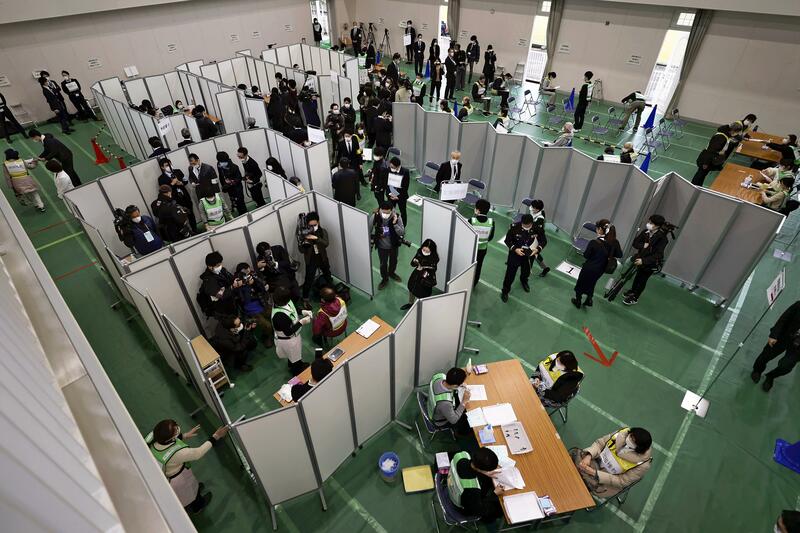
On the day, they must go to the venue with their vaccination voucher and an identification card. After verifying their identity at the reception desk, they submit a preliminary medical checkup sheet and undergo a medical interview, similar to the process for getting an influenza vaccination.
After getting inoculated, a sticker is attached to the voucher to serve as the person's certificate of vaccination.
In a training session held in Kawasaki in January, it took 13 to 26 minutes for a person to get from the reception desk to receiving the vaccination certificate. Afterward, people needed to wait at the venue for about 30 minutes to check for acute allergic symptoms. People are encouraged to allow sufficient time when they go to get vaccinated.
Two doses of the vaccine need to be given. In the case of the Pfizer-BioNTech vaccine, the second dose will be administered three weeks later. It is important to remember to get a second vaccination.
If a person has a valid reason, they can get vaccinated in a different municipality than where they are registered. The procedure differs depending on the reason. For example, if a person is living away from their family for work, they need to apply to the local municipality, but if they are hospitalized, they do not need to do so. The details are yet to be determined.
Q: Is vaccination compulsory?
A: Make your own decision based on benefits and risks
The government revised the Immunization Law in December last year, designating the coronavirus vaccine as a "provisional vaccination" that needs to be implemented urgently in order to prevent the spread of infections. Under the law, people are obligated to make an effort to receive the vaccine, but the government bears the entire cost of vaccinations and all residents of Japan can receive it free of charge.
The obligation to make an effort is a general rule, and the final decision on whether or not to receive the vaccine is left up to the individual. Corporate managers and supervisors cannot force their employees or subordinates to get vaccinated.
There is a historical background to why the individual's decision on vaccination is respected. After the end of World War II, vaccinations were made compulsory for all. However, severe side effects for some vaccines became a social problem, and the law was revised in 1994 to make it a requirement simply to make the effort.
It is important for people who receive vaccinations to understand both the expected benefit, which is the prevention of a serious illness, and also the side effects that occur at a certain rate. The elderly and people with chronic illnesses, who are more likely to become seriously ill if infected with the virus, will probably benefit more from the vaccine than healthy young people.
Tsuneo Morishima, a visiting professor at Aichi Medical University who is an expert on vaccines, said: "Some people may perceive common side effects, such as pain, swelling and fever, as serious. It is best to consult with your family doctor before making a decision."
It has been reported that pregnant women are more likely to become seriously ill if infected, but there is insufficient data on the safety of vaccines for pregnant women and their babies. On Jan. 27, obstetrics and gynecology experts released recommendations in which they said that pregnant women should not be excluded from the vaccination program. The experts recommended that pregnant women who wish to receive the vaccine should receive it at an obstetrics and gynecology facility where the mother and fetus can be properly cared for. They also said that pregnant women should receive sufficient explanations beforehand and avoid vaccination until after 12 weeks of pregnancy.
Q: How good are the vaccines?
A: Efficacy rates of the 3 overseas products range from 70% to 95%
The government plans to purchase a total of 314 million doses of three different COVID-19 vaccines, enough for 157 million people. The Pfizer-BioNTech vaccine, the Moderna vaccine and the AstraZeneca vaccine, named for the U.S. or European companies that developed them, are all based on artificially synthesized genetic material of the coronavirus, a novel technology that has been put to use for the first time in vaccine development.
The vaccines are injected into the muscle of the upper arm. The genetic material enters the cells of muscles and lymph nodes to produce a substantial amount of the spike protein that is located on the surface of the coronavirus. The immune system memorizes the features of this spike protein and targets the virus if a vaccinated person later comes into contact with it.
In principle, the vaccines from these three companies should be administered twice. Giving two doses per person is aimed at boosting the immune system, and the second dose can help the body be fully prepared to fight infection even if the first shot was not effective enough. The Pfizer-BioNTech vaccine can begin to show its efficacy about two weeks after the first dose, and the second shot should be given three weeks after the first.
According to clinical trial data, the two-dose efficacy rate stands at 95% for the Pfizer-BioNTech vaccine and 94% for the Moderna product. This means that should 20 people become ill from the virus in a group of unvaccinated people, that number could be reduced to just one person in a similar but vaccinated group. The efficacy rate for the AstraZeneca vaccine is about 70% on average.
The COVID-19 vaccines are also said to be effective in preventing patients who do become infected from developing serious symptoms. They are presumed to be effective against new variants that are considered more transmissible than earlier ones, even though there are some reports that they have a reduced ability to protect against the illness caused by these variants.
However, many important issues remain unknown, such as how long the vaccines will be effective, whether they can prevent some asymptomatic infections and whether they will help prevent further outbreaks.
This means that you will not be free from all risk even after being vaccinated. People are advised not to change their approach: Our current lifestyle of caution will remain unchanged for the time being, such as wearing masks, washing and disinfecting hands and avoiding the so-called Three Cs of closed spaces, crowded places and close-contact settings.
Q: What about side effects?
A: Contact a doctor if you notice anything unusual
Vaccines can sometimes cause a variety of side effects. Many of these adverse effects, which are natural reactions triggered during the process of boosting the immune system, can be observed within a few days of inoculation.
According to a paper carried by The New England Journal of Medicine regarding clinical trials of the Pfizer-BioNTech vaccine, 78% of recipients aged 16 to 55 reported pain at the injection site after the second dose, while 59% suffered fatigue and 16% developed a fever of 38 C or higher. It is worth noting that more recipients reported these symptoms following their second dose, and the rate of recipients who developed side effects was higher than among recipients of influenza vaccines.
"Fever usually subsides in about a day," said Prof. Ken Ishii of the University of Tokyo. "Consult a doctor immediately if you have a high fever for two days in a row or continue to suffer any abnormal conditions."
In the near future, prefectural governments plan to set up counter services or call centers to handle inquiries about side effects.
Caution is required for anaphylaxis, which refers to acute allergic reactions such as difficulty breathing or a drop in blood pressure that occur within 30 minutes of vaccination. According to the latest data compiled by the Centers for Disease Control and Prevention in the United States, the Pfizer-BioNTech vaccine caused one case of anaphylaxis per about 200,000 doses, while the Moderna vaccine triggered one such case per about 360,000 doses. This data indicates that cases of anaphylaxis rarely occur for the COVID-19 vaccines, but the rates are slightly higher than the average for vaccines in general.
Vaccine recipients will be asked to remain at the venue after getting their shots. If they develop an allergic reaction, the symptoms can be treated with injections.
There are no particular diseases, unique to COVID-19 vaccines, that would prevent patients from getting vaccinated. The Pfizer-BioNTech and Moderna vaccines contain chemical compounds that can also be found in cosmetics and other products. If you have any allergies, make sure to report them during the medical interview before receiving your shot.
Because the COVID-19 vaccines have been developed using a novel technology, it is possible that very rare cases of side effects could be found, or recipients could suffer adverse effects several months after receiving shots. Experts around the world are continuing to analyze data from the vaccinations.
Read more from The Japan News at https://japannews.yomiuri.co.jp/