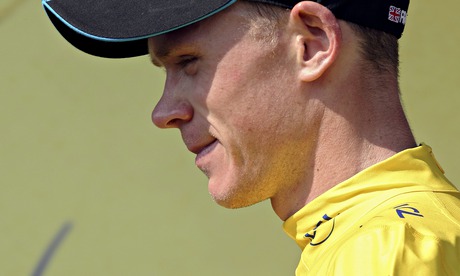
Trust is one of the most scarce and sought-after commodities in every sphere of public life. Most people don’t trust politicians, government, banks or the press. And ever since the grand départ of the Tour de France three weeks ago, it’s been all too clear that no one trusts racing cyclists any more. With just a few lung-lacerating days left, Chris Froome, the man in the yellow jersey, has acknowledged that whatever he says or does, people are going to suspect him of not doing it just by honest sweat and iron discipline.
There is no need to be much of a fan to know that cycling and the Tour in particular has a trust problem. Froome is deemed to be outperforming not only his rivals but his previous best, and that, it is immediately assumed, means he must be on something. He has had urine thrown in his face by a fan shouting “doper” at him. There is speculation that there is some previously unimagined mechanical enhancement on his bike that allows him to hang on to his three-minute overall lead. Needless to say, he and his team, Sky, deny any such thing in the strongest and most detailed possible terms, publishing data about his heart rate and power ratio that is normally kept secret. But when trust is gone, it is gone.
It’s not only to do with money. Doping in cycling appears so pervasive that now even amateurs do it. Men in their 50s and 60s are reported to be so hungry for the status, the buzz and the bragging rights of victory that they’ll jeopardise their health by buying performance-enhancing substances online. They do it because they can. They don’t expect to get caught.
Cycling, where the tiniest physical margins make the difference between victory and defeat, seems particularly vulnerable to a curse that afflicts much of public life. Lance Armstrong, the serial winner and cheater of the Tour, says that in the same circumstances, he would do it all over again. Everyone else was doing it, so he had to too.
Pleasingly, there is now maths to describe this. Game theory, which looks at competition and collaboration, describes something called the prisoner’s dilemma, where everyone knows it is in the interest of the sport not to cheat but suspects that since a significant number of the others are doping, they need to as well. In theory, if there is a genuine fear of getting caught – which means a testing system that cannot be evaded – then doping would die out.
There is also a refinement to the theory, introduced by the Hamburg economist Berno Buechel, that points to a flaw. It doesn’t take into account the economic basis of the sport – the fans and the sponsors. If the sport’s authorities are so terrified that a rigorous testing regime might reveal a system corrupt from the front of the peloton to the back then they would rather catch one or two every so often, and claim they are merely bad apples, a defect of human nature etc, than take the risk of a wholesale unmasking of the corruption.
After Armstrong, who issues denials for a decade in the strongest and most litigious of terms, finally fessed up on Oprah Winfrey, cycling appeared to go through a mass commitment to clean up. Now it is back in bad apple mode. For all we humble observers know, it might also be true of, say, athletics, where a BBC Panorama programme recently cast a shadow over the most glorious of our Olympic heroes, Mo Farah, when the producers alleged that his trainer Alberto Salazar was not entirely clean. Salazar denies the allegations.
So why don’t the relevant authorities implement the kind of rigour that might restore trust? Certainly in the Tour, competitors are subject to tests even in the middle of the night in case they are using tiny amounts of dope undetectable soon after it has been taken. It doesn’t silence the critics.
Politics is in something of the same dilemma. The yearning for a figure who seems to act only according to some inner compass, without reference to fashion or with an eye to electoral advantage, has always had a certain appeal. When it’s someone like Jeremy Corbyn, who has been a lifelong lefty and suddenly finds himself surfing the zeitgeist, it could be irresistible. Corbyn is (as, I quaintly believe, are most of his colleagues) a decent and honourable man who would unquestionably be a political catastrophe for Labour. Game theory does not offer a way out of that particular dilemma.
But part of the reason for his appeal is not just the substance of his politics, it’s his integrity. He stands out at a time when politics among the elite of all the main parties – most obviously at the moment the prime minister and the chancellor – is being conducted as if it was some kind of parlour game where the winner was the one who scored most points for positioning their policies in a way that would most compromise the opposition.
What once preoccupied even the most partisan political leader on both left and right – national wellbeing – is no longer treated as the cornerstone of all political decision making. Instead, Cameron and Osborne seem happy to jeopardise even the union of the United Kingdom itself if it embarrasses Labour and consolidates power for the Tories.
They would do well to look at the state of professional cycling and wonder if that is really the fate they wish on the governance of Britain.