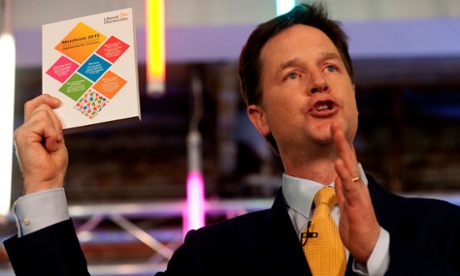
The Liberal Democrat leader, Nick Clegg, launched his party’s manifesto in Battersea, south London, on Wednesday and we have analysed the document to give an indication of the party’s priorities.
Here are some of the most mentioned words in the 160-page manifesto.
Health
With 153 mentions in the manifesto, health is clearly a top concern for the Lib Dems. A £500m investment in mental healthcare and the introduction of waiting time standards in line with physical health are proposed. There is also a promise of £8bn more funding a year by 2020 to the NHS - the investment called for by the service’s chief executive, Simon Stevens.
The management of the health service is one of the top concerns for voters (second only to immigration). An Ipsos Mori poll from March showed that four in 10 voters said that healthcare, the NHS and hospitals would be very important in helping them decide which party to vote for.
Spending
Spending is a word that you’d expect to rank highly in a party manifesto. The Lib Dems don’t disappoint, mentioning the words spend, spends, spending, investment, invested, investing and invest a total of 117 times.
As well as the proposed increases in NHS spending – and in particular mental health spending – for the NHS (£500m a year by 2016-17 for England and cash for similar investments in Scotland, Wales and Northern Ireland), the Lib Dems’ manifesto pledges to double innovation and research spending across the economy. Money saving by scrapping police and crime commissioners is also mentioned in the document.
Crime and policing
With 112 mentions, crime and policing is the third most mentioned theme in the manifesto. It’s interesting that it ranks so highly – topics such as health, economy, immigration and education are the areas voters are currently most concerned about.
However, a look at thedocument shows some policing issues tied to these concerns:
- New waiting time standards and better crisis care in A&E, in the community and via phone lines. This will enable us to end the use of police cells for people facing a mental health crisis.
- Provision of experts in courts and police stations to identify where mental health or a drug problem is behind an offender’s behaviour so they can be dealt with in a way that is appropriate.
- Complete border checks, using the information to improve visa rules and deport people with no right to stay.
Boosting police recruitment from black, Asian, and minority ethnic groups, and introducing specialist drug courts and non-criminal punishments that help addicts get clean also feature.
Education
Education features in the manifesto 103 times. Some of the key points on education in the manifesto are:
- Protecting early years, school, sixth form and college budgets.
- Extending free school meals to all primary pupils.
- Doubling the number of businesses hiring apprentices.
- Increasing the early years pupil premium to £1,000 per pupil per year.
- Establishing a review of higher education finance within the next parliament to consider any necessary reforms.
Methodology
Our approach is limited in that we will only see how frequently the words we have chosen as keywords are used. Given the complexity of language, this could mean that some issues have been missed out or overrepresented.
However, by comparing the three main parties across the week we will be able to get a picture of how much importance they have placed on the issues of most concern to the electorate. The list of keywords we have used are as follows:
Health – health/NHS/doctors/nurses/GPs
Education – education/schools/universities
Inequality – inequality/poverty/wage/pay
Spending – spend/spends/spending/investment/invested/investing/invest
Taxes – tax/taxpayers/taxes/VAT
Crime and policing – crime/crimes/police/policing/prisons
Jobs/employment – unemployment/jobs/employment/workers
Economy – economy
Deficit/debt – deficit/debt/borrowing/cuts
Housing – housing/buyers/rent/renters/property/house/housebuilding
Immigration – immigration/immigrants/migration/migrants
Europe – Europe/European/EU/Foreign