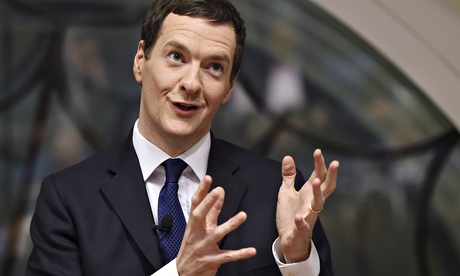
In his budget speech (Report, 19 March) the chancellor, George Osborne, forgot to mention the following eight factors: missed target to eliminate the deficit by end of this parliament; larger debt in the government’s five years than Labour accrued over 13 years in office; tax breaks for millionaires and hedge funds; a million people using food banks; 59% rise in working people forced to claim housing benefit; 1.4 million people on zero-hours contracts; record numbers of people living in poverty; and another £60bn in cuts still to be found before 2020. All seemed to have slipped George’s memory.
Terry Palmer
Barnsley
• Simon Jenkins has fallen for the claim that Osborne has brought us out of recession (Cameron may be PM, but Osborne is the one in charge, 19 March). The economy was already recovering when Labour left office in 2010, having put on four quarters of solid growth. As soon as Osborne announced his draconian cuts, GDP slumped back under zero and then seesawed up and down for three years, so that a median line drawn on the graph shows us bumping along just above zero. In other words, he delayed a nascent recovery by three years. As for Britain being the fastest-growing nation in the developed world, this is of course relative. If you go down in the dumps for so long it can look dramatic when you finally recover. Germany, for instance, didn’t go down in the dumps in the first place, so inevitably its growth rate may look relatively modest.
David Redshaw
Gravesend, Kent
• The coalition government has not been shy in celebrating record levels of employment in the budget. However, there were 5,030 fewer young people starting apprenticeships across London in the past year. Despite the budget focusing on setting up young workers in life, if youth employment starts to fall the savings projected by the chancellor are unlikely to be sustainable.
The government has rallied behind apprenticeships and they are now more appealing for employers than ever. No longer the preserve of trades, apprenticeships have widespread appeal across the professions as well as flourishing creative and emerging industries. So why are apprenticeships falling? The apprentice brand has been damaged by government policy. They are increasingly being used as cheap labour, which is unsustainable and undermines current employment policy. The chancellor’s announcement that employers’ NICs will be abolished for apprentices from 2016 will do nothing to ensure the necessary commitment and investment in apprentices.
The legal profession is opening access to apprentices in many different forms. Here, in my experience, apprentices are seen as a true future investment and one that can lead to positive cultural and financial returns for the individual, consumers and business. Apprenticeships offer a great deal as long as they are used wisely, for the right reasons and individuals are treated as valued members of any team. I hope tax breaks don’t blur that message.
Kevin Poulter
Legal director, Bircham Dyson Bell LLP
• Is it not the case (Surprise of help-to-buy Isas for first-time buyers is sprung on housing industry, 19 March) that, to use George Osborne’s own language, over £2bn of hard-working taxpayers’ money is being passed straight to wealthy property owners as an incentive to increase their prices still further and so extend the inflation of the housing market for the benefit of this government’s friends? 25% of deposits paid for by taxpayers means nothing more or less than this.
Ian Flintoff
Oxford
• George Osborne is a master conjuror. Illusion one: the deficit has been paid back. It hasn’t. Illusion two: unemployment has all but vanished. It hasn’t. What we have is under-employment. Now it’s under the guise of the zero-hours contract and the seasonal small business. Illusion three: the country is booming and we are at the start of a sustained recovery. Rural Wales is struggling. What we need, like many parts of the UK, is investment in our long-term future. The money is there, hidden in several hats that Osborne says are untouchable because they belong to friends he’s promised never to upset. This month Barclays announced profits of £5.5bn. Several other banks, supermarkets and energy companies are making similar profits. If, instead of allowing them to be used to fund bonuses and global expansion, we applied a windfall tax on half of these profits we could find the money for half a million affordable house a year at a stroke. What’s stopping you, George?
Quentin Deakin
Tywyn, Gwynedd
• Freezing and in some cases cutting the duty on alcohol sends out the wrong message. Alcohol is the cause of Britain’s biggest drug problem and wastes millions of the limited NHS budget in treatment and millions of the police budget. This is quite apart from the effects of people taking time off work and the contribution of alcohol to increased crime, road accidents and family breakdown.
John Wainwright
Potters Bar, Hertfordshire
• A suggestion for the rich of a legal way to pay less tax: pay yourself less and pay workers a living wage. This way we would all pay less as the benefit bill would reduce. Fortunately, it is also Ed Miliband’s policy, so all we have to do is vote Labour to help the rich ease their tax burden.
Brian Keegan
Peterborough