WICHITA, Kan. _ As a seventh-grader, he walked past a guitar store one day. That was the beginning.
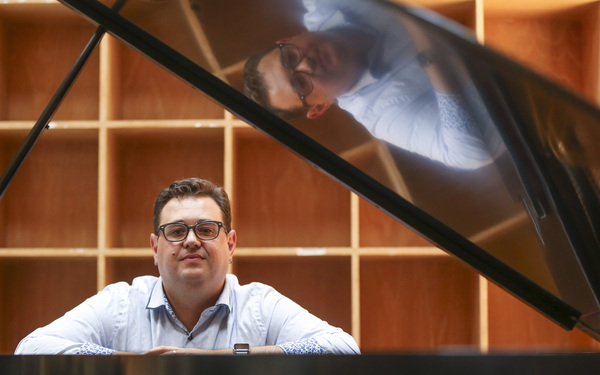
Aleksander Sternfeld-Dunn began playing guitar, then piano, eventually the stand-up bass. He began to write music that won accolades, and became a teacher and professor at Wichita State University.
The bosses there think he'll become more than that now. "We have faculty here who ignore the customary (closed) silos of learning, and that should now be the norm," said Tony Vizzini, WSU's provost and vice president for academic affairs. "He's developed interesting ideas about how people learn."
Sternfeld-Dunn at 35 is one of the teachers Vizzini mentions these days in describing a new course he and President John Bardo have set for WSU's future. Vizzini arrived three years ago and began urging faculty and deans to do more to blur lines, to cross tradition-bound barriers between engineering, business, liberal and fine arts, education _ everything. People learn more when they work with people who think differently.
Tradition might have meant Sternfeld-Dunn would have stuck within the lines of rhythm and sound: He's written classical music that won him national awards. He can play a good piano interpretation of Bach's Prelude No. 1 in C major.
But earlier this month he took part in panel discussions with business people at the Kansas Leadership Center, discussing how to create, inspire and lead people.
One of his passions is teaching Introduction to Fine Arts, to anywhere from 60 to 100 students a semester, where a key idea is to capture the imaginations of young students early and teach them curiosity and passion.
Teach them passion, he said, and they will teach themselves.
A 'BETTER SOCIETY'
The arts are often the first things cut in a time of cutbacks, Sternfeld-Dunn said. "They are seen as luxury items.
"This is a mistake, and I'm not saying that just to protect our jobs."
Jobs are important; business is important, he said. But seeing universities as a place to get only job training, he said, is "a problematic view."
Jobs, and what people buy and sell, change all the time, Sternfeld-Dunn said. "A lot of what used to be white-collar jobs are getting outsourced now. Even lawyers are getting outsourced, including to computers. I did my will on LegalZoom.com."
But critical thinking is timeless; creativity is timeless.
So is the 1956 Chevy, he said.
Is a car just a car? Is a car merely a tool that gets you from place to place?
He saw a 1956 Chevy at a car show recently.
"It's a thing of beauty; it was designed with art in mind. It was designed for beauty."
It's the same thing with the iPhone, Sternfeld-Dunn said. Over recent history, more people bought iPhones than other phones in part because Apple included artistic designers in creating it. It's designed not only to function but to create artistic experiences.
This is where education in art can lead to better business, he said. Including in the design and manufacture of automobiles.
"In 50 years, are we going to see the 2016 Toyota Camry at car shows? I don't think so. But we will still see the 1956 Chevy."
WHAT THE ARTS TEACH US
Nursing, business and engineering are good professions, Sternfeld-Dunn said.
"But are you learning how to be creative? Successful companies are looking for that in their hires."
The arts teach not only creativity but passion, he said. "It's unlike any other field."
The arts taught him not only the mechanics of how to play notes on an upright bass but how to think critically, how to test the limits of ideas, and how to work with and even teach people who don't think like him.
So in that introductory course for the fine arts, he teaches people who he knows will become accountants, business people, engineers. What they learn about the arts from WSU, if he does it right, will shape how they do those jobs.
If you're in business and need to lead people, studying for speech class will teach you how to do that. If you run a laboratory and need to raise money for it, the arts can teach how to talk to donors. "Many wealthy donors, by the way, donate a lot to the arts."
How to fail big, and come back? They teach that in the arts. "When I write a piece of music, I wonder: What if no one likes it?"
The arts teach how to work relentlessly. To take risks, to dare, and be daring. To look at problems, especially human problems, from many different angles, from outside those silos Vizzini mentioned. The arts teach critical thinking, Sternfeld-Dunn said.
"And a side effect of that? They can get a job."
The arts teach empathy.
"All the conflict and strife in the world comes from lack of empathy," Sternfeld-Dunn said. "With all of our conflicts, if we can't have empathy, there's no hope for any of us to come to the middle and agree."