The text that chose fire as its narrator
Of all the eighteen Mahapuranas, only one opens with Agni, the god of fire, speaking directly. The Agni Purana does not describe fire from the outside. It speaks as fire. That choice is not decorative. The entire text treats agni as a principle of transformation: the force that converts raw matter into something the cosmos can use. Every ritual instruction in the Purana flows from this premise. Havan is not symbolic burning. It is a precise technology for moving substance from one state to another.
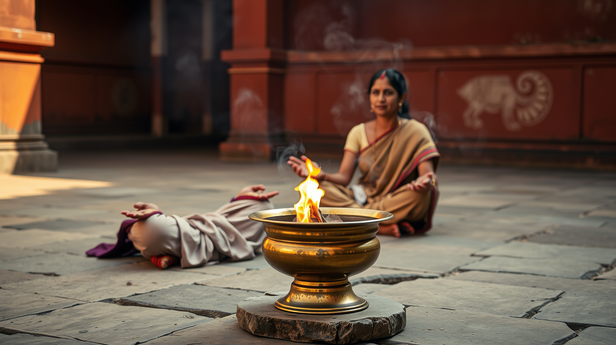
The Purana describes the sacred fire as a witness, sakshi, to every significant human event. Marriage vows are sealed in its presence. The dead are returned to it. A child's first solid meal is offered to it. This is not superstition dressed in ceremony. It is a claim that fire participates in biological and social transformation, not merely observes it.
What havan smoke actually does to a room
A 2007 study published in the Journal of Ethnopharmacology by researchers including Manoj Nair tested the effect of burning medicinal herbs, the kind used in traditional yajna, on airborne bacterial populations in a closed room. After an hour of burning, bacterial counts dropped by 94 percent. Twenty-four hours later, they had not returned to baseline. Thirty days later, some pathogenic species had not reappeared at all. The researchers called this effect "medicinal smoke" and noted that the specific combination of wood and dried plant matter mattered enormously, not just any fire, but the prepared fire.
The Agni Purana specifies which woods to use for which purposes. Mango wood for fertility rites. Peepal for ancestral offerings. Specific dried herbs, ghee as a carrier agent. This was not aesthetic preference. The text understood, in its own vocabulary, that the chemical composition of the smoke changed the effect. Modern phytochemistry calls this the difference between combustion products of terpene-rich wood versus plain cellulose. The Purana called it the difference between a sacred fire and an ordinary one.
Infrared light and the body that sits beside the flame
You sit near a havan kund and feel something that is not just warmth. The heat from a wood fire peaks in the near-infrared spectrum, between 700 and 1400 nanometres. This is the same range that photobiomodulation therapy, a field now studied seriously in dermatology and neuroscience, uses to stimulate cellular repair. Mitochondria, the energy-producing structures in your cells, have photoreceptors that respond to this specific wavelength. Sitting near a correctly built fire is, in measurable biological terms, a form of light therapy your body has been calibrated for across hundreds of thousands of years of evolution.
The Agni Purana instructs practitioners to sit at a prescribed distance from the fire, not too close, not too far. The reasoning given is ritual purity. The mechanism, as biology now reads it, is optimal photon dosage. The text got the distance right. It simply had a different name for why.
Mantra, frequency, and what sound does to flame
The Purana does not treat mantra as prayer in the Western sense, a petition sent upward. It treats mantra as a physical force applied to the fire. The chanting is part of the ritual technology, not the devotional garnish on top of it. Sanskrit mantras used in yajna are composed in specific metres, Gayatri, Trishtubh, Jagati, each with a distinct syllable count and rhythmic pattern that produces a measurable acoustic frequency when chanted correctly.
Cymatics, the study of how sound organises matter, has shown that specific frequencies create stable geometric patterns in physical media. A fire fed with sound at certain frequencies burns differently, more completely, with altered flame geometry. The Agni Purana's insistence on correct pronunciation and correct metre was, from this angle, an insistence on correct frequency. The mantra was not decoration. It was a parameter.
What the Purana understood about transformation that science is still mapping
Modern thermodynamics describes fire as a rapid oxidation reaction releasing energy as heat and light. That is accurate and incomplete. Fire does not merely release energy, it reorganises matter. Carbon bonds break. New molecules form. Some of those molecules, in the case of a prepared yajna fire, are biologically active: volatile organic compounds, aromatic acids, ionised particles that alter the electrical charge of the surrounding air. Negative ion concentration near a wood fire is measurably higher than in still indoor air, and elevated negative ion environments are associated with reduced cortisol and improved serotonin regulation in peer-reviewed literature.
The Agni Purana called this the purifying action of agni, not metaphorically, but as a description of what fire does to the space around it. Purification, in the Purana's framework, is not a moral category. It is a physical one. The fire changes the air. The air changes the body. The body, changed, is capable of different states of attention. That chain, fire, atmosphere, biology, consciousness, is what the ritual was designed to complete. Science has now confirmed the first two links. The last two are where the laboratory runs out of instruments and the Purana keeps going.