
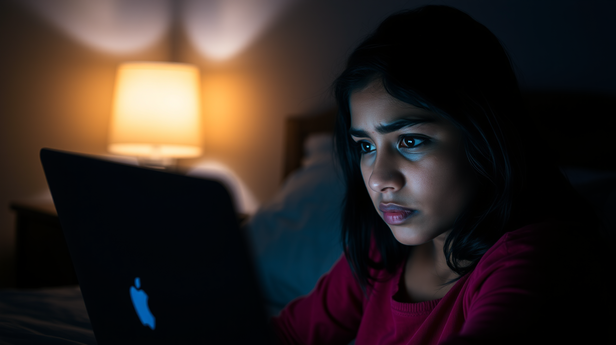
The dark room makes it worse, not the screen alone
Most ophthalmologists will tell you screen time is the concern. The darker truth is that the room matters as much as the device. When you sit in a dark room with a bright screen, your pupil dilates to gather ambient light, and then the screen floods the retina with high-intensity blue light through a wide-open aperture. The eye has no time to reconcile the two. The result is sustained pupil instability, a condition researchers at the Toho University School of Medicine in Japan documented in a 2021 study showing that high-contrast screen use in low-light conditions significantly increases accommodative lag, the gap between where the eye is focused and where it needs to be. Over months, that lag compounds.
The retina itself contains two types of photoreceptors: rods, which handle low-light vision, and cones, which process colour and fine detail. In a dark room, the rods are active. The screen then demands cone-level processing. Both systems fire simultaneously, neither optimally. This is not a design the eye evolved for.
What blue light does to photoreceptors over time
Blue light occupies the 400 to 490 nanometre range of the visible spectrum and carries more energy per photon than red or green wavelengths. A 2018 study published in Scientific Reports by researchers at the University of Toledo found that blue light converts retinal, a molecule essential to light detection, into a toxic form that kills photoreceptors. The cells do not regenerate. Once lost, that visual resolution is gone. The study used cell cultures, not living eyes, and the leap to clinical damage in humans requires more longitudinal data. But the mechanism is real and established. The concern is cumulative exposure over years, not a single late-night session.
Most smartphone and laptop screens emit peak blue light between 455 and 470 nanometres, squarely in the highest-energy band. Indian users spend an average of 6.5 hours per day on screens according to the 2023 DataReportal Digital India report, placing daily blue light exposure well above what research models treat as low-risk baseline.
Pupil strain and the contrast problem
In a lit room, ambient light keeps the pupil partially constricted. The screen adds its own light, but the eye is already managing a baseline. In a dark room, the pupil opens fully, then receives a concentrated beam of high-luminance blue light directly onto the macula, the central zone of the retina responsible for sharp vision. The macula has the highest density of cone cells in the eye. It is also the site of age-related macular degeneration, one of the leading causes of irreversible vision loss in adults over 50 in India, according to data from the L V Prasad Eye Institute in Hyderabad.
The strain is not just photochemical. Constantly shifting focus between a bright screen and a dark background triggers repeated cycles of ciliary muscle contraction and relaxation. The ciliary muscle controls the lens shape. Sustained overuse leads to a condition called digital eye strain, or computer vision syndrome, which the American Optometric Association estimates affects 50 to 90 percent of regular screen users. Symptoms, burning, blurred vision, headaches, are the short-term signal. Structural fatigue is the long-term one.
What the research says about protective habits
The 20-20-20 rule, every 20 minutes, look at something 20 feet away for 20 seconds, has been validated in multiple clinical reviews as a way to reduce accommodative lag and ciliary fatigue. It does not address blue light exposure directly. For that, screen filters in the amber or warm-tone range (reducing blue light output by 40 to 60 percent) show measurable reductions in photoreceptor stress markers in short-term studies, though long-term retinal protection data remains limited.
Ambient lighting matters more than most users account for. Keeping a lamp on behind the monitor, not in the line of sight, but filling the room, reduces the contrast differential the pupil has to manage. The screen should not be the only light source in the space. This is a structural fix, not a supplement.
Blue-light-blocking glasses have a more contested evidence base. A 2021 Cochrane review found insufficient evidence that they reduce eye strain compared to placebo lenses. They may help with sleep disruption by filtering the wavelengths that suppress melatonin, but their direct retinal protection claim is not yet supported by the same quality of evidence as the lamp-on-in-the-room intervention.
The retinal damage you won't notice until later
Photoreceptor loss is painless. The retina has no pain receptors. Early macular stress does not produce a symptom the user can identify as distinct from ordinary tiredness. By the time vision loss becomes noticeable, a blurred centre, difficulty reading fine print, the damage has been accumulating for years. An annual dilated eye exam, which most urban Indians skip, is the only way to catch early retinal changes before they become permanent. Optometrists at Sankara Nethralaya in Chennai have reported a measurable increase in young adult patients presenting with early macular stress, a pattern they associate with high screen use in low-light environments.
The retina is not repairable the way skin or muscle is. It does not regenerate lost cells. The photoreceptors you have at thirty are the ones you are trying to keep at sixty. Dark rooms and bright screens are not a crisis per session. They are a slow subtraction, running quietly in the background every night.
The room and the screen together create a problem neither creates alone, the pupil opens for darkness and the retina absorbs light at full intensity, every evening, for years. That combination is what the eye was never built to sustain.