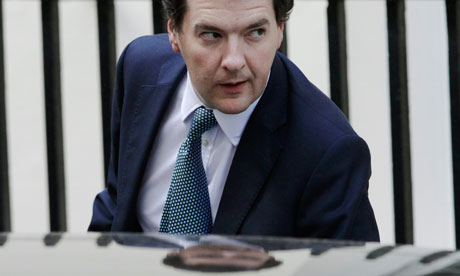
The battle between the Department for Business Innovation and Skills (BIS) and the Treasury being conducted in the media over the past few weeks is a clear sign that the budget is nearly upon us.
It has seen Vince Cable on the offensive and George Osborne holding steadfast against a bombardment of column inches and the din of talking heads. All seem to be imploring the Chancellor to take on the Lib Dem proposal of a "mansion tax". Cable wants his pet proposal adopted and in return will get his troops on the left of the party to lay down arms when the Chancellor announces the scrapping of the 50p rate.
However, many remain unconvinced. As much as the Conservatives may want to be rid of the 50p rate, the symbolism of such an act could still be too great a barrier. The taxation of the wealthy isn't a fruitful battleground for either party right now and Britain's economic future will not hinge on whether a tiny proportion of society pays 10% more or less of their earnings in tax.
Instead, what seems to be emerging is a competing plan for the future economic recovery of the UK. For the first two years of this parliament, the deficit reduction first plan was omnipotent. Beyond a few skirmishes with Cable over banking reform, the Chancellor looked imperious in the face of ill co-ordinated ventures onto his terrain by the BIS secretary of state.
However, over the past 12 months, Cable has slowly been crafting a powerful economic story. BIS has taken hold of the local enterprise partnership agenda, the Portas Review on the future of high streets, the red tape challenge and linking skills provision more closely to future needs of industry. Suddenly, Cable looks bullishly pro-enterprise, big picture and active.
What's more, by taking on this agenda BIS seems to be edging closer to recognising place in its economic thinking – something local government should seek to build on. It will be interesting to see if the budget marks the opening of fiscal and economic localism to match the coalition's already-stated objectives.
A bigger win for Cable would be changes to public procurement and an extension of credit easing to small- and medium-sized enterprises. On procurement specifically, we may see the Treasury make positive noises on EU regulations and encourage a shift in their interpretation by central and local government.
This would be much more in keeping with the current trajectoryand it has the advantage of being eminently achievable. Thinking in this way makes his foray into taxation policy look all the more peculiar, save for tactics and politics.
This isn't a question of whether the budget belongs to Cable or Osborne: the budget is always the chancellor's. But there is a genuine battle over the political momentum that flows from the announcement, not least in the run up to some very important mid-term local elections.
The Liberal Democrats took a pasting last year and will be keen not to be at the sharp end of the stick yet again. This electoral context makes raising the mansion tax again look like an astute piece of political positioning from a seasoned veteran, which in turn explains the Treasury's nonchalance on the matter.
Ultimately, the primary dynamic that shapes the relationship between the coalition partners is politics, not economics. The government remains caught between two visions for economic recovery, but only in so far as it serves the respective parties for it to appear that way: Conservatives more fiscally prudent while remaining compassionate; Lib Dems more fiscally expansionist but to socially positive ends. Achieving deficit reduction and growth together will result in a more sustainable public spending settlement and a higher tax yield. However, the coalition has not been able to marry these two together.
This budget is just an extension of the continuous struggle for political definition and the protection of identity. What has clear is that the Lib Dems have become the de facto official opposition to the Conservatives, with Labour being the official opposition to the coalition. A subtle – but important – distinction.
Liam Scott-Smith is head of external affairs at the New Local Government Network thinktank
This content is brought to you by Guardian Professional. Join the local government network for more comment and analysis – and the latest job vacancies – direct to your inbox
.jpg?w=600)