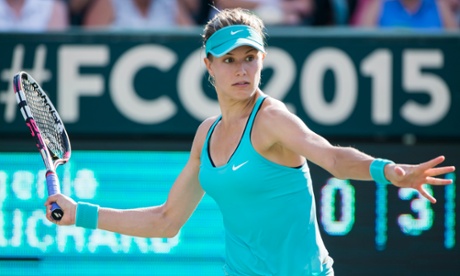
Eugenie Bouchard enjoyed a remarkably smooth, steady, and steep ascendancy. A junior title at Wimbledon in 2012 was followed by winning WTA Newcomer of the Year honors in 2013, and then in 2014 came a breakout year of semifinals at the Australian Open and French Open before a run to the Wimbledon final and a stint in the top five of the rankings, all before her 21st birthday.
Throughout it all, Bouchard expressed a remarkable lack of surprise at her success, saying that she always expected great things from herself.
“You get used to it a bit,” she told the Guardian this week. “I made three semis in a row, and I was like, ‘OK, this is normal, I’m going to do this for the rest of my career’. So I look back and I’m like, wow. In the moment I try to stay in the moment and try not to think it’s a big deal. It’s just one match, just one tournament. But looking back now, that’s an amazing result. It doesn’t always happen, even though you hope it does. You should just appreciate it and enjoy it.”
Though she has several, the now seventh-ranked Bouchard said she will not rest on her laurels, nor feel undue pressure because of her recent successes.
“I really try to focus on starting the year with a clean slate,” she said. “Let’s see what I can do this year. Use last year’s experiences, but not worry about defending and have the self-confidence that if it doesn’t happen this week it can happen next week, and not to put so much pressure on myself.”
But week after week in the early part of this season, Bouchard’s steady arc has been shaken by unmistakable turbulence. Losses have piled up to players ranked far below her, including defeats to qualifiers in the two biggest events of the spring: 85th-ranked Lesia Tsurenko in Indian Wells, and 113th-ranked Tatjana Maria in Miami.
And this week a 6-3, 6-1 shellacking by 66th-ranked Lauren Davis.
Bouchard has handled the stumbles with remarkable self-awareness, maintaining faith in her abilities while not simply making excuses for her recent slide. She understands that her partnership with new coach Sam Sumyk, who switched to her side in February after years with Victoria Azarenka, may take time to bear fruit.
“Maybe there’s an adjustment period,” she suggested. “I had this memory of Tiger Woods, when he changes his stroke, he says it himself: there’s going to be a slump before it gets better. It’s the same thing, it’s a big change. I was used to someone for a while, so I have to accept that it’s going to go down before it goes up, and you’ve got to just keep working and working, and know that there’s going to be light at the end of the tunnel.”
Bouchard says one of Sumyk’s mantras is that “perfection is impossible,” something she has to remind herself of as she grows frustrated with each successive stumble.
“I do expect big things, but I’m going to try to not put as much pressure on myself as I think I did at the end of last year, and I realize that you can’t be perfect,” she said. “That’s something that Sam has been saying to me. And you will probably lose every week of the year, besides a couple weeks, hopefully. So I just need to realize that, and make sure I learn, and always try to get better.
“I’m going to expect great things, but also not put too much pressure on myself so that I don’t enjoy it, because then it’s not worth it. And I want to enjoy every little step. If I win a match, I want to enjoy that match, and not just think it’s normal, you know? I actually won a match, and that’s a really great thing. I’ll try to enjoy the little things.”
After her loss to Davis, her fourth loss in the six matches since starting with Sumyk, the voraciously ambitious Bouchard acknowledged a need to be able to wait, if need be.
“I know it won’t all come overnight,” she said. “It’s not like as soon as you make a Slam final everything is easy after and you’re going to make the finals every week. It just doesn’t work that way. You’ve got to take the lows with the highs, so I’m just going to keep working hard and wait until this low turns into a high, and really try to learn in the process and be patient. I know I won’t win every tournament. I think patience is really important for me, because I’m not very patient.”
In her defense, up until now she hasn’t had to be.