
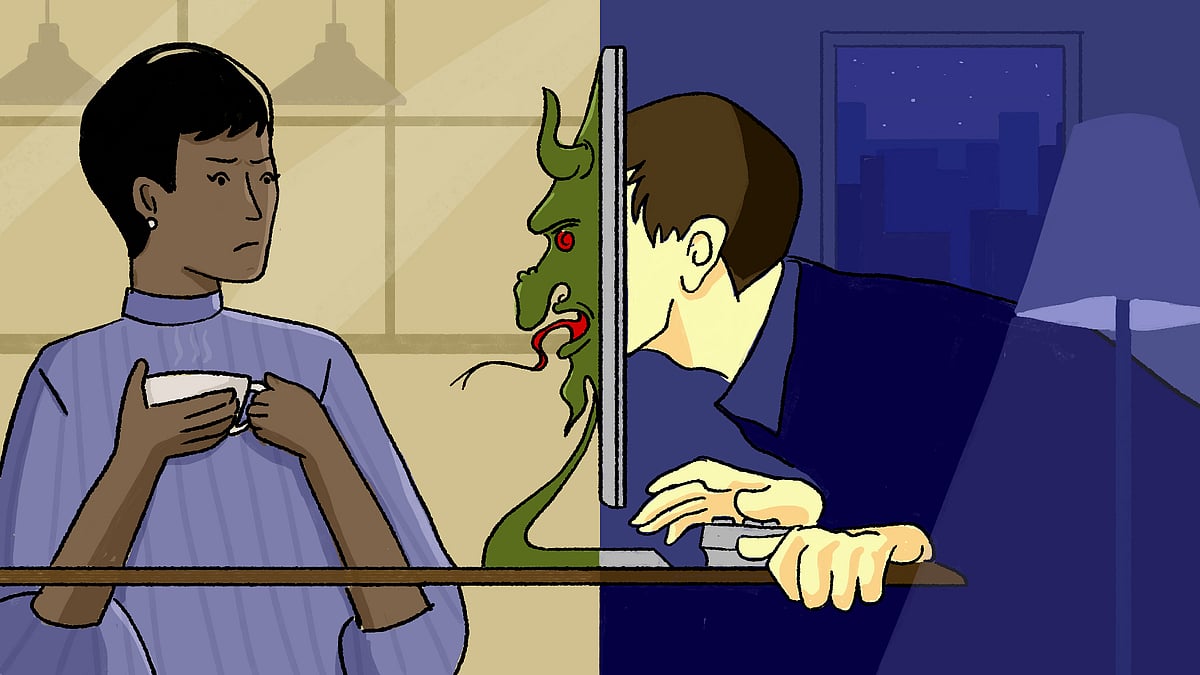
The impact of social media on our social fabric is a recurring theme in conversations around politics, economics, religion, media, and almost everything that marks us as individuals and as society.
Social media has challenged established norms, given voice to the voiceless while also providing a platform to amplify bigotry, sexism, and all kinds of prejudice. But some of what we see on social media, often from people we know, we would not experience in offline interactions. In other words, the vitriol many people pour online is often absent from their real-world lives. Time magazine has done a story on this phenomenon, which is called the online disinhibition effect or syndrome.
That this syndrome has afflicted a large number of people in India is clearly visible on social media platforms. And this when less than 10 percent Indians are on Twitter and no more than a third on Facebook. Imagine the consequences if the majority of the population joined in.
As I see people I have known for years transform into unrecognisably hideous trolls online, saying things I could never have imagined a civilised person articulating, I’m growing increasingly aware of the importance of physical interactions in keeping things real.
There used to be a social cost to offensive speech. Not anymore. In school, college, playground, workplace, there was always someone who would sometimes talk nonsense with confidence, casually making bizarre, obviously false, or bigoted comments. But they would face consequences: the pushback was immediate and often harsh. They would be challenged or corrected and, in extreme cases, mocked or bullied. On the upside, this would lead to course correction, and on the downside, the habitual offender would lose their self-assuredness and become reticent and underconfident.
Sometimes, nicknames mocking gasbags and bigots had a sobering effect. Other times, they had a damaging effect that victims of bullying carry throughout their lives. Either way, the impact of prompt pushback to bullshit could not be overstated.
Social media does not have the inhibitions of real-world interactions. There’s no shame in stupidity, for one, because there will always be a cohort of like-minded loons to cheer you on. There is a constituency online for every shade of opinion. For someone with low self-esteem, low confidence, or low relevance, it is more than they could ever experience in the real world. People who clamped up in face-to-face conversations or slunk away have, in their online avatars, become celebrities by endlessly spouting nonsense. For many, in fact, their social media pack is the first support group they have ever had. This, combined with the relative anonymity social media offers, imbues them with an addictive feeling of power – and dispels the shame associated with being called out for what was considered bad behaviour.
In effect, then, the online disinhibition syndrome has created a new kind of person with contrasting avatars and multiple personalities: the version that walks the real world is different from the one that stalks social media or sits on TV news panels that have been reduced to extensions of Twitter.
For the generation that grew up without the internet, this contrast in character and behaviour is astonishing. For the generation growing up with texting and Instagram as their primary means of communication, perhaps there will eventually appear an equilibrium in their online and offline selves.
A species that has thus far evolved through in-person contact is becoming increasingly reliant on virtual interactions, which, thanks to social media, are of a different nature and driven by different rules. In-person interaction, I believe, had a net positive impact on our collective consciousness and our society’s moral bearing, even if it led to psychological scarring for some. Precisely what kind of people and society the shift to uninhibited virtual interaction engenders will be interesting to witness.
Newslaundry is a reader-supported, ad-free, independent news outlet based out of New Delhi. Support their journalism, here.