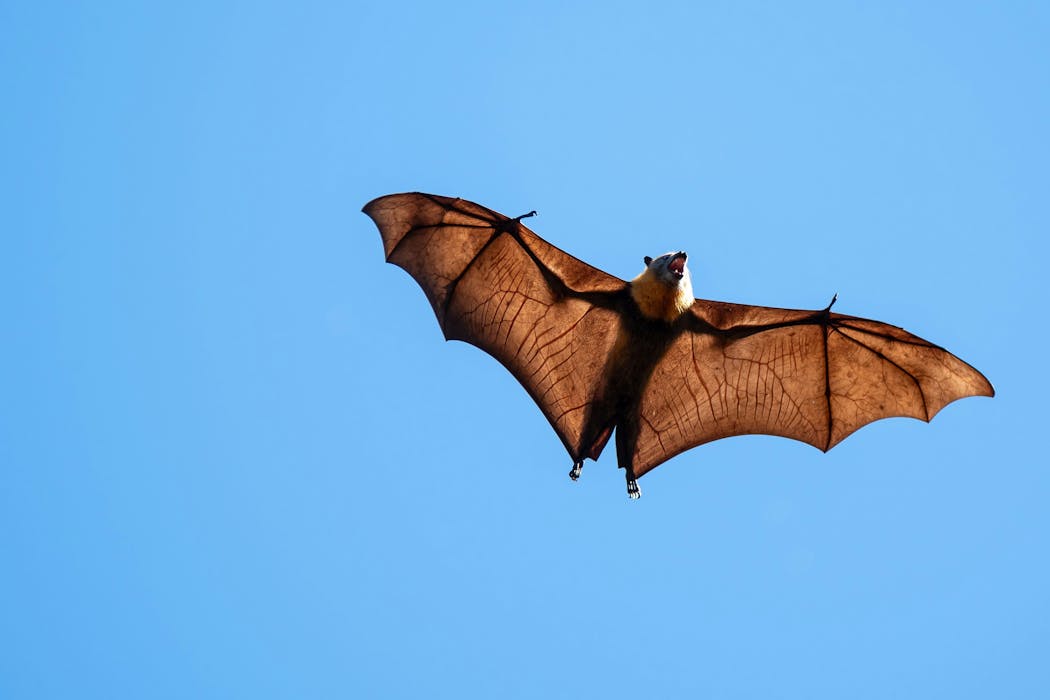
In 1974, philosopher Thomas Nagel posed a deceptively simple question: “what is it like to be a bat?”. His point wasn’t really about bats. He was offering a provocative challenge about the limits of understanding another mind: no matter how much we try, we cannot access what it feels like to experience the world as another.
This might seem like an abstract philosophical puzzle. But it’s crucial when we consider the billions of animals in our care – whether in farms, laboratories, homes or zoos. We make daily decisions about their lives, from their environment, to separation from companions, to whether they are suffering. Still, we face Nagel’s problem. We cannot directly access their experience. We can only infer it.
For decades, animal welfare science has grappled with this challenge. But in a recent paper published in the journal Frontiers in Animal Science, we’ve developed a framework called the “teleonome” that provides a way forward – not by transcending the limits Nagel identified, but by understanding each species on its own evolutionary terms.
It’s hard to see the whole
Currently, when we assess animal welfare, we’re like mechanics checking individual car parts without understanding how the engine works.
Physiologists measure stress hormones. Behaviourists count how often animals move or vocalise. And veterinarians check for disease.
Each specialist produces valuable data. But what’s missing is a way to evaluate these data from the animals’ lived experience.
A horse might have normal cortisol concentrations, show no abnormal repetitive behaviour, and appear physically healthy. But it might still be chronically distressed by separation from its companions.
A chicken in a cage might produce eggs efficiently. But she might be suffering chronic frustration because she cannot scratch, bathe in dust, flap her wings, explore and nest – behaviours the cage makes impossible.
Enter the ‘teleonome’
The teleonome is an animal’s integrated system of perceptual, physiological, behavioural and emotional capabilities. It is shaped by evolution to enable adaptation, survival and reproduction.
Back to the bat. Its DNA doesn’t “contain” echolocation like a blueprint contains a house plan. What exists is an integrated auditory-brain-body-behaviour system that only emerges when genes encounter the right environmental conditions.
That’s the bat’s teleonome: not just the genetic potential, but the living, functioning survival system.
The teleonome operates through a continuous four-step process. It detects change, evaluates whether it’s a threat or opportunity, forecasts the best response and, finally, acts.
This isn’t conscious deliberation but an embodied system guiding physiology and behaviour across timescales from milliseconds to months.
Emotions are central to the teleonome. An animal’s feelings of fear, frustration, contentment, or curiosity are evolved mechanisms for prioritising what matters, guiding learning and coordinating adaptive responses. These emotions reflect welfare and also actively maintain it. Negative experiences stimulate animals to resolve problems; positive experiences prompt them to carry on their activities.
Of course, the behaviour of individual animals of the same species will vary. This can be explained by the “expressed teleonome”: genes provide biological potential, but lifetime experiences, current stress load, and environmental context shape expression.
The teleonome also recognises that animals need environments that offer what their bodies and brains evolved to anticipate, use and learn. A hen doesn’t just prefer to dust-bathe; she does so to keep her feathers and skin in good condition. Remove that opportunity and you disrupt the process, creating ongoing biological stress – even if the bird appears healthy.
Why this matters
The teleonome provides welfare science with a biological north star.
Instead of arguing whether enrichment is “necessary” or debating which behaviours matter most, we can ask: does this behaviour support the animal’s evolved way of functioning, and does the environment enable it?
This has immediate practical applications.
For separation anxiety in dogs, we can identify and even rank the events and contexts which, in combination, trigger distress. We can then design interventions that fully support, rather than override, evolved social systems.
For farm animals, it explains why productivity doesn’t equal welfare. Domestication creates animals that are highly productive, producing a lot of milk, eggs or meat, but that also suffer chronic stress because we’ve disrupted animal-environment relationships that evolved over millions of years.
Perhaps most importantly, the teleonome transforms the ethics debate.
Treating animals as “ends in themselves” isn’t just philosophy. Rather it means recognising what matters to them based on how they have evolved.
The teleonome provides the biological foundation for making welfare decisions grounded in the animal’s perspective, rather than human preferences or industry convenience.
We may never solve Nagel’s philosophical puzzle. But animals are not black boxes either. Understanding their teleonome gives us a practical guide for care: not just to keep them alive and productive, but to enable the lives their biology prepared them for.

Cristina Wilkins is supported by a Commonwealth Government Research Training Program (RTP) Stipend Scholarship. She is the lead investigator of a project funded by the Horses and Humans Research Foundation that aims to improve assessments of equine mental state. She is also a Director of Saddletops Pty Ltd, which publishes the media site 'Horses and People'. 'Horses and People' licenses an online horse welfare assessment course to the University of New England.
Amy Lykins has received funding from Horses and Humans Research Foundation for research supporting the improvement of assessments of equine mental state.
Cathrynne Henshall has received funding from the Hong Kong Jockey Club Welfare Research Foundation
Paul McGreevy has received funding from the Australian Research Council, RSPCA Australia and animal welfare focussed philanthropy. He is a Fellow of the International Society for Equitation Science, a member of the British Veterinary Association and currently sits on the NSW Veterinary Practitioners Board.
Melanie Fillios does not work for, consult, own shares in or receive funding from any company or organisation that would benefit from this article, and has disclosed no relevant affiliations beyond their academic appointment.
This article was originally published on The Conversation. Read the original article.