
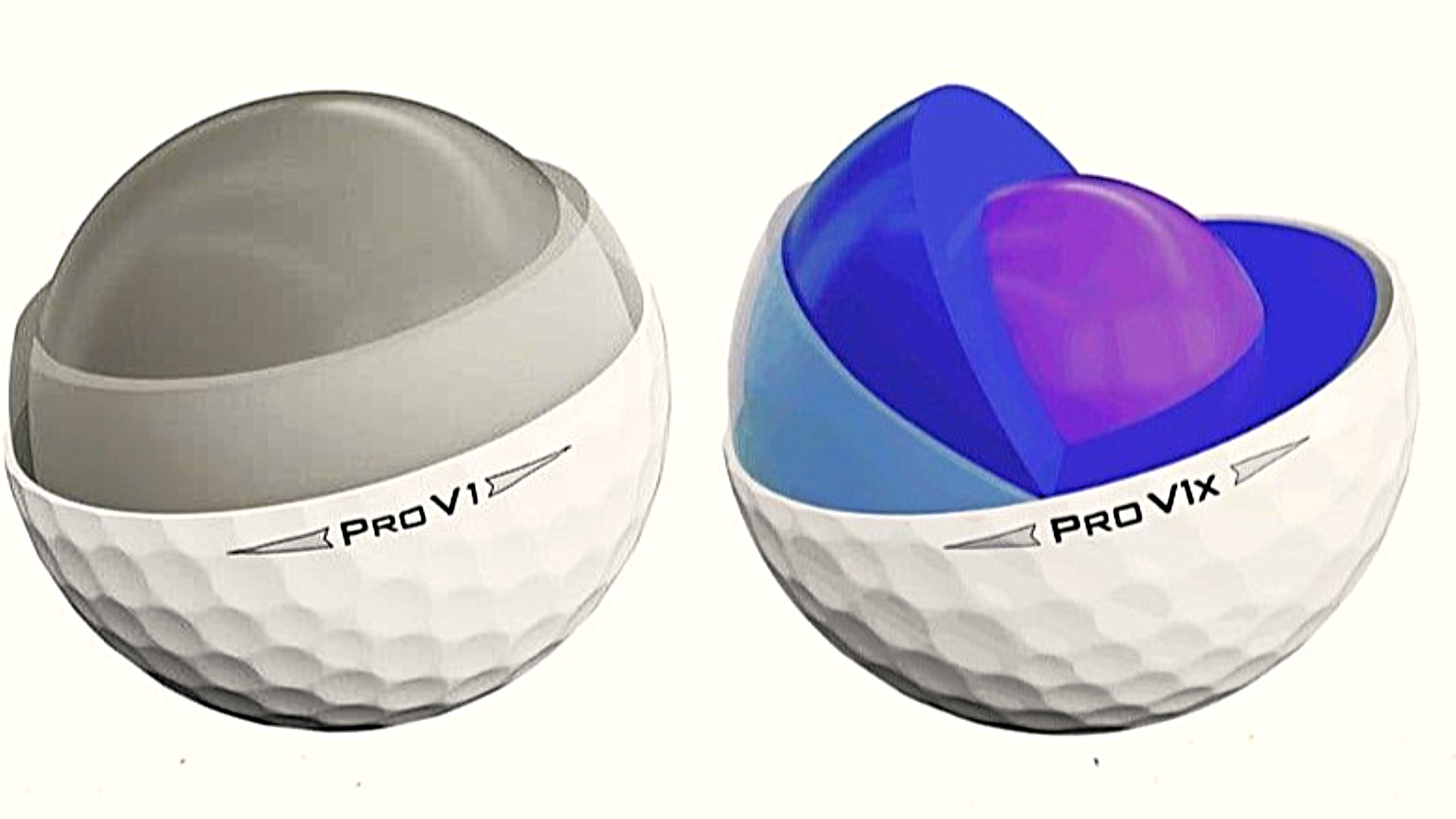
What is inside of a modern golf ball depends upon what type of ball it is. Golf balls are categorised by pieces, whereby ‘pieces’ simply means ‘layers’.
One-piece golf balls are solid and made of only one material, usually Surlyn. Surlyn is a brand name of an ionomer resin, which is used as a coating material.
One-piece construction is the cheapest way to make a golf ball. The ball itself is durable but does not travel as far as other types of golf ball. For these reasons, they are often the type of ball supplied for use on commercial golf ranges.
Once you go beyond a one-piece golf ball, there is a rubber core at the centre of the ball with different layers wrapped around this. This core is the largest component of a golf ball and its principal component is usually polybutadiene. a synthetic rubber known for its elasticity and strength.
A two-piece golf ball has a solid rubber core contained in an outer layer, often simply referred to as the cover. This outer layer will typically be made of Surlyn, although some balls use urethane, which has a softer feel to Surlyn.
A three-piece golf balls have a thin mid layer between the rubber core and the outer layer. This extra inner layer, made of rubber, is known as the mantle, and affects the ball's spin. A high-spin mantle helps with control, while a low-spin mantle helps with distance.
Most golf balls on the market are either two- or three-piece ones, as normally only top golfers are interested in having, or are able to benefit from, anything beyond a three-piece ball. Also, these are also cheaper golf balls than the many-piece golf balls.
Four-, five- and six-piece golf balls are made by increasing the number of mantles that a ball has. But golf balls are forbidden to have a weight that exceeds 1.62 ounces (45.93g).