
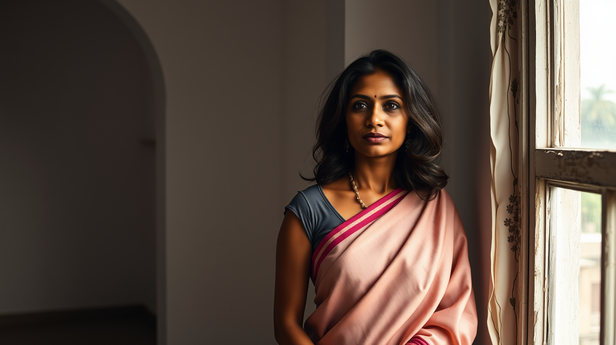
The Quiet That Costs Something
A Raw Mango sari does not announce itself. That is the point. The weave is dense, the colour sits in the fabric rather than on it, and the border, if there is one, earns its place. You have seen it at literary festivals, at gallery openings, at weddings where the bride's mother has decided she is done competing. The woman wearing it has made a choice that reads, to other women, as a statement: I know what good taste is, and it looks like this.
The brand, founded by Rahul Mishra's former colleague Sanjay Garg, built its reputation on handloom, chanderi, maheshwari, kota, treated with the seriousness that Indian fashion had mostly reserved for bridal wear. The fabrics were always there. What Raw Mango did was insist they were enough. No zari flooding the field, no sequence, no moment of theatre. Just the cloth, doing what cloth does when a weaver has spent three days on one metre of it.
What Restraint Looks Like When It Becomes a Rule
There is a version of this that is genuinely freeing. If you grew up in a house where more was always better, more work on the blouse, more stones on the dupatta, more gold at the neck, then Raw Mango's aesthetic can feel like exhaling. You are allowed to wear less. The fabric is the argument. You do not have to perform.
But watch what happens when restraint stops being a choice and starts being a standard. The Indian fashion conversation around Raw Mango has a particular texture: women who wear it are described as having arrived at something. Women who prefer embellishment are described, gently, as still getting there. The brand did not invent this hierarchy. Indian aesthetic discourse has always had one. Raw Mango simply gave the hierarchy a new address, handloom instead of silk brocade, muted instead of bright, understated instead of festive, and women absorbed it as a verdict on their own clothing history.
The Woman the Brand Imagines
She reads. She travels. She has opinions about craft and probably knows the name of at least one weaving cluster. She does not need her clothing to do the work of signalling status because her status is already legible through other means. She has, in short, the luxury of restraint. And this is where the aesthetic gets complicated, because restraint has always been a class position before it is a style position. The woman who dressed in heavy embroidery for a wedding was not doing it because she lacked taste. She was doing it because the occasion demanded visibility, and visibility was what she had instead of the other kinds of capital.
Raw Mango's woman has the other kinds of capital. Her clothing can afford to be quiet because nothing else about her life is. When you wear the brand without that context, when you wear it as an aspiration rather than an expression, you are not wearing restraint. You are wearing someone else's confidence as a costume.
What the Fabric Actually Offers
Strip the ideology away and what remains is genuinely beautiful. Chanderi in the right light has a translucence that no synthetic can replicate. Maheshwari holds a drape that feels like water. These are not small things. The handloom movement in India, weavers in Chanderi, Maheshwar, Kota Doria, has been in structural crisis for decades, and a brand that makes handloom desirable to the urban Indian woman with purchasing power is doing something real for those supply chains. The aesthetic and the economics are not separate conversations.
The clothing also asks something physically different of you. A handloom sari in a muted palette puts the face in focus. There is nowhere to hide. If you are used to clothing that carries some of the visual weight, a heavily worked blouse, a bright pallu, then Raw Mango's restraint can feel exposing. Some women find that clarifying. Others find it cold. Both responses are honest.
Taste Is Not a Destination
The problem with the brand's cultural reception is not the clothing. The problem is the word taste, and what happens when a particular aesthetic gets appointed as its guardian. Indian women have spent generations being told that their clothing choices need refinement, by mothers-in-law, by magazines, by the slow pressure of what the women they admired wore. Raw Mango arrived in that conversation and was received, by a certain class of Indian woman, as the answer. The search was over. Restraint was sophistication, handloom was conscience, and muted was finally, officially, correct.
That is a lot to put on a sari. And it is worth asking, not of the brand, which is just making beautiful things, but of yourself, whether the pull you feel toward that aesthetic is yours, or whether you have simply found a new authority to defer to. The difference matters less in the wearing than in the wanting.
The clothing you reach for without thinking, before the question of taste enters the room, is the clothing that is actually yours. Raw Mango may be in that pile. Or it may not. Either answer is complete.