TREVOR BAYLISS AND THE IMPOSSIBLE JOB
Thirty minutes after Mark Wood had taken the final Australian wicket, and England had won the 2015 Ashes, 60 or so cricket hacks gathered behind the pavilion to address the pressing question “how many people can you fit inside a squash court?” Best answer? More than anyone would think decent. In what a more generous writer might describe as an “endearingly amateur touch”, Nottinghamshire CCC had decided that in the absence of any better facilities, post-match press conferences should be held in the court around the back of the ground. After an hour spent, as Pete Lalor of The Australian had it, “farting and sweating”, under the gas mark nine TV lights, we were cooked– and it was another 30 minutes before Trevor Bayliss finally arrived.
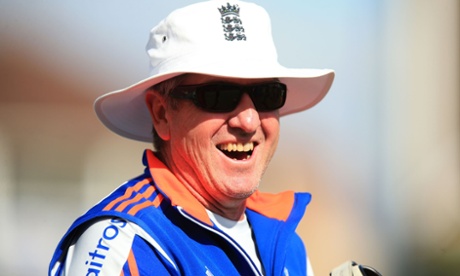
Bayliss wrinkled his nose. He seemed a little amused by it all, especially the – and I’ll leave you to fill in whatever collective noun you imagine is most appropriate – group of excited cricket journalists in front of him. He has had a ringmaster’s view of the Ashes circus, looking out at the crowd from the middle. What a time to take charge. These last few weeks, when the sport has been on the front and back pages of the papers, filled radio phone-ins, topped the TV news bulletins, when thousands have gathered in grounds around the country to mock Mitchell Johnson, will be unlike any others he’ll have until Australia are here again.
Bayliss is not an emotional man. The good cricket coaches seldom are, inured as they are to the vicissitudes of the game. His idea seems to be to try to keep his head when all about him are losing theirs. It’s worked well for him this summer. He likens himself to a duck, nothing much happening above the water, but “feet paddling pretty quickly” underneath.
While the players wore their joy on their faces, you would have had to look pretty hard to find signs that Bayliss was feeling any great sense of jubilation. But then, he has been with the team for only six weeks and, given that he’s spent the last two years coaching New South Wales and the Sydney Sixers, he must feel he knows some of the opposition better than he does his own players. As Alastair Cook put it, tongue-in-cheek, “he’s only just turned up, let’s not give him too much credit.”
Bayliss holds his press conferences like other people do their pub conversations. Easy, honest, informal. On Ben Stokes: “We don’t want to put too much expectation on him and say he’s going to be the next Ian Botham, or the next Andrew Flintoff. He’ll be the next Ben Stokes.” On the Australians: “I’m not going to gloat … well, not in front of them, anyway.” And on how he felt himself: “When the boys took that last wicket, and the lap of honour, the hairs on the back of the neck were standing up.”
Then came a question that made Bayliss stop and think. Something along the lines of: “And where to from here Trevor? What do you have to do to get to world No1 in the Test rankings?” Suddenly, he got a little more serious. “We’re not going to paper over the cracks,” he said. “There are some improvements to be made with this team if we want to be the best in the world, and want to play consistent cricket over a period of time and on foreign soil. We know there’s some hard work ahead of us.”
No word of a lie. In the short term England need to decide whether to stick with Adam Lyth as an opener, and if Moeen Ali is really going to be their sole spinner, or whether they need a replacement for one and reinforcements for the other. Add to that the fragility of the batting line-up who have made only two centuries between them in their last four Test matches, both by the same player, Joe Root. Australia have been so very poor that it has obscured the fact that in some areas, England haven’t been all that great themselves.
Bayliss knows all that. It was what gave him pause for thought as he pondered his response. Rather, it seemed to me, he was considering the idea of what was next on his to-do list, and where exactly No1 in the world Test rankings fitted in to his list of priorities. A little like the Ashes victory under Andy Flower in 2009, this series win is unusual in that it has come at the start of the cycle, rather than the end of one. Bayliss has spoken before about the shelf life of an international coach, which he reckons to be about four years. That was how long he spent with Sri Lanka, and likely how long he will spend with England too, given that his contract takes him up to the 2019 World Cup. That’s precious little time to achieve an awful lot.
Stretching ahead is an endless row of fixtures. The Oval, obviously, for a match that could put them 4-1 up. After that, a Twenty20 in Cardiff, and five one-day games, Australia here a more formidable proposition again than they are in the Tests. Exactly one month after the last of those comes the first of three Tests against Pakistan in the UAE, then three ODIs and three T20s. A little less than a month later, Durban and the first of four Tests against South Africa. Then five ODIs, and two T20s. A fortnight off, and then the World T20 in India. The month after that, the 2016 season starts.
Winning the Ashes was only the first thing Bayliss’s England had to do. Now, he has three broad tasks. The first is to shape the Test team into one that can buck the modern trend and win away from home in an era when tours are so short that teams have little time to acclimatise to new conditions. The next is to turn the ODI team into one that has a shot at winning the 2019 World Cup – and this, remember, was one of the key reasons why he was hired. And the last, perhaps the least, but also one tied to the one-day work, is to make the T20 side competitive. While doing all that, he has to manage the workloads of his key players, especially those who can expect to appear in all three formats, such as Stokes, Jos Buttler and Root. He also has to do some continuity planning, to figure how best to replace the ones, such as Jimmy Anderson and Ian Bell, who may retire along the way.
Reckon it all up, and it begins to seem almost like an impossible job, only a little less onerous than shovelling out the Augean Stables. Even Flower, who coached the team to three Ashes wins, a Test victory in India, the World No1 spot in all three formats, and the World T20, didn’t get close to winning the World Cup, much less figure out how to manage workloads or succession planning. In an era of short tours and three formats, it is going to be harder than ever for any one team to dominate the international game as the West Indies and Australia once did. But that, ultimately, is what Bayliss, and every other coach out there on the top-end of the international circuit, is trying to achieve.
QUOTE OF THE WEEK
“Leading up to a game, I always like to do things in threes. So on the field I have to mark my run-up three times and bowl three balls, and in the changing room I tie my boots up three times. It’s a strange superstition but something in the number three makes me feel safe. I do three sprays of aftershave before I go on the field.”
Turns out that wasn’t fear we could smell while Stuart Broad was bowling on the first morning at Trent Bridge, but Paco Rabanne Invictus.
ROOT’S RELISH
Also in the lifestyle sections this week Joe Root, who was the subject of the Sunday Times’ famous feature A Life in the Day. Perhaps the best thing about it is Root’s relish for his food. Breakfast, he says, “might be Weetabix with chocolate chips on top or a nice, tasty bacon sandwich”, lunch is “usually pasta, or my favourite roast beef and Yorkshire pudding”. Unless he happens to have the day off, “then I’ll go to the nearest Nando’s”, but his “biggest weakness” is “a bag of pick’n’mix”.
Cricket has always been a gourmand’s game, and it’s reassuring to know that Root, the world’s new No1 batsman, is fuelled by a diet of roast beef, sweets, and chocolate-topped cereal. And at the risk of reading too much into all this, there’s something quite refreshing about it too. As Root says, “the England squad has a nutritionist to advise us on what to eat, but I don’t stick to a strict diet.”
Seems a sharp contrast with the infamous England team menu that was leaked to the Australian press during the last Ashes tour in 2013. That made for sorry reading, included as it did dishes like “quinoa, cranberry and feta salad”, “baby spinach, mixed leaf salad, raw nut coleslaw”, and “mungbean curry with spinach”. England seem to have loosened the players’ stays a little since Andy Flower left. All part of Trevor Bayliss’ efforts to get them to enjoy playing the game again. And if that means they have to let out their trouser elastic a touch too, so be it.
STILL WANT MORE?
Boy, that escalated quickly. Mike Selvey sums up England’s win, and Jason Gillespie tries to find something positive about the Australian performance.
Last words on Michael Clarke’s career, from Russ Jackson.
After they lost the one-day series, England’s women are 4-2 behind on points heading into their Ashes Test, which starts this Tuesday. Amy Lofthouse has the latest.
And finally, a treat, as Tanya Aldred returns to the Guardian with this lovely article about the beach and backyard game.
CONTACT THE SPIN
… by writing to andy.bull@theguardian.com
IN!
To subscribe to the Spin, just visit this page, find ‘The Spin’ and follow the instructions.