“I know the whole country will want to share in a moment of remembrance,” the prime minister told the house. “So we will have a national minute’s silence on Friday at midday, one week on from the moment of the attack.” And so the silent minute came, familiar to us all from Remembrance Sundays and from past disasters and atrocities, but a mysterious minute nonetheless. People don’t talk much about their silences.
I was at Churchill Square, Brighton’s big shopping centre, busy on a sunny day. Memorial events were arranged around the UK, especially at churches, town halls and football grounds near where the Sousse victims lived, but the ritual in places like Brighton, with no direct connection, was less clear. The council posted a notice on the staff intranet, but “participation is voluntary”, they stressed. At 11.38am, therefore, as shoppers strode about to the sound of Chic’s Le Freak, it would be hard to say there was an air of expectation.
“The absolute genius of the idea of the two-minute silence is that it is a silence,” Prof Adrian Gregory, a historian of the two world wars at Oxford University, has said, “and that means that what people think about during the two-minute silence is their own business … You can bring together a conventional patriot and a highly critical pacifist and they can do the same thing, but understand what they’re doing completely differently.” They both have to know about it, though.
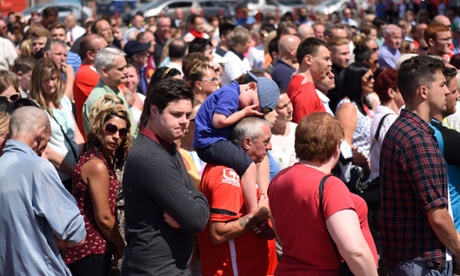
As midday approached in Churchill Square, a line of staff assembled and a man with a video camera began to film the crowd. Noticing it, and understanding, a few shoppers themselves stood still, although the large majority carried on obliviously around them. And when it came, the inaudible announcement on the public address system helped nobody out. Gradually during the minute more people cottoned on until about half were still and silent. In the cavernous space, however, the other half were still noisy enough.
Was this disrespectful? Should we blame the shoppers for their non-observance, or the facilities manager for the weak PA? “I didn’t realise it was a minute’s silence,” said Sue Taylor, 58, a community support worker. “I couldn’t hear the announcement properly. I was watching to see what was going on, because I saw all the staff there, and I saw the camera, but I didn’t realise it was a minute’s silence, not until the minute was over, and I think a lot of the people along here were the same. They were saying: ‘What’s going on?’” How did she feel afterwards? “You feel quite disrespectful, don’t you? If I’d known I would have done a bit more. I’m assuming it’s because of Tunisia? I would, definitely, of course.”

Xavier, a 43-year-old restaurant manager, realised just in time and stood silent next to me. “It’s good of course,” he said. “It’s good to remember.” When asked what he had thought about, he said simply: “You remember when they passed away. The victims.” Monika Raniszewska, a 27-year-old cook, had planned quite deliberately with her boyfriend to mark it, but when the moment came, she clean forgot. “I didn’t check the time,” she said. Did she feel guilty? “Yeah, a little bit. It’s the minimum that I can do, and I didn’t do it.”
What is a “national minute’s silence”? In one way the question seems too simple to ask. It is a gesture of respect from the whole nation. Yet this simplifies the story, because we all know that a minute’s silence is part of a range of different tributes, a growing range, whose roles and protocols may be written down somewhere in Whitehall but which to the rest of us are far from clear.
Like the Sousse attack, the July 7 bombings were marked a week later at midday, but with a two-minute silence, and then two more after a year. Next week, on the 10th anniversary, there will be one minute more. Two minutes is familiar, of course, as the special length set aside to remember the enormity of the world wars, but a three-minute silence was observed worldwide 10 days after the Asian tsunami, as it had been after 9/11. In Spain there was a five-minute silence after the Madrid train bombings of 2004.

What people went through in Sousse a week ago, and what they are still going through, is too awful to contemplate, and no one would be so callous as to rank the attack on some kind of list – yet implicitly, this is what our many shades of public silence do. It seems right that Israeli society should halt completely, cars stopping in the street, for the silence of Yom HaShoah, or Holocaust Day. Yet nobody would propose that Britain do the same, not even for July 7. Why not? That’s difficult. So we don’t talk about it.
This tactful silence that surrounds our silences may be right and proper, but it is not necessarily what people need. “My view would be it is a failed social technology that rarely does the work we want it to do,” says Steven Brown, a psychology professor at Leicester University. “Silence works when it is performed on a small scale with people who have an ongoing relation to one another, not, I feel, when it becomes a national exercise, despite the doubtless good intention of producing a brief moment of national solidarity.”
Our custom only really became established after the first world war, with the commemorations that eventually became Remembrance Sunday. It is hard to measure, but it does now seem as though Britain is making ever more use of public silences, perhaps as our exposure to catastrophe in the media has risen, perhaps as people stopped going to church – perhaps, as some say, because sentimentality swallowed Britain whole after Diana. Last June, hundreds of journalists around the world observed a silent minute to protest against the imprisonment of their fellows in Egypt. At football matches there seems to be a minute’s silence most weeks, often with the club mascot bowing his cartoon head beside the players.

When the terms are so changeable, it may be that – once the rawness of Sousse has passed, and as distasteful as it may seem – we should begin to talk more seriously about what merits a minute’s silence, what doesn’t, what merits two, and so on, and agree a way to keep everyone informed. At the moment we have politicians announcing them by whim, people who want to observe them missing out, and the ever-present danger of a PR blunder – what if, say, Wimbledon had not realised it needed to delay the start of play.
Leaders of all kinds can also become subject to campaigns, like that which focused on the IOC president, Jacques Rogge, rightly or wrongly, when he refused to allow a minute’s silence marking the massacre of Munich 1972 into the opening of the London 2012 Olympic Games.
“I think the argument around what it all means is actually central to its vitality,” Gregory has said about Remembrance Sunday. “Once people stop arguing about it, it should probably end.”