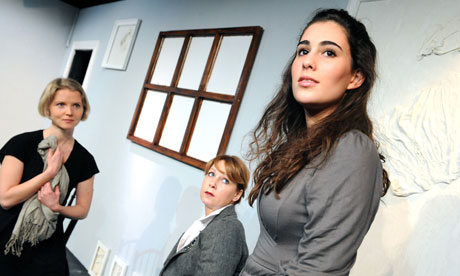
In 1962, Sylvia Plath wrote her first and only drama of a sort: a radio play for the BBC's Third Programme entitled Three Women. After stints in London and Edinburgh, a theatrical production of the play will soon arrive in New York. I recently interviewed its director, Robert Shaw, and was struck by what he described as his immediate affinity with the text. After a quick perusal on a website, he knew he had to produce it.
I, too, had stumbled upon the text some years ago (in Plath's "Winter Trees" collection), but it had never struck me as stageable. Or even, really, as a play. Though written for three voices, this meditation on pregnancy and childbirth takes the form of poetic stanzas and lacks named characters, stage directions, dialogue – all the markers by which we recognise a text for performance. Just when is a play not a play?
Since Seneca, and perhaps even before, writers have published dramas and dialogues that were never intended for the stage. These were sometimes written to register disgust with theatrical practices of the day (as Seneca did), sometimes relegated to the page because a censor deemed them impossible to produce (Wilde, Shaw), sometimes as a kind of literary experiment (Stéphane Mallarmé), and sometimes intended for another form altogether, like Plath's play or Virginia Woolf's Freshwater – a rather unfunny caper intended only for private use.
Despite the fact that shelves already groan with scripts, directors seem quite interested in bringing these dramas out of the closet. Shaw's Plays Unpleasant have become repertory classics, as have radio dramas such as Beckett's All That Fall and Dylan Thomas's Under Milk Wood. Peer Gynt, once considered unstageable, appears almost yearly. Recently, avant garde director Anne Bogart staged Freshwater, and the Wooster Group's Elizabeth LeCompte has pillaged Flaubert's The Temptation of Saint Antony and Gertrude Stein's Dr Faustus Lights the Lights. This has most likely something to do with advances in staging and permissibility. In an earlier era, plays by the likes of Sarah Kane would likely have been considered unplayable.
Yet some closet dramas seem to want to stay in the closet. The French symbolist poet Mallarmé has never really caught on. Productions of Tennyson, Shelley and Swinburne remain rare. And, unlike Plath's radio play, the vast majority of Woman's Hour Dramas and Play of the Week never get a chance to tread the boards, which probably isn't such a bad thing.
It's difficult to generalise about what makes some of these more attractive than others. Both those that are often produced and those that aren't possess a linguistic density and typically necessitate directorial innovation. Perhaps it's simply just a matter of time before theatremakers decide to stage the neglected ones. So, where's the enterprising young company desperate to take on Milton's Samson Agonistes? Who's the auteur eager to attempt Lord Byron's Manfred? Anyone for Wyndham Lewis's Enemy of the Stars?