A draft of the government's new basic energy plan (see below) has been drawn up. While international momentum toward creating zero-carbon societies is growing, some emerging economies are scrambling more for fossil fuels and other energy sources, as they expect the demand for electricity will rise. What vision should resource-poor Japan have for its future energy policy? The Yomiuri Shimbun asked three experts to assess the new energy plan and give insights into how Japan's energy usage should be shaped.
(From The Yomiuri Shimbun, May 24, 2018)
Public needs to better understand problem
The current basic energy plan formulated four years ago was written with a view toward the situation in 2030. The new draft adds to this an approach that looks further ahead to the year 2050. It reflects the government's stated goal of slashing greenhouse gas emissions by 80 percent by 2050 based on the Paris Agreement. In that regard, the draft deserves to be praised.
For example, the draft does not stop at the three main energy sources of renewables, nuclear power, and fossil fuels such as coal and liquefied natural gas (LNG) -- it also stipulates that the nation should "retain the options of each and every energy technology." This shows an approach that enables flexible decision-making on energy options, based on changes in the international situation and future technological innovations, such as with hydrogen, which is attracting attention as a next-generation fuel.
The new draft sticks to targets that a government plan set in 2015 for the proportion of each component in the overall mix of power sources in 2030. [Under this plan, the figures were 22 percent to 24 percent for renewable energy, 20 percent to 22 percent for nuclear power and 56 percent for thermal power.] This was due to a lack of sufficient evidence for making a decision on changing the plan. Any decision on whether to review the nation's energy mix should be made when the plan is next revised, and be based on power generation costs and technological developments in renewables as well as careful consideration of the situation surrounding the restart of nuclear power plants.
Meanwhile, there has not been enough discussion on building new nuclear power plants or rebuilding and expanding facilities at existing plants. The government's position is that if nuclear plants are steadily brought back into operation, there will be no need to build new or extra facilities. However, given that an increasing number of reactors will have to be decommissioned, the government needs to also discuss building new or additional facilities.
When it comes to building new facilities or expanding existing ones, two key issues need to be addressed: how to gain the support of local governments that host the nuclear plant, and how to cover security management costs for nuclear reactors over the long term. Power plant operators need considerable financial muscle to overcome these problems. Though liberalization of the electricity market has enabled these operators to sell power outside areas where they previously did business, doubt remains over whether they can find the capital needed to build new facilities or expand existing ones.
For example, I believe major electric utilities and other operators should be consolidated into two companies, one in eastern Japan and another covering western Japan.
If these operators do not boost their administrative clout and effectively use their technologies and human resources, there are concerns they might not be able to build or add to their facilities. The central government's responsibility for and involvement in nuclear power should be debated when the plan is next revised. The discussion should include whether to apply a feed-in tariff system, in which power utilities pay fixed prices to purchase electricity generated from renewable energy sources, to nuclear power.
Ensuring the public becomes more aware of these issues will be crucial when crafting a future vision for the nation's energy policy. An expert panel [at the Economy, Trade and Industry Ministry] that discussed the new draft held all its meetings in Tokyo. Next time, it might be a good idea to hold some meetings in other regions and listen to the opinions of local governments and residents. Discussions held only between government officials and power operators will not be very meaningful.
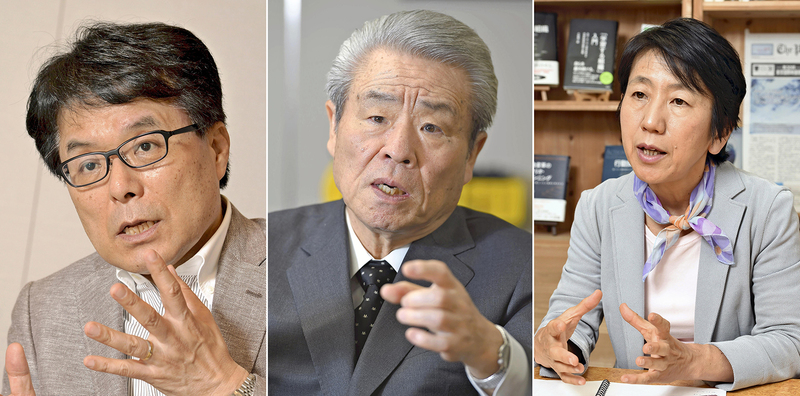
--Hiroya Masuda
Former Internal Affairs and Communications Minister
Joined Construction Ministry (now Land, Infrastructure, Transport and Tourism Ministry) in 1977. Served as Iwate governor and internal affairs and communications minister. Has presented proposals on the population decline in regional areas and other issues. Currently an adviser at Nomura Research Institute and a visiting professor at the University of Tokyo's Graduate School of Public Policy. Aged 66.
--This interview was conducted by Yomiuri Shimbun Staff Writer Yasuhiro Kobayashi.
Don't dodge nuclear power discussions
Energy is like lifeblood flowing through people's daily lives and economic activity. People first notice energy's importance when the supply is suddenly cut off. It's highly possible fossil fuels such as oil and natural gas will be exhausted globally around the time children born recently reach the end of their lives. Japan and other advanced nations need to reduce their use of limited natural resources and boost technologies that efficiently use these resources so developing countries can use them for economic development.
Ideally, fossil fuels will eventually be completely replaced by renewable energy sources such as solar power. However, to entirely focus on renewable energy would be risky. For example, Komatsu is a global manufacturer of the machinery required for manufacturing panels used in solar power generation, but most of these products are shipped to China. China has a competitive edge in terms of cost when it comes to panel production, so it has become difficult for Japan to meet its own demand in this field. Japan's renewable energy policy is heavily skewed toward solar power generation, but it should shift this balance more toward wind and biomass-based generation, in which the nation has a high degree of self-sufficiency.
Japan is a resource-strapped island nation, so the energy sources it can secure by itself are limited to renewables and nuclear power. Renewable energy and nuclear power plants do not produce greenhouse gases when they generate electricity, so they can help resolve two problems -- global warming and the depletion of energy resources.
Japan has nurtured its nuclear power technologies for a long time. Our experience with the March 2011 accident at the Fukushima No. 1 nuclear power plant is precisely the reason why the nation needs to push ahead with research in this field and try to develop safe, next-generation reactors, including small reactors. Japan must not abandon its own human resources and technologies.
The draft of the new basic energy plan positions nuclear power as an "important base load power source." This echoes the current plan. Even so, the draft states that the nation should try to reduce its reliance on nuclear power "as much as possible."
However, the draft made no mention of how Japan would lower this dependence on nuclear power while it aims to achieve the greenhouse gas reduction targets trumpeted in the Paris Agreement (see below) . Politicians and bureaucrats should not dodge discussions on this issue due to fear of a backlash in public opinion. They should squarely discuss nuclear power's place in Japan.
Coal is said to produce higher volumes of greenhouse gas emissions than other resources do, but technological developments could very well improve coal into a clean power source. Around the world, there has been a growing focus on "decarbonization," or not relying on fossil fuels. If coal is singled out as the bad guy, producers will become unable to get money needed from financial institutions for technological development and constructing new facilities.
The ideal state of Japan is to promote the spread of renewable energy sources while utilizing its nuclear power plants, accompanied with efforts to improve their safety. As for coal, the nation should gradually switch to methods that generate fewer greenhouse gas emissions [such as new-type coal-fired power plants]. It should continue providing technical support to other countries, particularly in Asia, so that it can help with reducing carbon dioxide emissions and economic development in this region.
--Masahiro Sakane
Komatsu Ltd. councilor
Joined Komatsu Ltd. in 1963. Served as president and chairman, and has been in his current post since 2013. Also served in posts including vice chairman of the Japan Business Federation (Keidanren). Chairman of the government's Advisory Committee for Natural Resources and Energy. Aged 77.
--This interview was conducted by Yomiuri Shimbun Staff Writer Hiroyuki Tanaka.
Roadmap needed to boost renewables
The new draft should be welcomed for clearly stipulating that renewable energy would become a main source of electricity. I expect it reflects the will of the Economy, Trade and Industry Ministry to earnestly take steps to help achieve the government's goal of reducing the nation's greenhouse gas emissions by 80 percent by 2050.
But the hard work starts now. Presently, about 15 percent of Japan's electricity demand is covered by renewable energy sources. Although a simple comparison is not possible, a growing number of countries are using renewable sources to meet 30 percent to 40 percent of their power needs. Without pursuing such high figures, it is difficult for Japan to describe renewables as a "main power source."
The draft also fails to mention any concrete policies. For example, it would have been good if the draft touched on policies and regulations such as carbon pricing, which are financial charges imposed depending on the volume of greenhouse gases emitted. This scheme will reduce use of fossil fuels such as coal and make switching to renewables easier.
The next review needs to go into greater detail, such as by upgrading renewables from a "main power source" to a source "that will meet a majority of the nation's electricity demand." The plan needs to more clearly show the path forward.
As for coal, I wonder why the draft could not go a step further and say the long-term course of action is to "sharply reduce" its use or "work toward to making its usage zero."
It is significant that the draft laid out a plan to have electricity and energy "produced and used locally." If electricity can be generated from renewables in different regions and then used in those regions, they could be self-sufficient in energy even if crude oil and LNG prices spike and it becomes harder to import those resources from overseas. The need to send electricity long distances through transmission lines also will vanish.
Power cuts affect the electricity used by households, but the economic losses are minor, if the cuts are not serious. However, even a blackout lasting just 1/100th of a second in the supply to a plant manufacturing semiconductors or similar goods could hugely affect the quality of these products.
In Japan, power utilities have been allowed to wield a monopoly over certain regions and new operators have struggled to enter the market. This resulted in household-use and industry-use electricity being generated at the same quality, which has led to high power bills. While electricity generated by renewables such as solar power can be unstable due to factors such as weather conditions, combining them with storage batteries and other technologies will broaden their potential application.
Informing and communicating with residents is also a major issue to be tackled.
For example, under the government's feed-in tariff system for renewables, the explanations offered have been insufficient and the costs of buying this electricity are passed on through higher power bills, placing a greater strain on household budgets. The government needs to explain to the public the necessity and significance of using renewable energy sources. The explanation could be something such as, "It is necessary to meet domestic electricity demand to avoid relying on imported energy."
The government also must clearly explain how it is trying to face up to nuclear power in the years ahead. Without doing so, it will be difficult for it to gain public support on the issue of selecting locations for final disposal facilities of radioactive waste produced by nuclear power plants.
--Junko Edahiro
Environmental journalist
Also well known as a translator of books, including "An Inconvenient Truth" by former U.S. Vice President Al Gore, which rang alarm bells about global warming. Chief executive of Japan for Sustainability, an environmental nongovernment organization. Aged 55.
--This interview was conducted by Yasuhiro Kobayashi.
--Basic energy plan
A plan compiled by the government based on the Basic Law on Energy Policy. It shows the direction of the nation's medium- to long-term energy policy over the coming 10 to 20 years, including for electricity created by nuclear power, renewable energy sources, thermal power generation and other resources. First compiled in 2003, the plan is reviewed every three or four years.
--Paris Agreement
An international framework for steps to combat climate change. Adopted in 2015 and came into force in 2016. Set the target of keeping the increase in global average temperature to well below 2 C above the level before the Industrial Revolution. All signatory nations submit to the United Nations their own reduction target for emissions of greenhouse gases and must carry out domestic measures to achieve this goal.
Read more from The Japan News at https://japannews.yomiuri.co.jp/