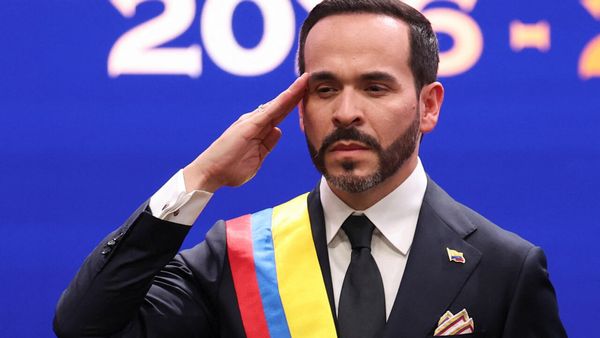
Peru's new rightwing president made a surprise announcement as she took power last week that she will raise the country's minimum wage, immediately renewing debate about whether higher pay will only result in more Peruvians working in the shadows.
President Keiko Fujimori said the minimum monthly salary will increase from 1,130 ($333 USD) to 1,300 soles ($384 USD) a month, a 15% increase of about $50 USD.
To offset the burden of higher labor costs, Fujimori said the government will provide micro and small businesses a one-time "compensatory bonus," though she did not immediately provide details or state when the increase would take effect.
The announcement raised questions about the impact higher wages will have on businesses and the government's ability to reduce the number of people working in Peru's substantial informal economy, which is untaxed and unregulated.
"We want better wages but also sustainable businesses and more formal jobs," Keiko said in her first speech as president.
Carolina Trivelli, the former Minister of Development and Social Inclusion of Peru, said that the move will provide only a small benefit to a narrow portion of workers.
The International Labor Organization estimated that about 70% of those working in Peru did so informally, making it difficult for the government to collect much-needed tax revenues to support social programs and infrastructure investments.
Of formal workers, only a fraction are actually earning the minimum wage. But the economic impacts could still be significant, and Trivelli expects formal sector workers will move to the informal sector as the minimum wage increases.
"By raising the minimum wage, many micro and small businesses face a dilemma. If they maintain formal workers, their labor costs will now be higher (and their productivity and income will likely remain the same)," Trivelli told Latin Times. "This creates incentives to move those workers to informal contracts or increases the pressure to reduce the number of workers (because the cost per worker increases)."
Tuesday's announcement caught many offguard. During her presidential campaign, Fujimori criticized opponent Roberto Sanchez, who had proposed raising the minimum wage to 1,500 soles, or about $442.
"Anyone can throw out a raise to the minimum wage," Fujimori said at the time. "Easy applause is not going to be a measure that we use."
Fujimori narrowly won election by a margin of fewer than 50,000 votes in the June presidential runoff election, and takes the helm of a country beset by political scandal. She is the ninth president to lead Peru in less than a decade.
Her swift decision to raise the minimum wage, which was last adjusted in January 2025, immediately invited criticism from multiple corners of Peruvian politics.
Jorge Zapata, president of the National Confederation of Private Enterprise Institutions, or CONFIEP, pushed in an interview with newspaper El Comercio for the wage hike to first be debated by the National Labor and Employment Promotion Council. Zapata noted the importance of the yet-to-be-announced details of the one-time bonus for microbusinesses, who he said will be the ones that "are going to suffer with this measure."
Jorge del Castillo, who was the prime Minister of Peru from 2006 to 2008, argued however that Fujimori had made a smart economic and political decision in an interview with RPP Noticias. He noted that Fujimori's opposition had pledged to immediately raise the minimum wage if elected, and now "that problem has already been solved."
"No company is going to go bankrupt because of that," del Castillo said of the wage hike.
Economist Jorge González Izquierdo, meanwhile, said in an interview on Panamericana Noticias that it is an "appropriate" wage hike given the rate of inflation since the last hike, particularly in food prices.
Though Peruvian politics has been notoriously turbulent, its economy has proven resilient, largely thanks to the high prices of its key exports like gold and copper.
The minimum wage increase was part of an ambitious agenda laid out by Fujimori that could significantly increase public spending, including a promise to construct four new metro lines in Lima. She also announced that the pension payments to low-income Peruvians over 65 years old would double from 350 soles ($103 USD) to 700 soles ($206 USD).
Asked if a minimum wage hike could result in greater tax revenue to offset government spending, Trivelli expressed skepticism. A key question is how long Peru's economy will continue to benefit from the high prices of its exports, which it is using to pay for permanent expenses, according to Trivelli.
"The problem is this increase isn't permanent," Trivelli said.