The FDA's controversial decision on Sunday to issue an emergency use authorization for convalescent plasma to treat COVID-19 patients has put new attention on the process of giving plasma.
Why it matters: If convalescent plasma does help mitigate the disease — a big and entirely unsettled if — then donating could be one of the most important things recovered patients could do. But the experience is a little different from standard blood donation.
Whole blood — what most of us are used to donating at blood drives — is, as the name suggests, everything in your blood: red blood cells, white blood cells, platelets and plasma.
- Plasma is the straw-colored liquid component that makes up blood. Roughly 90% of it is water, but the rest includes nutrients, minerals, hormones, proteins — and antibodies that help fight infection.
How it works: Plasma donation, though, is a little different, as I learned when giving convalescent plasma after recovering from a (thankfully mild) COVID-19 infection this spring.
- To make a convalescent plasma donation at the New York Blood Center, I first needed to show proof of my positive COVID-19 test results, as well as indicate that I had been symptom-free for at least 14 days.
- After an on-site test to prove that I actually had antibodies that could be shared — and a very extensive quiz about any past behaviors that might cause my blood to be tainted and rejected — I was taken into the plasma donation room.
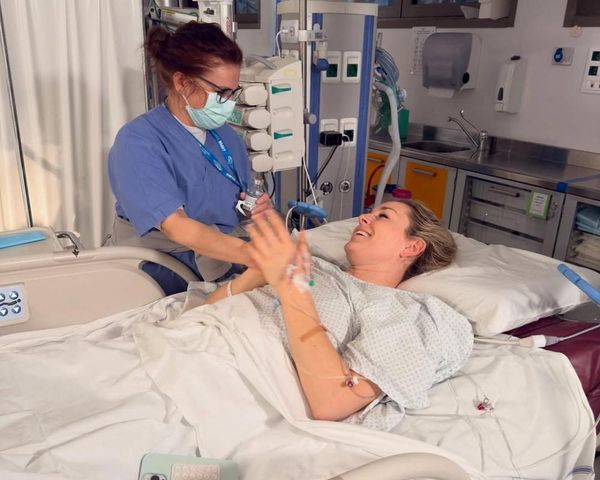
- There a sterile needle was inserted into my left arm (I'm right-handed), and my blood was siphoned off into an apheresis machine, where it spun in a centrifuge that separated out the plasma. The remainder of my blood flowed back into my arm.
- The donation process was no more uncomfortable than giving whole blood — the needle does pinch, but it was longer, about 50 minutes, compared to 10 for whole blood.
Of note: If you'd rather have the process explained to you by Walter White, you can watch this video from July of actor Bryan Cranston giving COVID-19 convalescent plasma.
The bottom line: What I don't know is whether the plasma I donated made a difference for a COVID-19 patient. The science — despite the FDA's move — remains far from clear.