Your beer will be cold, your holidays perfect and your children beautiful. Or so it would seem if you believe the inflated buzz around some new piece of technology.
It's in the interests of purveyors of new ideas to get as much mileage as they can. Research institutions and even scientists need to generate excitement and, hopefully, funding. Technology companies want sales, while media outlets (and science writers) want people to read their stories.
If it goes well, the technology will create a great wave of enthusiasm. And then ... reality bites. Is this latest development really that good? Disappointment sets in and interest slumps.
After a while, however, the real value of the technology emerges.
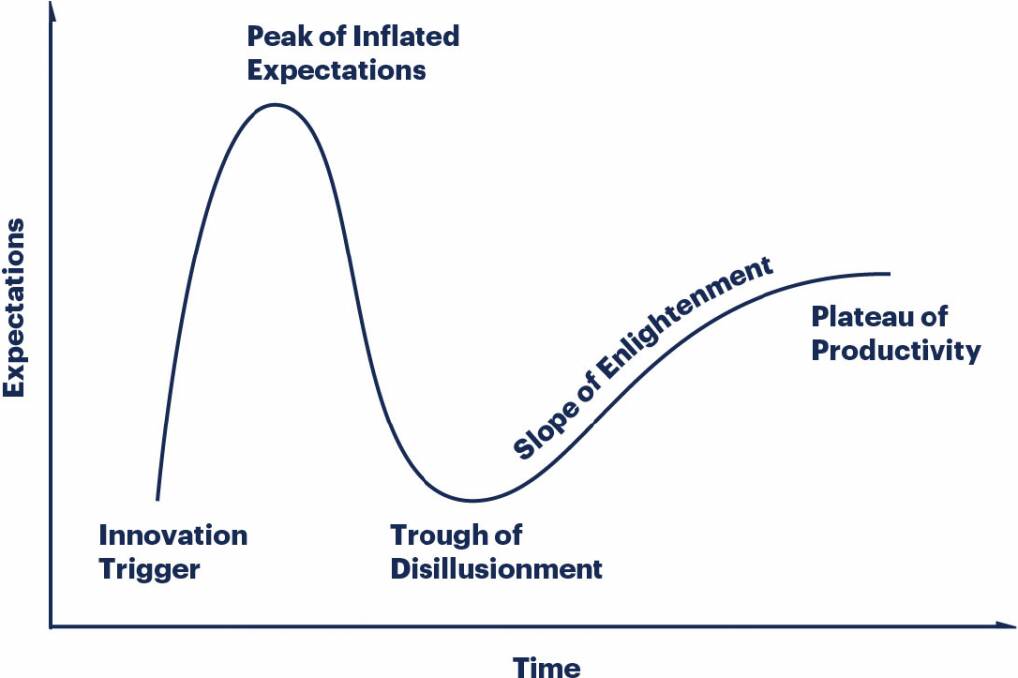
This concept is brilliantly encapsulated by the Gartner Hype Cycle, which is named after the IT research company.
In the early stages, hype climbs rapidly towards The Peak of Inflated Expectations. This is followed by a drastic dip into The Trough of Disillusionment. A naive interpretation at this point says that the promises of the technology are completely hollow and it is doomed to disappear.
These evocative labels perfectly capture the over-inflated rollercoaster in the more extreme cases of the hype cycle. It also reflects the naivety of many media and popular responses to technology.
Remember the Dot-Com Bubble? That peak was drastically over-hyped and many people lost a lot of money when it fell into the trough.
With hindsight, the impact of online shopping has become much clearer in what the hype cycle calls The Slope of Enlightenment.
The real strengths and weakness of the technology are better understood and a clear picture of its role emerges.
Online shopping has been a significant long-term shift into the Plateau of Productivity.
The hype cycle, of course, paints an idealised picture of how a technology matures in the marketplace.
Not all examples fit this pattern because many are accompanied by little or no hype and, instead, move more or less directly into maturity.
Conversely, many technologies simply fail, disappearing without a trace.
In that sense, the hype cycle isn't very scientific, however it is a useful way to bring some sobriety to the endless stream of "breakthroughs" and, after you've seen a few, you're likely to be a little more sceptical when the next one arrives.
One thing the hype cycle doesn't address is the purported demise of a technology when a new one appears.
Books were going to disappear, first when radio then television arrived. E-book readers and the internet have likewise failed to kill printed books.
That suggests there should be - shall we call it - The Fuzzy Logic Death Cycle that is almost the inverse of the Gartner cycle.
This charts the imagined death followed by recovery of an older technology.
Listen to the Fuzzy Logic Science Show at 11am Sundays on 2XX 98.3FM.
Send your questions to AskFuzzy@Zoho.com Twitter@FuzzyLogicSci