I've been at the Institute of Fundraising for just over a year now. It is a huge privilege to lead the community of fundraisers – they really are the lifeblood of every charity. And despite being a tough year, their endless enthusiasm for fundraising and their commitment to making the world a better place never ceases to impress me.
In the wider world the economy continues to struggle. Our YouGov polling earlier in the year showed the biggest reason people say they don't give is because they can't afford to, but at the same time the vast majority who do give said they only do so when Charities specifically ask for support. Fundamentally they understand the need for charities to employ fundraisers.
But still only 7% of the population give more than £100 a year. This means that giving as a whole is flat, although evidence from our members shows that those Charities that are investing in fundraising continue to grow. Similarly, research shows that even those who have traditionally relied on statutory funding are now beginning to diversify their income streams in order to maintain their services. Many of these have benefited from our Small Charities Training programme, which has already reached over 10,000 organisations.
So fundraising is more important than ever.
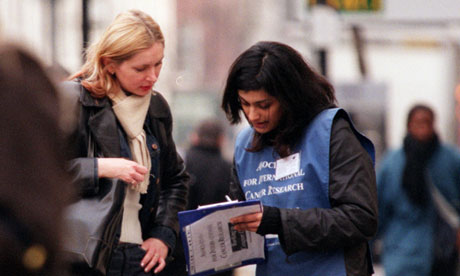
Yet we would be complacent to ignore the fact that some forms of fundraising do annoy a small percentage of people. Face-to-face fundraising is currently the most prominent example. Despite the fact that 865,000 people last year decided to sign up to a support a charity long term as a result of a face-to-face ask for support, securing £130 million per annum, a significant minority of people find it inconvenient. Others have been unfortunate enough to come across bad practice, which although not prevalent in the sector, does exist.
For the Institute this is serious stuff. And we reacted swiftly. Our face-to-face Summit set up three high level taskgroups to look at standards, training and space allocation. They will report later this Autumn.
Linked to this, the Review of the Charities Act has enabled us to clarify roles and responsibilities with the Fundraising Standards Board (FRSB) and the Public Fundraising Regulatory Authority (PFRA), with the IoF's role as the single code-writer formally confirmed as the foundation of the self-regulation system. And I'm looking forward to informing MPs about the success of self-regulation at the Public Administration Select Committee later this month. And our new, single code will be published on 13 November, and will be a huge asset for charities up and down the country committed to best practice fundraising.
On behalf of members we also played an important role in the successful give it back george campaign, and are now lobbying hard to make the Gift Aid Small Donation Scheme work better for everyone.
The Institute's professional development programme has continued to prosper, with, over 2,300 people at the convention, and each and every conference crammed. And fundraisers are embracing our new professional qualifications delivered through IoF Academy. 250 people graduated with our certificate or diploma in fundraising last year. 56 people are studying for our online certificate of fundraising at this very moment. Our international advanced diploma is in development.
What else lies ahead?
We need to ensure that self-regulation continues to inspire the long term trust and confidence that charities deserve, whilst at the same time not consuming disproportionate amounts of charities time or precious resources.
For the wider fundraising community we will work to make sure we become the best knowledge and resource hub that the whole community of fundraisers can turn to for the latest skills development, information, advice and research into fundraising. It is our role to enable fundraisers become the best they can be.
And we will continue to press the government to create a better environment for fundraisers to raise money: improving Gift Aid; transforming payroll giving and encouraging more legacy giving to charity.
Fundamentally we share the government's desire to increase giving, but will continue to make the case that an increase in giving is unlikely without more and better fundraising.
Peter Lewis is chief executive of the Institute of Fundraising.
This content is brought to you by Guardian Professional. To join the voluntary sector network, click here.