
The ratio is one way investors judge the value of a company–comparing its stock market price to shareholders' equity.
Canva
What Is Price-to-Book Ratio?
Price-to-book ratio is a metric that values a company based on its market price relative to its net assets, typically calculated on a per share basis. It’s comparable to other ratios such as price-to-earnings in that it is one common way investors try to determine whether a company is undervalued or overvalued.
The ratio is used mainly for valuing publicly traded companies since market prices, as well as their assets and liabilities, are publicly available.
How Do You Calculate Price-to-Book Ratio?
Price-to-Book Ratio = Market Capitalization / Book Value
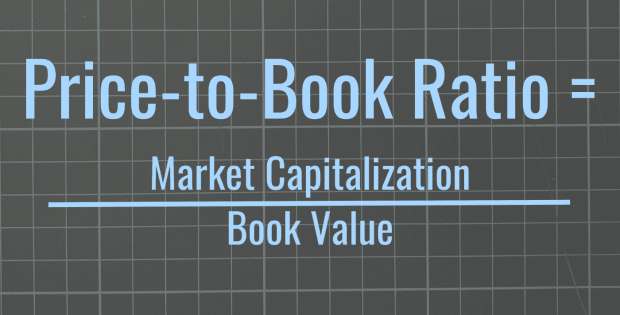
Dividing market capitalization by book value, or shareholders' equity, provides a ratio that helps investors determine whether a company is undervalued or overvalued.
Dominic Diongson; Canva
Calculating the ratio may involve a few steps, depending on the availability of information. Companies may provide their book value, or what is known as shareholders’ equity, on the balance sheet of their quarterly or annual filing of their financial statement to the Securities and Exchange Commission. Book value may also appear on data provided by third-party financial data providers such as Bloomberg. For more information on book value and how to calculate it, go to the article What Is Book Value? Definition, How to Calculate & FAQ.
The fundamental way to calculate price-to-book ratio is dividing market capitalization by book value.
Calculating on a per share basis involves a few steps, but the ratio works the same way. Divide market capitalization by the number of shares outstanding. Then, divide book value by the number of shares outstanding. Dividing the market capitalization quotient by the book value quotient will result in the P/B ratio.
Below is a table of price-to-book ratios of the 10 biggest companies on the S&P 500 by market value, based on their financial statements from the end of the third quarter of 2021.
How to Interpret Price-to-Book Ratio
A company’s P/B ratio can indicate whether its stock is undervalued or overvalued relative to its book value. A ratio of 1 or less would indicate that the company’s stock price is being valued at or below book, and it would be considered undervalued. A low ratio (or a ratio of 1) suggests that the company’s net assets, or shareholder equity, is less than or equivalent to the stock price. In other words, if the company were to be sold, its net assets would sell at the same price as its total stock (market capitalization). Conversely, a higher ratio would indicate that the company is trading at above book value. Too high a multiple would mean that the company is overvalued.
Can Price-to-Book Ratios Be Compared by Industry?
Companies differ in their classification of assets, so when comparing companies’ price-to-book ratios with each other, it’s better to compare those with similar types of assets. For example, comparing the ratio of a property developer to a crypto financer would be arbitrary because the property developer would have tangible assets in the form of buildings and land, while the crypto firm would have intangible assets that cannot be quantified in physical form.
What Are the Limitations of the Price-to-Book Ratio?
The ratio would be considered a lagging indicator because book value is typically historical data. Few analysts, let alone companies, would provide estimates for a future period or guidance. Investors could focus on other ratios such as price to estimated earnings, commonly referred to as the forward or leading price-to-earnings ratio. The forward P/E ratio provides a multiple for the valuation of a company based on its future earnings of a given period, usually one year ahead of the current fiscal or calendar year.
Frequently Asked Questions (FAQ)
The following are answers to some of the most common questions investors ask about price-to-book ratio.
Can Price-to-Book Ratio Be Negative?
It would be a rare occurrence, but the ratio can be negative only if book value becomes negative. A negative ratio could indicate that a company is insolvent, or on the verge of bankruptcy.
What Is a Good Price-to-Book Ratio?
That is subjective to how much an investor is willing to pay for a company’s shares. A high multiple might be indicative of overvaluation, while a ratio closer to 1 could be viewed as cheap.
How Does Price-to-Book Ratio Relate to Return on Equity?
Return on equity is similar in one way with the price-to-book ratio by having book value as the common denominator. Return on equity is calculated by dividing net income by book value. If a company’s return on equity is high, its price-to-book ratio is likely to be high as well because investors justify the high market value via the increase in earnings.