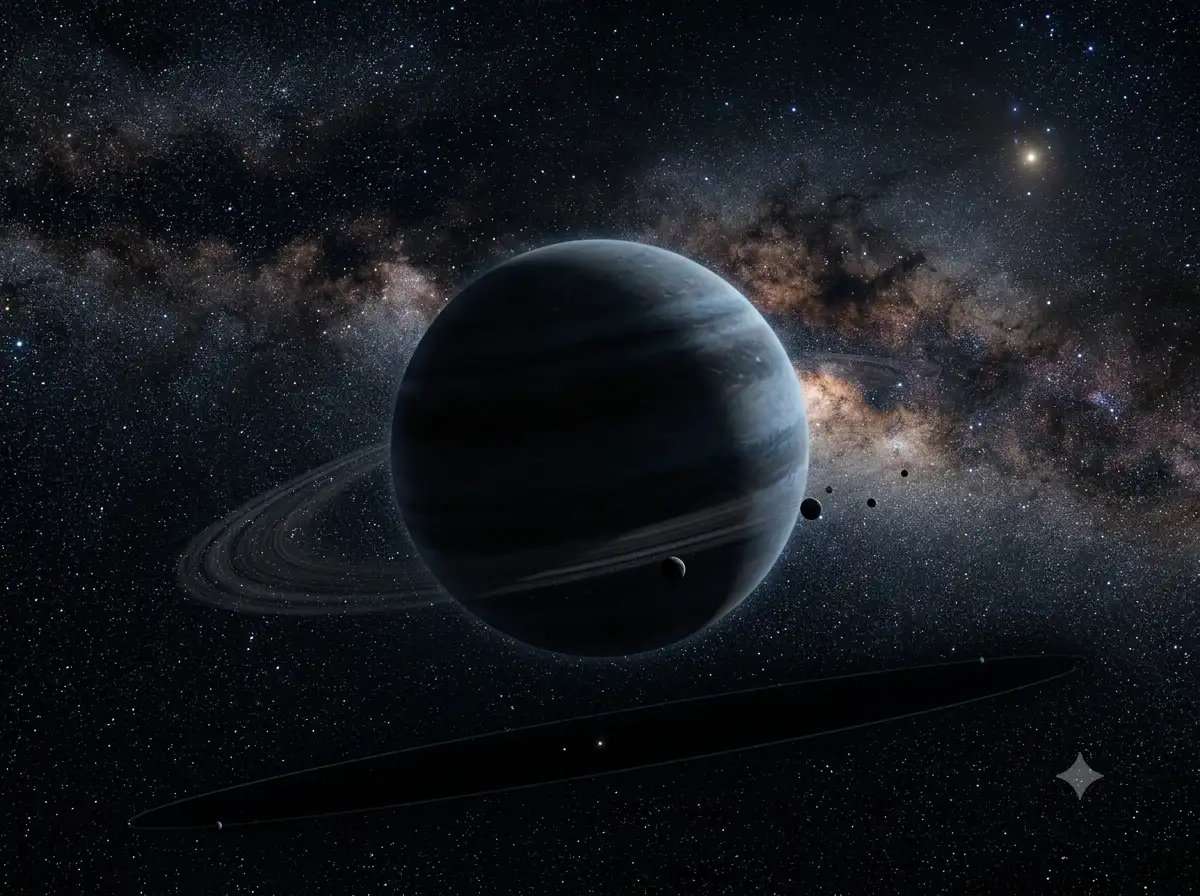
What is Planet Nine, and where is it? This question remains one of the biggest mysteries in astronomy. Researchers believe a giant planet may be hidden far beyond Neptune in the distant regions of the Solar System. The idea is based on unusual orbital patterns observed among several distant objects in the Kuiper Belt. While no direct evidence has confirmed its existence, astronomers continue to investigate whether an unseen planet is influencing the motion of Extreme Trans-Neptunian Objects and other distant bodies. New discoveries, advanced telescopes, and improved observations are helping scientists explore this possibility and understand what may exist in the outer Solar System.
A Search for a Planet Beyond Neptune
The idea that another large planet exists beyond Neptune is not new. Long before Pluto was discovered in 1930, astronomers proposed the existence of a hidden world called Planet X. Scientists believed that irregularities in the orbit of Uranus could be explained by the gravitational pull of a large unseen planet. For many years, this idea attracted attention. However, later studies in the 1990s showed that a revised calculation of Neptune's mass explained the orbital discrepancies without requiring another planet.
The concept returned in 2016 when astronomers Konstantin Batygin and Mike Brown of the California Institute of Technology proposed a new theory. Instead of focusing on Uranus, they examined the behavior of distant objects beyond Neptune.
What is Planet Nine, and where is it? Evidence Behind the Theory
The modern Planet Nine theory is based on observations of the Kuiper Belt, a vast region beyond Neptune that contains dwarf planets, asteroids, and icy objects, including Pluto. Batygin and Brown noticed that several Extreme Trans-Neptunian Objects appeared to have unusual orbital patterns. These objects followed highly elongated paths and seemed to cluster together in space.
Researchers found that:
- Their elliptical orbits pointed in similar directions.
- Their orbital planes were tilted in comparable ways.
- The chance of such alignment occurring randomly was estimated at about 0.4%.
This suggested that a large unseen object's gravity might be influencing them. Scientists proposed Planet Nine as a possible explanation for this orbital clustering.
How Gravity Could Shape These Orbits?
Astronomers compare this phenomenon to the relationship between Earth and the Moon. The Moon travels around the Sun along with Earth. However, Earth's gravity also causes the Moon to orbit our planet every 27 days. As a result, the Moon follows a spiral-like path through space.
Scientists believe something similar could be happening in the outer Solar System. Distant Kuiper Belt objects may not be influenced solely by the Sun. Instead, the gravity of a hidden planet could be shaping their motion over thousands of years.
As more observations have been collected, support for the theory has grown. Mike Brown stated in 2024 that existing evidence strongly suggests Planet Nine may exist because no alternative explanation currently accounts for all observed effects.
What Planet Nine Could Look Like?
If Planet Nine exists, it is not expected to resemble Pluto. Scientists believe it would be a sub-Neptune or mini-Neptune planet.
Current estimates suggest:
- Mass: Between 5 and 10 times the mass of Earth.
- Orbit: Highly elongated and tilted.
- Closest distance from the Sun: Around 300 to 400 astronomical units (AU).
- Farthest distance from the Sun: Up to 800 AU.
- Orbital period: Between 10,000 and 20,000 Earth years.
One astronomical unit equals the average distance between Earth and the Sun. Because of its enormous distance, Planet Nine would receive very little sunlight and remain extremely difficult to detect.
Why Astronomers Have Not Found It Yet?
The biggest challenge is distance. A planet located hundreds of astronomical units from the Sun would reflect only a tiny amount of sunlight. This makes it very faint when viewed through telescopes. Another challenge is speed.
A planet following such a vast orbit would move very slowly across the sky. Its movement could easily blend in with background stars, making detection difficult. For this reason, astronomers are increasingly searching for thermal and infrared radiation rather than visible light. Researchers have examined archived data from infrared space missions such as IRAS and Akari. Some moving thermal objects have attracted attention, but none have been confirmed as Planet Nine.
New Discoveries Raise Questions
While some findings support the theory, others create challenges. In 2018, astronomers announced the discovery of 2017 OF201, a possible dwarf planet measuring around 700 kilometers across. It follows a highly elliptical orbit around the Sun. Scientists suggested that either an ancient collision or gravitational influence from Planet Nine may have produced this unusual path.
However, more recent discoveries have complicated the picture. One example is 2023 KQ14, discovered using the Subaru Telescope in Hawaii. This object belongs to a group called sednoids. These objects spend most of their time very far from the Sun and are largely unaffected by Neptune's gravity. 2023 KQ14 comes as close as 71 AU to the Sun and travels as far as 433 AU away. Its orbit remains relatively stable despite being highly elliptical. Researchers argue that if Planet Nine existed nearby, it might have disrupted this orbit more significantly.
Challenges Facing the Planet Nine Theory
The discovery of 2023 KQ14 marked the fourth known sednoid. The other three sednoids also possess stable orbits. This raises questions about whether a massive nearby planet is influencing them. Some scientists believe Planet Nine may need to be located farther than 500 AU from the Sun to explain these observations. Other astronomers remain skeptical and suggest alternative explanations.
These include:
- Incomplete observational data.
- Gravitational effects from a ring of debris.
- Other unknown processes in the outer Solar System.
- Theoretical ideas involving a small black hole.
Scientists also note that many distant objects have extremely long orbital periods. For example, 2017 OF201 takes approximately 24,000 years to complete one orbit around the Sun. Because humans have observed these objects for only a tiny fraction of their orbital periods, detecting subtle gravitational influences remains difficult.
Future Searches May Provide Answers
The search for Planet Nine is entering a new phase. Astronomers are placing significant hopes on the Vera C. Rubin Observatory. The facility will use a 3,200-megapixel camera to survey the visible southern sky.
Researchers believe it offers the best opportunity to either discover Planet Nine or rule out its existence. Direct exploration remains difficult. Estimates suggest that a spacecraft traveling at speeds similar to NASA's New Horizons mission would require around 118 years to reach the suspected region.
As a result, astronomers must continue relying on telescopes and advanced observation techniques. New Kuiper Belt objects, Extreme Trans-Neptunian Objects, and sednoids are being discovered regularly. Each discovery provides additional clues about the structure of the outer Solar System and whether a hidden giant planet truly exists.
Common Interest in Astronomy Mysteries
The search for Planet Nine highlights how much remains unknown about our Solar System. Even after centuries of observation, astronomers continue discovering distant objects and uncovering new questions about the regions beyond Neptune. Ongoing research, future telescopes, and improved technology may eventually reveal whether Planet Nine is a real planet or simply an idea created by unusual orbital patterns.
FAQs
Q1. What evidence supports the existence of Planet Nine?
Astronomers observed clustered and tilted orbits among Extreme Trans-Neptunian Objects. These unusual patterns suggest an unseen gravitational influence, leading scientists to propose the existence of Planet Nine.
Q2. Why is Planet Nine difficult to detect?
Planet Nine is believed to be hundreds of astronomical units from the Sun. It reflects little sunlight and moves slowly, making it difficult for telescopes to distinguish.