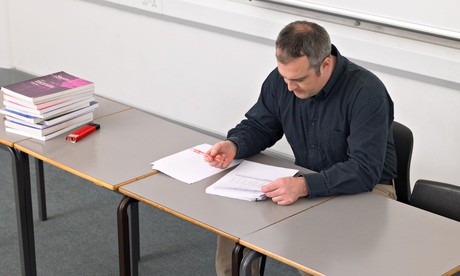
For most teachers, the final exam of the summer signals the end of a process: all they can do now is wait until August for the results to come in.
But for some it is the start of a period of activity that will see them mark hundreds of exam papers in time for results day.
The day after the AQA English language A-level, a pile of scripts arrives at Felicity Titjen’s door. An examiner for 20 years – she has also marked GCSE in the past – she has three weeks to turn around anything from 75 to 150 papers.
“A single script can take 15-20 minutes, but you speed up as you get to know what you’re looking for,” says Felicity, who teaches in a sixth form in north-west England.
Before anything can happen, Titjen must undergo a standardising process. This involves assessing around 10 exam papers, selected to show a range of answers, to see how she applies the marking scheme. These papers then provide a benchmark for her own marking.
“You have to apply that marking standard to your own scripts and you can constantly refer back to them,” she says.
This standardising also constitutes a key element of examiner training, but there is constant support and advice throughout the process. AQA examiners receive online-learning support which explains how to apply the mark scheme and a self-assessment exercise to test their understanding.
“There is a team leader who gives you feedback on your marking and gives you support and advice,” Felicity adds. “If you’re not sure how to award a script you can always go to someone and ask.”
Examining is not just a matter of giving a final mark. Examiners must annotate each paper to explain their marking so it can be understood by their team leaders, and potentially by the students themselves, in the event marks are challenged.
Managing the workload is crucial, according to Steph Wood. Wood, who teaches English in a Hertfordshire based school, has been examining for 10 years and this year marked around 250 A-level English literature scripts for AQA.
“The first few are always slower because it takes you a while to get your eye in,” she says. “But I can usually manage three an hour.”
With her year 11 and year 13 classes having left school she has more time to put aside for marking, although for confidentiality reasons it all has to be done at home. She finds it easier to set herself regular targets to make sure she doesn’t fall behind.
“Every day I know I need to get through a certain number – you can’t leave it all until the end,” she says. “It means for three weeks I’m not going out but it is only for three weeks and it’s worth it.”
Not all examiners mark exam scripts. Keith Bartlett, now retired from teaching after 30 years, is AQA’s principal moderator for GCSE geography, and he ensures that marks awarded by schools for the fieldwork element of the course are correct.
Keith and his team select a sample of papers from each centre – unless the centre has fewer than 20 candidates, in which case they are all sampled – and checks their marks.
“If it is clear that the centre knows what they’re doing and the marking is accurate, we can stop at this sample,” he says. If, on the other hand, there is a discrepancy between the marks awarded by the teachers and those deemed appropriate by the moderators, then a bigger sample is taken and the marks revised accordingly.
Training to become a moderator is thorough, he says, and mostly takes place online, looking at how to ensure marks are awarded fairly and consistently. Each AQA moderator has a personal secure web page on the examiner extranet and receives training to help them use the online standardisation and marking applications.
Moderators can choose how many centres they feel they can cope with and have about five to six weeks to complete their marking. Verbal and written feedback is given throughout the process.
“There is always someone to offer support and advice,” Keith says. “If a moderator comes across a centre they’re not sure about, they can discuss it with their team leader. There are checks and balances throughout the process.”
While being an examiner involves an intense few weeks over the summer, the rewards are substantial, says Adrian Beard, AQA’s chair of A-level English literature, not least in providing ongoing development for teachers.
“I left university at 21 and examining has been my continuing professional education,” says Adrian, now retired from teaching. ”You’re constantly having to read new texts and think of new ways of literary criticism and get to grips with the subject matter.”
Contact with other examiners has been a boon for Felicity Titjen. “I’m now part of a larger community of people who teach English and I really value the relationships I’ve built up through this,” she says.
Being an examiner can also benefit a teacher’s own practice, says Steph Wood. “It has made me much better at teaching and has positively impacted my teaching,” she says.
“I feel much more confident in teaching it because I know what is required.”
But that’s not all. There is another advantage to her 10 years as an examiner. “It helped me save up for my wedding and a new kitchen, and now it pays for a summer holiday,” she says. “There are lots of things I’ve been able to buy that I wouldn’t have been able to afford otherwise.”
Find out more about being an examiner with AQA here.


.png?w=600)