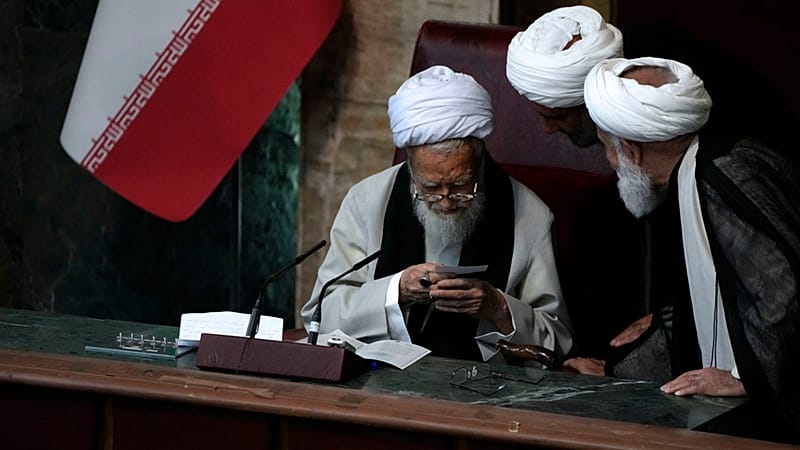
Tehran faces an unprecedented leadership crisis following the surprise death of Ayatollah Ali Khamenei in joint US-Israeli strikes Saturday, with the regime's urgent need for his successor complicated by ongoing war — and now a strike on the body responsible for choosing his replacement.
The Assembly of Experts building in Qom was hit in US-Israeli strikes on Tuesday, according to media reports.
An Israeli defence official told Israeli media the strike targeted the building during a vote on Khamenei's successor, although it remained unclear how many of the 88-member body were present.
Wartime succession
According to the constitution of the Islamic Republic, the 88-member Assembly of Experts, composed largely of senior clerics, holds the authority to appoint a new ayatollah.
Until the Assembly convenes and decides, governance passes temporarily to a three-member interim council, which Tehran announced on Sunday.
It comprises President Masoud Pezeshkian, Judiciary Chief Gholam-Hossein Mohseni-Ejei and Ayatollah Alireza Arafi, a Guardian Council member selected by the Expediency Discernment Council.
This marks only the second time the constitutional process has been activated. The first occurred in 1989 following the death of Ayatollah Ruhollah Khomeini, when Khamenei was appointed his successor, but the transition was largely peaceful, unlike now.
Mohseni-Ejei, appointed by Khamenei in July 2021, is regarded as a hardliner with a history in prosecutorial and judicial roles during crackdowns on protesters. He previously served as the intelligence minister from 2005 to 2009.
In January, when economic protests erupted across Iran, Mohseni-Ejei promised "no leniency" towards what he called "rioters". He is considered among the potential successors.
Arafi serves as deputy chairman of the Assembly of Experts and heads Iranian religious seminaries. He gained international attention when he met late Pope Francis at the Vatican in May 2022.
According to media reports, Arafi is "a prominent hardline cleric" and "staunch loyalist to the core ideology of the Islamic Republic". Like Mohseni-Ejei, he is considered a potential successor.
The Assembly of Experts has come under fire for its lack of independence. The Guardian Council, whose members Khamenei appointed, vets candidates for the Assembly, meaning opposition or dissenting voices are largely unrepresented.
Who is in the running?
Speculation about potential successors includes Mojtaba Khamenei, Ali Khamenei's son, who reportedly garnered support from hardline factions and the Islamic Revolutionary Guard Corps (IRGC), the regime's hardline army.
Former President Hassan Rouhani, previously disqualified from the Assembly, and Hassan Khomeini, grandson of Ruhollah Khomeini and also previously barred, remain possible candidates.
Sadeq Amoli Larijani, former judiciary chief and current chairman of the Expediency Discernment Council of the System — a body whose power comes from its advisory role to the ayatollah — and his brother Ali Larijani are widely considered capable of preserving the regime under extreme pressure.
Ali Larijani currently plays a central role in national security coordination and has been cited as associated with hardline crackdowns. Just a few weeks ago, Khamenei himself delegated further power to Ali Larijani, especially in foreign relations, making him a potential next top target for elimination.
The Larijani family has a long record of corruption allegations, which particularly came to the fore during the presidency of Mahmoud Ahmadinejad, another Iranian leader killed in the most recent strikes.
Chain of command decentralised
Iranian authorities appear to have anticipated major military action and have decentralised the chain of command beforehand.
Foreign Minister Abbas Araghchi's statements regarding IRGC strikes suggest regional and provincial commanders may have been granted pre-authorised operational authority if senior leadership were incapacitated.
Ali Larijani, secretary of Iran's Supreme National Security Council, claimed Iran is prepared for prolonged war.
If the Islamic Republic's system survives, succession will likely remain within the existing power structure. More crucially to Iran's future, the current crisis represents a test of the regime's ability to survive during war and amid further political and economic pressures.