For Pete Hegseth, the Iran war is not only a conflict between states, but a cosmic showdown between good and evil, where bullets are instruments of divine will, and fallen foes are condemned to eternal hellfire.
The defense secretary, an Evangelical Christian, has explicitly framed the Middle East war through the lens of his faith, weaving scripture into his remarks, praying for “overwhelming violence” against his enemies and insisting that God stands with the U.S. against Iran, a Muslim-majority nation of some 90 million people.
Rhetoric of this intensity and frequency — from an official of Hegseth’s stature — has scant precedent in modern American history, according to former officials, scholars and military advocates who spoke with The Independent.
And the consequences could be dire. His language potentially undermines the constitutional separation of church and state, alienates patriotic non-Christian service members and risks supercharging the conflict with Tehran, whose leaders are Islamic fundamentalists, they said.
“This is completely, totally unprecedented,” said Michael Weinstein, the president and founder of the Military Religious Freedom Foundation. “He's making it clear that this is Jesus versus Muhammad.”
Such criticisms were dismissed by the Defense Department.
“Secretary Hegseth, along with millions of Americans, is a proud Christian,” Pentagon Press Secretary Kingsley Wilson told The Independent.
“The Christian faith is woven deeply into the fabric of our nation and shared by America’s wartime leaders like President George Washington, who prayed for his troops at Valley Forge, and President Franklin D. Roosevelt, who gifted Bibles to America soldiers during WW2 and encouraged them to read it,” Wilson added in an emailed reponse.
“Encouraging the American people to pray for our troops is not controversial.”
‘Wicked souls’ and ‘eternal damnation’
The thrice-married ex-Fox News host has long worn his faith on his sleeve — and on his flesh. A Jerusalem cross is tattooed across his chest and the words “Deus Vult,” a rallying cry used by crusaders, which means “God wills it,” is inked on his arm.
In his 2020 book “American Crusade,” Hegseth rejected the separation of church and state as “leftist folklore.” And at a prayer breakfast on Feb. 6, he said that the U.S. “remains a Christian nation in our DNA, if we can keep it.”
But his religious rhetoric gained new scrutiny after Feb. 28, when the U.S. and Israel attacked Iran, igniting a regional war that has engulfed the Middle East and claimed thousands of lives.

“The providence of our almighty God is there protecting those troops,” Hegseth told CBS News on March 6. When asked if he views the conflict in a religious context, Hegseth responded: “I’m a man of faith, who encourages our troops to lean into their faith.”
During a press briefing on the war four days later, he quoted Psalm 144, stating, “Blessed be the Lord, my rock, who trains my hands for war and my fingers for battle.”
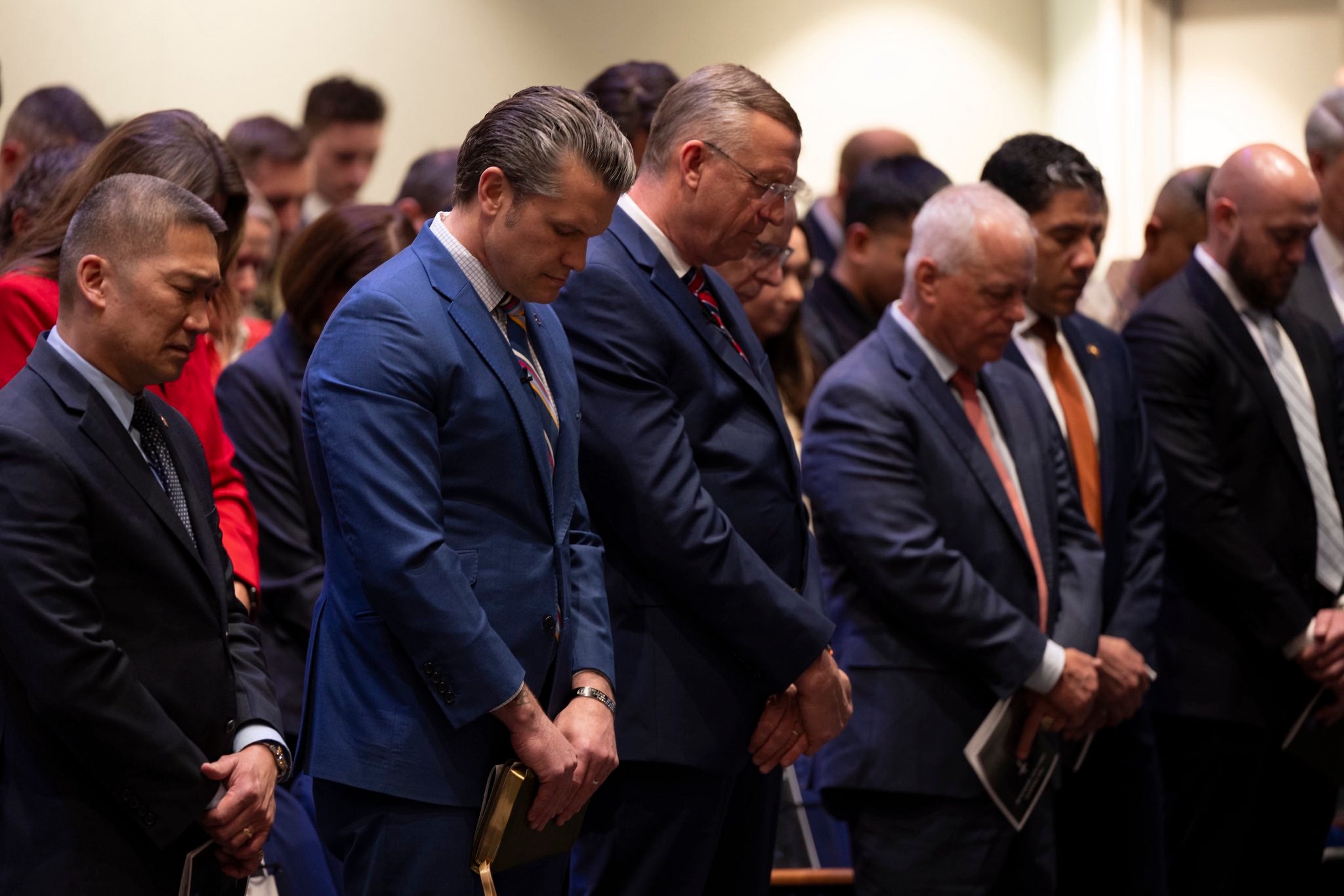
And last week, while hosting a Pentagon prayer service, the 45-year-old Army veteran implored God to: “Let every round find its mark against the enemies of righteousness and our great nation” and asked that “wicked souls be delivered to the eternal damnation prepared for them.”
The prayer, written by a chaplain, was “fitting given what’s going on right now,” he said.
Historical precedent — or lack thereof
Many past American leaders, including defense secretaries and presidents, have invoked their Christian faith during times of war.
For example, at the outset of the Allied invasion of Normandy in 1944, President Franklin Roosevelt delivered a radio address during which he prayed that, “We shall prevail over the unholy forces of our enemy.”
“It's quite a prayer,” said John Bolton, who served as Trump’s national security adviser during his first term. “So, to say that somehow [Hegseth’s remarks are] totally unprecedented is just not accurate.
“The general tenor of some of the criticism I've heard is just anti-religion, and I don't think that reflects the tradition of our military or the country's history,” Bolton said. However, he also described Hegseth’s scripture-infused statements as “performance art.”
Others pushed back forcefully, arguing that the Pentagon chief’s rhetoric — authentic or not — plunges into uncharted territory, especially in the context of recent decades.
“We've had presidents dip into religious space with comments like, ‘May God protect our soldiers,’ that kind of thing,” said Eugene R. Fidell, a former Coast Guard lawyer who teaches military law at the Yale Law School. “But they've all been kind of peripheral and sort of aspirational. This is different in kind from anything we've seen before.”
Weinstein said any attempt to equate Hegseth with his predecessors is “fatuous.” In his telling, the defense secretary is the “poster child” for the “ninth f****** version of the eight prior crusades.”
“There's a long history of Christian nationalism and Christian nationalist rhetoric in U.S. politics — but it's unprecedented in modern times,” said Matthew Taylor, a visiting scholar at the Center on Faith and Justice at Georgetown University.
Echoing this, David Kieran, a professor of military history at Columbus State University, said: “There’s an acceleration of the way a particular strand of Christianity seems to be evoked here in way we haven’t seen in those earlier moments.”
Demographic change shouldn’t be overlooked, Taylor said.
Prior to 1990, the share of Americans who identified as Christian stood at 90 percent or higher. That figure now stands at about 62 percent. According to a 2022 Pew Research Center survey, 51 percent of Americans do not think the U.S. should be a Christian nation, while 45 percent said it should be.
“Hegseth's Christian nationalist rhetoric is part of a broader effort…to run back the clock and take us back to a time before all that diversity and complexity became part and parcel of U.S. culture and identity,” Taylor said.
Constitutional foul
Multiple academic experts said that, by constantly invoking his private faith from his Pentagon perch, Hegseth is running afoul of the Constitution.
“His comments are preposterous for a public official,” Fidell said. “We have in this country separation of church and state. We do not have an established religion. We've never had an established religion since the Bill of Rights was ratified.”
The First Amendment’s establishment clause bars the government from creating an “official” religion, while the free exercise clause protects Americans’ right to practice their religion without government interference.
Weinstein added that by hosting Pentagon prayer services, which service members may feel pressured into attending, Hegseth is also violating Article Six of the Constitution, which prohibits the government from adopting religious tests for public officials.
“What Hegseth and other figures in the second Trump Administration are doing is trying to enshrine a sort of Christian privilege within government policy,” Taylor said.
Risk of alienating troops
According to a 2019 study, about 70 percent of active duty service members identify as Christian, leaving another 30 percent who subscribe to another faith or are nonbelievers.
Weinstein said his organization, MRFF, represents “hundreds of secularists, humanists, atheists, agnostics, Jews, Buddhists, Hindus. We've got 12 members of the Jedi Church right out of Star Wars.” Many, of these service members, he said, feel alienated by Hegseth’s posturing.
This could have major implications for recruitment and retention rates, Fidell noted. “Are members of minority faiths going to look for the exit when their enlistments are up because he's created a hostile environment?” he asked.
‘Provoking the Iranians with his rhetoric’
By framing the Iran war in religious terms, the defense secretary is also undermining or distracting from the justifications the administration has provided for launching the offensive, sources said.
“When you're in a wartime situation, you should think carefully about everything you say, and it should all be aimed at bolstering the central objective, not not pursuing side issues,” Bolton said.
Trump has provided several reasons for entering the war, claiming that Iran posed an imminent threat to the U.S. while hinting that regime change was part of his rationale. Yet recent polls indicate that a majority of Americans oppose the conflict.
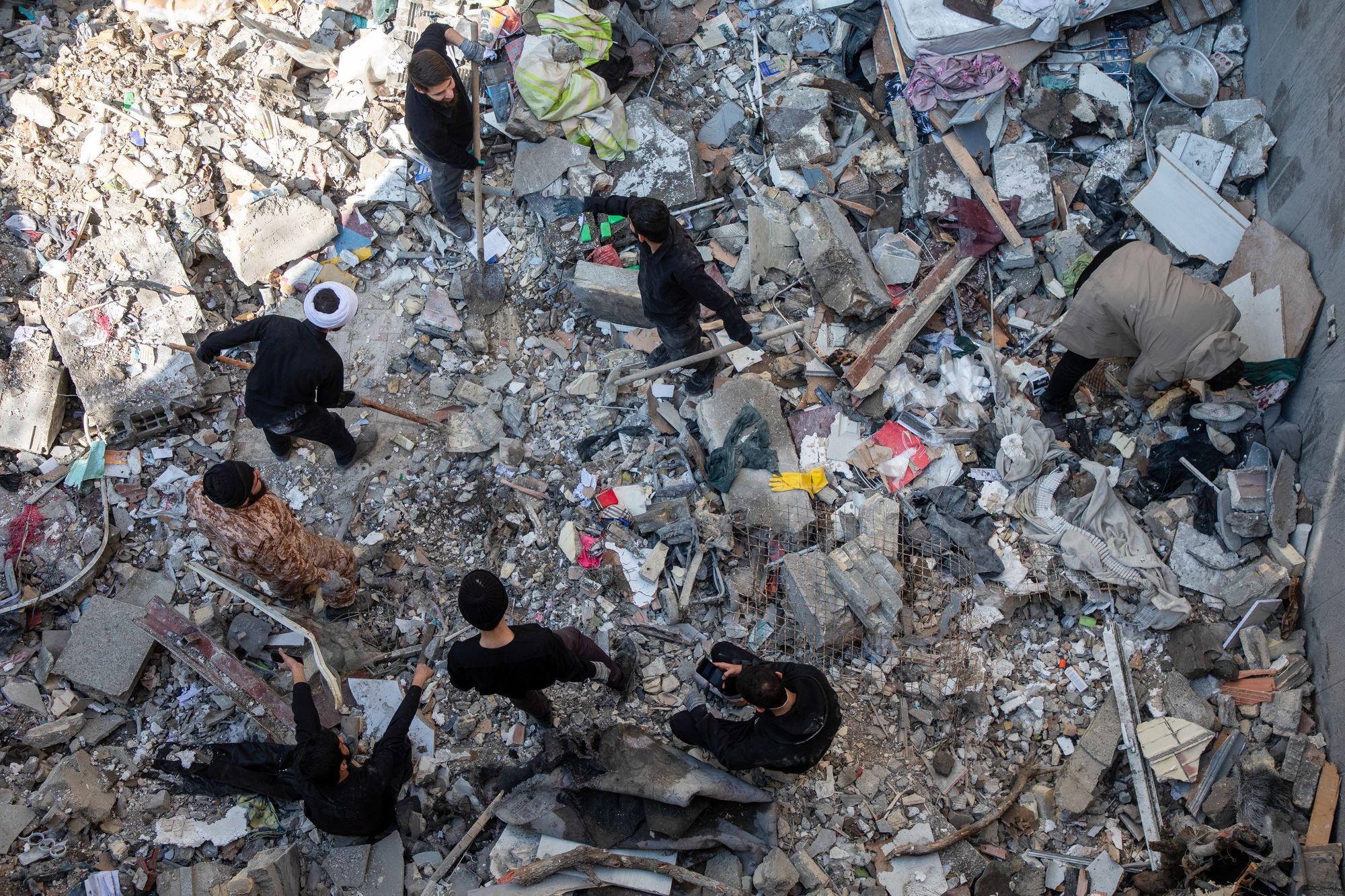
“To gussy it up with the notion that God is somehow behind all this, that's not going to save the administration's failure to explain why we're doing what we're doing,” Fidell said.
Hegseth’s rhetoric further risks unnecessarily inflaming the conflict with Iran, whose new supreme leader Mojtaba Khamenei is considered to be a hardline conservative cleric.
“The Iranian regime, which is built around a radicalized and even apocalyptic vision of Shiite Islam, is already inclined to view this war in existential, civilizational, and religious terms,” Taylor said. “Those narratives of holy war and apocalyptic clashes are already built in.
“The last thing we need in global politics today is religious extremists like Hegseth provoking the Iranians with his rhetoric and potentially causing this war to spiral out even further into regional conflict and destruction,” he concluded. “But that's an almost inevitable impact of the kind of language he's using.”
Prediction markets challenge tribal casinos’ hard-won place in US gambling
Iran-US war latest: Macron tells Trump ‘don’t speak every day’ in scathing attack
Iran could face further sanctions if Strait of Hormuz remains closed – Cooper
Pope Leo XIV revives the Holy Thursday foot-washing of priests after Francis's inclusive tradition
Trump polled advisors on whether to fire Tulsi Gabbard as well as Bondi: report
Pam Bondi breaks silence after Trump fired her and promoted Todd Blanche