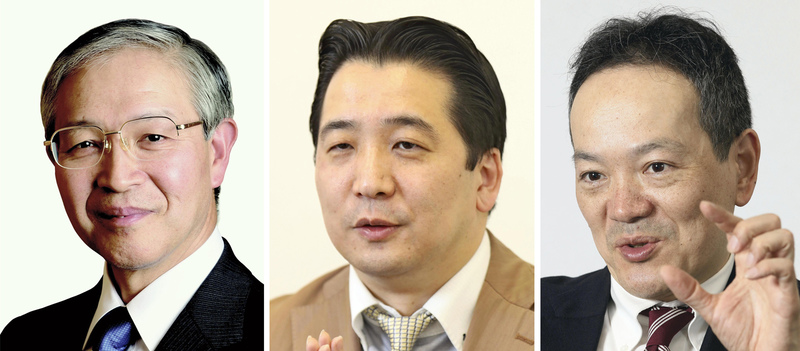
The scandal over the alteration of documents related to approval of the sale of state-owned land to private school operator Moritomo Gakuen is sending shock waves through the administration of Prime Minister Shinzo Abe. National Tax Agency Commissioner Nobuhisa Sagawa, who was the director general of the Finance Ministry's Financial Bureau, resigned to take responsibility, and the ministry explained to the Diet on March 12 the findings of an investigation into the issue. Opposition parties, however, are unsatisfied with the response and are aggressively seeking to expose the entire picture of what happened. How should we interpret the situation? We asked three experts. The following are excerpts from the interviews.
(From The Yomiuri Shimbun, March 13, 2018)
====
Get serious about electronic data management
Hiroshi Miyake / Lawyer
The scandal involving the alteration of public records is connected to the approval and display process for official documents, a process that forms the foundation of bureaucratic institutions. The falsification of public records data, which underpins democracy, represents a grave situation for democracy itself. It goes without saying that this conflicts with the ethical norms of government officials.
As for whether the falsification of public records deserves criminal punishment, we won't know until we see how the situation develops. From what I have seen of the alterations to 14 documents, considerable changes have been made, including the deletion of entire paragraphs. While it is necessary to work out the circumstantial elements as to why it was done, this is without doubt an extremely important fact. Whether it merits criminal punishment will vary depending on the circumstances of who did it and for what reasons. While I believe it is possible to ascertain whether it meets the requirements of a violation, whether to pursue charges is for the public prosecutors to decide.
In December last year, the government revised its guidelines on managing administrative documents. Central to the new policy were provisions stipulating that documents of high importance, such as those concerning policy decisions, must be retained for at least one year. However, in light of the document alteration scandal, it is necessary to seriously tackle how to manage electronic data retention.
To begin with, the approval and display process for public records used to be done entirely on paper, so the final draft would be read by the person authorized to give approval and stamped with their seal, finalizing it as an official document. However, today it is possible to create and overwrite documents on a computer, and I have a sense that our awareness to recognize the authenticity of documents is poor.
As a countermeasure, they must either make it impossible to alter electronic data, or introduce software that preserves a complete record of all changes even when alterations are made, and clearly identifies the first, original draft of the electronic data as quickly as possibly at all ministries and agencies.
For about a decade we have been arguing for requiring the retention of documents as electronic data, but it never ends up getting done. In the United States, they have developed a system to manage public records in the form of electronic data. I believe this scandal should be used as the impetus to deal with this as one of the most critical issues in the new fiscal year -- that is the correct attitude for politics to take with respect to democracy in this country.
They must also devote efforts to training civil servants in managing public records. It seems they have forgotten the existence of the Public Records Management Law [passed in 2011]. They must recognize the role of public records as a resource upholding the foundation of democracy, which forms the basis of this law, and ensure that this sort of situation never happens again.
(This interview was conducted by Yomiuri Shimbun Senior Writer Haruki Sasamori.)
-- Hiroshi Miyake
Member of the Cabinet Office Public Records and Archives Management Commission, as well as a lawyer and specially appointed professor at Dokkyo Law School. He previously served in posts including chairman of the Daini Tokyo Bar Association. He is 64.
====
An inconceivable blunder by the Finance Ministry
Kazumasa Oguro / Hosei University Prof.
I still cannot believe the Finance Ministry altered official documents. Those documents stipulate the final decision after the details have been ironed out internally within the organization. When I worked at the ministry, they were never altered after approval, except to correct numerical errors or factual matters. Under ordinary circumstances, this would be inconceivable.
If they were altered, there is a possibility that charges could be filed under the Penal Code. Administrative officials have clearly exceeded the level of "reading between the lines."
Unlike the Economy, Trade and Industry Ministry, which emphasizes individual action, the Finance Ministry is an office where deliberations are held as an organization before decisions are made. It should have been easy to foresee that if official documents were altered and it came to light, it would undermine confidence in the ministry and influence future debate on issues such as finance reform.
Because alterations were made at such a ministry, there must have been considerable pressure of some kind. Who ordered and implemented these alterations, and for what purpose? It is necessary to reveal the reasons for and background to the scandal.
Though there have been many scandals involving listed companies recently, arguing that an inquiry by a third-party commission or others would affect the investigation is no excuse for not holding one. Companies are basically accountable to customers, shareholders and other people concerned. The public administration, which runs on tax money, has an even greater responsibility to explain itself to the Diet and the people.
For the people to rectify politics through elections, the volume and quality of information, including information on the policy-making process, is critical. This is deeply related to the proper management of public records.
When the management of public records loses substance, the significance of the Freedom of Information Law is diminished. As a necessary cost, isn't it preferable to allocate an adequate staff and budget to document management, and to establish a politically independent organization capable of conducting checks from an external perspective?
It may also be necessary to reconsider the state of the Cabinet Bureau of Personnel Affairs, which was established in 2014 to manage the staffing of senior officials at ministries and agencies. Though there has traditionally been an unwritten rule against politics interfering with the personnel decisions of bureaucracies, politicians responsible for running the government have begun to assert control over the staffing of senior officials at ministries and agencies. Against the backdrop of the scandal, concern is growing that some senior officials at ministries and agencies have become "yes-men" who are overly sensitive to the mood of the Prime Minister's Office.
What is crucial here is how to evaluate the expertise and accomplishments of bureaucrats in a system in which they share roles with politicians. In the civil servant systems of countries such as Britain and New Zealand, politicians who run the government have no substantive authority over personnel matters.
What must be done so that the people, with whom sovereign power resides, can make decisions after obtaining correct information? With that question in mind, cool-headed debate is required regarding the proper way to manage public records and have a system in which politicians control the staffing of senior bureaucratic officials.
(This interview was conducted by Yomirui Shimbun Staff Writer Ryosuke Yamauchi.)
--Kazumasa Oguro
Specialist in public economics. After joining the Treasury Ministry (now the Finance Ministry) in 1997, he worked in the Minister's Secretariat Administration and Legal Division as well as the Customs and Tariffs Bureau Enforcement Division. He assumed his current post in 2015. He is 44.
===
Scandal shakes foundations of democracy
Satoshi Machidori / Kyoto University Prof.
The alteration of the documents, which are public records, defies the imagination. Tampering with a fundamental element of the government's operations is an extremely serious matter that shakes the administration of government under democracy.
The alterations must have been made with the awareness that politicians were intervening and that people close to politicians were present. Is this particular case unique? How high up did knowledge of this go? Unless these things are brought to light, it will be difficult to assess the matter itself, but it was undoubtedly inappropriate.
It is abundantly clear that public administration currently works at the behest of politicians. It does not create policy independently the way it once did. This is not something exclusive to the Abe administration, but the trend grows stronger when the administration is stable.
In terms of the relationship between politics and public administration, this in and of itself is natural. However, when the wishes of ruling party politicians and those close to the prime minister come into play, they probably cause bureaucrats to become excessively meek. In the latest case, the result was that actions were taken that conflict with the core principle that "public administration operates according to rules." It ought to be possible to implement policies at the behest of politicians while also conducting public administration in accordance with the law and rules.
It is a serious problem that administrative documents containing fabrications were presented to the Diet and questions and answers were posed based on those documents. However, confirming the authenticity of all administrative documents in advance is impossible for both the Cabinet and the ruling parties. It is only possible to assume that individual documents contain no tampering, and to exercise control over ministries and agencies through organizational shakeups and personnel reshuffling should the worst come to pass. Ultimately, individual ministry and agency officials must be keenly aware that both individuals and organizations will be held responsible for this sort of foolish behavior. In this sense, the extent to which penalties are imposed on the Finance Ministry and relevant officials will be a litmus test.
Naturally, the finance minister must face some kind of punishment or penalty as the individual responsible for supervising the Finance Ministry. However, if this results in their resignation, that in itself will have political significance of a different kind. If cabinet ministers resign every time there is illegal or improper conduct in government offices, bureaucrats dissatisfied with the cabinet or the administration will be able to join forces with opposition parties to topple the cabinet.
Resigning is not necessarily the only way to take responsibility as a supervisor. If there are voters who think, "This is no good," the only option is to apply a penalty by ousting the ruling parties in the next election, in principle.
Having come this far, the Finance Ministry should release all of the information they have. If Akie Abe, the prime minister's wife, was involved in the sale of a state-owned land plot, she has a responsibility to appear before the Diet, give a full explanation and apologize.
Moreover, perhaps measures should be taken to remedy the current state of public document management and mediation by politicians.
(This interview was conducted by Yomiuri Shimbun Senior Writer Tatsuya Fukumoto.)
--Satoshi Machidori
Specialist in comparative political theory. Before assuming his current post, he served as an associate professor at Osaka University. His publications include "Seito Shisutemu to Seito Soshiki" (Party systems and party organizations) and "Daigisei Minshushugi" (Representative democracy). He is 47.
Read more from The Japan News at https://japannews.yomiuri.co.jp/