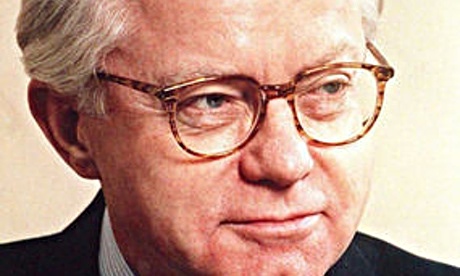
To say the least, the return of Lord Stevens of Ludgate to Express Newspapers is a surprising move.
Clearly, the mercurial Richard Desmond has something up his sleeve. Is it commercial, a sell-off perhaps? Or is it political, an alignment with Ukip?
Or could it be, as some suggest, a liaison that will enable Desmond to obtain a desired peerage?
Speculation is bound to occur because it is hard to fathom the reason for 78-year-old Stevens climbing back aboard the Express ship that he tried so hard to scupper during his 14 years at the helm.
Richard Desmond hardly needs advice on cost-cutting. Stevens, at first glance, is an odd choice of deputy chairman at Northern & Shell for Desmond because they come from very different backgrounds and are, in so many ways, different characters.
But there is at least one rather odd parental connection. Desmond's father, the managing director of the cinema advertising company Pearl & Dean, suffered an ear infection that resulted in a loss of hearing.
Stevens's father invented the first portable hearing aid, which made him a substantial fortune. It enabled his son to go to Stowe and he then went up to Cambridge, from which he graduated with a masters in economics.
David Stevens's first job was as a trainee in a merchant bank, and his great claim to fame was in building up a pension fund manager, Montagu Investment Management (MIM), which became a sizeable and profitable company.
His financial acumen drew him to the attention of Lord Barnetson, chairman of a group called United Newspapers, the first true example in Britain of a newspaper chain.
When Stevens joined the board in 1974, United owned two morning papers, seven evenings, 32 weeklies and eight magazines. Its newspaper flagship was the Yorkshire Post and the jewel in its magazine division was Punch.
Stevens impressed the United board and, on Barnetson's death in 1981, he took the chair. Through clever acquisitions and tight accounting, Stevens enabled the group to make huge profits.
In 1985, he made a play for the newly-floated Express Newspapers, eventually paying £317m for the privilege. After a difficult 20 years for the staffs of the Daily and Sunday Express, things were about to get a good deal worse.
A man with a Napoleonic physique and ambitions, he was noted for his pinstriped suits and highly polished shoes, looking every inch the City figure he was.
It was always hard to discern what Stevens was thinking behind his pale grey eyes. He often appeared with a slight, sardonic smile, which could change in an instant to rage.
Andrew Cameron, the then deputy managing director, wrote years later of Stevens being unpleasant with staff and occasionally "extremely nasty."
It was soon evident that his acquisition was primarily about money, but that didn't inhibit him from having a large say in the pro-Conservative party editorial policy, about which he was candid.
"I do interfere," he told the Independent in 1989. "I don't ram my views in but I'm quite far out to the right... I suppose my papers echo my political views."
One of his first major moves was to decamp from the Express's Fleet Street headquarters, known as the Black Lubyanka, and set up shop - minus some 1,300 employees - on the south side of Blackfriars Bridge.
Stevens established himself in a vast ninth-floor office with a butler dancing attendance and installed a bust of himself in the foyer.
He was never certain what to do with the Daily Star and in 1987 made the calamitous decision to give the Sunday Sport publisher, David Sullivan, editorial and marketing control over the Star.
The Star's editor was fired. In his place came Mike Gabbert, Sullivan's "editorial adviser", who had been fired from the News of the World 10 years before for sexual and financial misbehaviour.
His editorial philosophy, he explained, was to publish "the biggest boobs possible" in every issue. His first example was a set of titillating pictures of a 15-year-old girl who vowed to go topless when she turned 16.
The exploitative nature of the exercise led to the resignation of several senior journalists; protests from the public and politicians; and the cancellation of advertising contracts. Circulation plummeted.
After eight weeks of the Daily Star/Sport, Stevens realised too late what he had done. He paid off Sullivan and asked a new editor, Brian Hitchen, to turn it back into a newspaper. But the Star's reputation, and sales, never recovered.
The prime minister, Margaret Thatcher, appeared unworried. She gave Stevens a peerage in 1987 and he just loved having the title. Soon after his ennoblement, while I was working at the Sunday Times, my colleague, Brian MacArthur, arranged a lunch in a private dining room at the Savoy for a group of us to meet Stevens.
At the start, MacArthur politely asked how we should address him. David perhaps? The prickly, pompous Stevens replied: "Lord Stevens will do at present."
Of all his stange manoeuvres at Express Newspapers, the most bizarre occurred in 1995 when he agreed a merger with the financial services company, MAI, run by the Labour peer Lord (Clive) Hollick.
Stevens stayed on as chairman while Hollick was chief executive. The editors of the Express and Star titles soon found themselves caught between the politics of the two men. Hollick eventually reigned and the true-blue Express became a Labour supporter, prompting many thousands of readers to desert.
Stevens clung on until July 1999, aged 63, and entertained himself thereafter as rich peers do, playing golf - a lifelong passion - and making political mischief.
He couldn't reconcile himself to the post-Thatcher Tories and was expelled from the party in 2004 after signing a letter in support of Ukip. After that, he sat as an "independent Conservative" until 2012, when the BBC reported that he was joining Ukip.
At the time, Ukip's leader, Nigel Farage, described Stevens as "a giant of Fleet Street." I don't think anyone who worked under his regime for the Express and Star titles or, for that matter, rival newspapers, could possibly agree.