Agriculture today is a massive, globally interconnected industry. That interconnectivity has brought jobs and varied foods to people who might not otherwise be able to access them.
However, like many other industries today, agriculture is dependent on a small number of key regions that support a vast network.
What made the modern food system seem resilient was never abundance alone. It was geography. Regions like the North American Prairies, Ukrainian Steppe and northern India grow much of the crops that feed humans and livestock.
The system works because crop failures are expected to be local, not simultaneous. If one breadbasket region fails to produce one year, another could cover the shortfall. The Earth itself provides a kind of buffer, but that buffer is thinning.
Multiple breadbasket failures are becoming more likely as climate change increases the chance of simultaneous stress across major producing regions. The danger is no longer only a bad harvest in one place. It is the possibility that several of the regions the world depends on for staple crops could come under pressure at once.
My PhD research focuses on how climate stress reshapes agricultural risk and food-systems. This perspective is important because climate shocks do not affect farms in isolation; they move through markets, supply chains and affect global food prices. In that sense, a drought is not only an environmental problem, but also a structural risk for the global food system.
The weakening breadbasket buffer
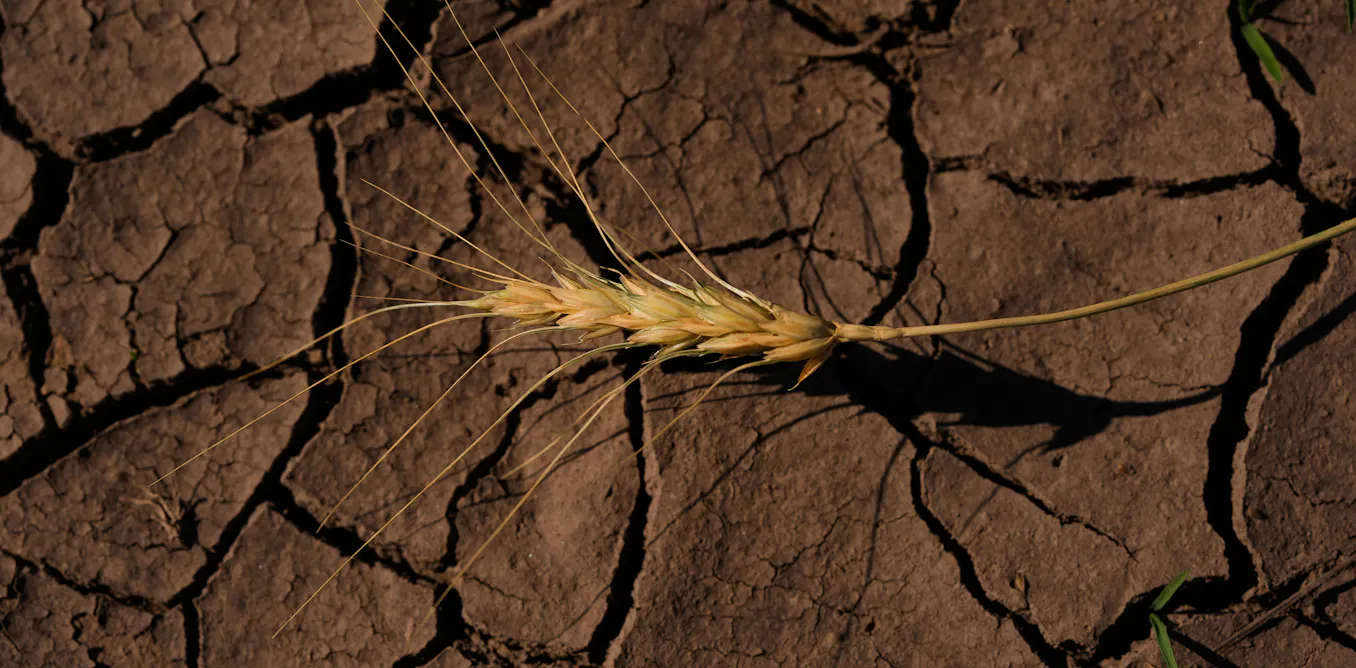
Drought is one of the clearest ways climate change is weakening the breadbasket system. Major crop-producing regions depend on predictable rainfall, stable soil moisture and reliable growing seasons. When one region experiences drought, other regions can sometimes compensate for the shortfall. But when several breadbasket regions dry out at the same time, the system has fewer alternatives.
A recent study on global breadbasket droughts found that the chance of simultaneous droughts across maize-producing regions this century are between 52 to 60 per cent depending on the scale of greenhouse gas emissions. The authors show that this risk is driven especially by long-term drying in Brazil, Europe and the United States, and that global shocks can emerge even when several regions experience only moderately extreme droughts at the same time.
The danger is not only that climate change is reducing yields. It is that it undermines the geographic logic on which the modern food system depends. Global trade works best when shocks are scattered. It works far less well when the places that are supposed to balance one another are all under pressure at once. What looks like a resilient system under isolated stress can become a brittle one under synchronized stress. Interconnectivity, in other words, can become its own form of risk.
The evolving fragility of the global food system suggests that, as trade networks deepen and more countries rely on imports, shocks do not simply pass through the system. They can intensify inside it. A harvest failure in one region can trigger export restrictions, precautionary buying and wider instability elsewhere.
The “evolving” part refers to how the system has become more densely interconnected over time. A trade connection is an import-export link between countries, such as one country supplying wheat or rice to another. As these links multiply, shocks have more pathways to spread.
During times of food scarcity, food producers will tend to reduce exports. In other words, when food becomes scarce, the same trade links that normally move grain efficiently can become channels for disruption, as countries protect their own supplies and import-dependent countries are left more exposed.
That matters because food systems are not just farms; they also include the manufacturing and distribution of seeds, animal feed, fertilizers and pest control, along with storage, transport, processing and retail.
Events like droughts are not just a production shock. They can be a whole supply chain shock. And the more a system relies on tightly timed, low-inventory supply, the more exposed it becomes when the weather stops behaving predictably.
Dangers of corporate consolidation
Modern agriculture does not simply rely on favourable climate conditions. It also relies on a continuous, co-ordinated flow of manufactured inputs arriving in the right place at the right time and at the right price.
That flow is not organized through a wide-open marketplace with endless alternatives waiting in reserve. It moves through highly concentrated corporate channels.
Corporate concentration and power in food systems shape choice, flexibility and control. Global agriculture’s top four firms account for roughly 50 to 60 per cent of the commercial seed market, and those same four control around 70 per cent of the global pesticide market.
Mergers between seed and agrochemical firms, and consolidation in fertilizer and retail, only deepen that pattern.
In stable times, this can look like strength. Large firms can move enormous volumes of seed and chemicals, co-ordinate supply across borders, standardize products and cut transaction costs. Producing at large scales can make the system faster, cheaper and more legible. However, scale is not the same thing as resilience.
Fewer, more dominant suppliers mean fewer alternatives. When a smaller number of firms control seed, pesticide and fertilizer markets, more of the system depends on fewer decisions and routes.
In a concentrated system, disruption does not stay isolated. It ripples outward across a larger share of the food chain. The vulnerability is not only scarcity, but co-ordination: when several pressures arrive at once, a concentrated system has far less ability to adjust.
Read more: Hormuz closure threatens the global food supply – why grocery price hikes are coming
A drought elsewhere can empty shelves here
International food supply shocks show that one country does not need to experience drought itself to suffer the consequences. If one country or region depends heavily on imported staples, a harvest shock thousands of kilometres away can raise prices, tighten supply and limit access to food.
When it comes to poorer communities, even a modest external shock can quickly become a crisis. The modern food system was built on the expectation that geography would keep climate risk uneven.
As long as shocks remained scattered, dependence on a few key suppliers seemed workable. The system did not need much slack because it assumed someone, somewhere, would still be producing.
Now the climate is testing all of that at once.
This article was originally published on The Conversation. Read the original article.