You don’t have to be around New Zealand rugby too long to understand the importance they give to the annual trip north, and particularly to Twickenham. It’s not just the competition or cultural friction with the Old Country, although playing down there you learn pretty soon it’s a factor. No. It’s because an All Black will live 12 months with failure.
Lose against England and he won’t put it to the back of his mind, start a three-month break and begin afresh. Quite the opposite. The structure of the international rugby calendar means it could be a year before things are put right.
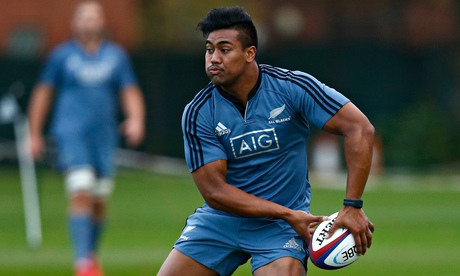
So no surprise this week that Julian Savea, a young man who has scored 29 tries in 30 Tests and who has made a speciality of running in at least a couple every time he confronts England, should spend as much time giving Saturday’s game a New Zealand perspective as he did brushing off endless comparisons with one of his heroes, Jonah Lomu.
The 38-21 defeat two autumns ago is still very fresh. “The way they blew us off the park, I was gutted,” he said, elevating that game above more recent victories, such as June’s in Hamilton when he scored a hat-trick, or the two previous encounters when he scored twice each time.
Further evidence of the mindset came when Saturday’s team were announced, minus Dan Carter despite the Chicago cameo against USA last week which seemed designed to pave the way. “Dan’s fitness is fine,” said the coach Steve Hansen. “He just hasn’t played enough rugby yet to play in a match like this.”
Carter’s 102nd Test, but his first for more than a year, now seems set for Murrayfield next week, so why the caution? The answer is despite beating England 3-0 in the summer, Hansen saw enough of Stuart Lancaster’s squad to know he cannot afford any concessions less than a year from the next World Cup.
Despite being undermined by those Twickenham planners who denied Lancaster a coherent tour agenda and left a chunk of his players elsewhere when the first Test started in Auckland, his England side came close to unpicking New Zealand tactically and Hansen knows it.
To understand England’s task then and now, you have to recognise how the All Blacks defend and attack. I’m not saying these examples are the entire package, merely an idea of how Hansen’s squad go about things.
In defence some sides rush – blitz – while others drift. The All Blacks do a bit of both, the flat defensive alignment having a hinge and a door which can be snapped shut in an attacker’s face depending on what’s needed. In phase play the door stays open to cope with attacking drift; if the attack looks like going wide immediately the door swings shut.
The task is to “fix” the player who operates the hinge – Ma’a Nonu has a broken arm so it could be Conrad Smith but more likely Sonny Bill Williams. Get him guessing or committing too soon and he’s on his heels rather than the front foot and the whole mobility of the defensive pattern is compromised.
In the summer England got part of the job done but it was the execution to the final pod of players out wide – the final piece in the jigsaw – that let them down. Either the wide men lacked discipline, sliding infield to make the attack too narrow or the men inside failed to play through their phase, getting bogged down and allowing the door to clang shut long before any threat of an overlap or even testing the full-back Israel Dagg.
Dagg, it should be said, has an extra sense when it comes to identifying threats and if his forwards can slow things up, which they are pretty clever at, snuffing out the danger becomes easy meat.
In attack the “fix” works in reverse. When the strike is on, say from a turnover, the All Blacks are flat in your face, confident in their skill to embarrass any defence. In phase play they have a method which is designed to freak out sides normally confident their line speed can suffocate attacking flair. To understand it, you have to understand the particular talents of Brodie Retallick, a 19st lock with the hands of a back and a rugby brain which makes him one of the key decision-makers in All Black ranks.
In phase play Retallick often takes on the role of second receiver, becoming the man charged with calling the shots. If he senses something fragile ahead of him, then that’s the obvious route and he’s been known to score tries himself. More likely he’ll offload, probably to the inside-centre standing deep, and this is where uncertainty undermines defenders rushing up.
Put simply they get out of their depth or in too deep. Denied the anticipated collision, a decision has to be taken on the hoof; rush on and risk ruining the entire defensive alignment or stop rooted to the ground, a traffic island inviting men in black to pass either side.
When the Retallick option is on the cards, that is when another ball-playing forward, Kieran Read, gets involved, drifting away from his ball-winning chores to take up station out wide as the man who gives a wing like Savea the scoring pass or scoring himself. It was something which occurred repeatedly last autumn – notably at Twickenham when Reid set up Savea’s first before scoring himself.