South Korean President Moon Jae In and North Korean leader and chairman of the Workers' Party of Korea Kim Jong Un agreed to the goal of "realizing, through complete denuclearization, a nuclear-free Korean Peninsula" at a summit meeting in Panmunjom on April 27. How will the situation on the peninsula develop as Pyongyang engages in a dialogue offensive? We asked experts both in Japan and South Korea. The following are excerpts from the interviews.
(From The Yomiuri Shimbun, April 28, 2018)
===
Japan's active engagement vital for building peace
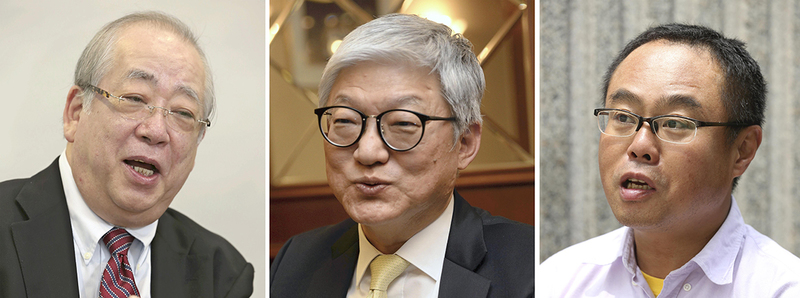
Hajime Izumi / Professor at Tokyo International University
The Panmunjom Declaration refers to "a nuclear-free Korean Peninsula," but that is nothing new. Just as in the Joint Declaration of the Denuclearization of the Korean Peninsula -- which was agreed on in 1991 by Seoul and Pyongyang -- the latest declaration does not solely mean the denuclearization of the North.
For North Korea, the country they will discuss the nuclear issue with is the United States. Obviously, what Pyongyang has in mind [in the latest declaration] includes [such goals as] Washington's abandonment of its hostile policy [toward Pyongyang] and conducting nuclear inspections of U.S. forces in South Korea.
It appears that Pyongyang does not see Seoul as its negotiation counterpart, as the nuclear issue is mentioned in the latter half of the declaration and also Chairman of the Worker's Party of Korea Kim Jong Un did not touch upon the issue at the press conference.
Regarding economic cooperation -- which was Pyongyang's biggest aim -- the declaration only reconfirmed active implementation of what had been agreed on in the 2007 declaration by the then-leaders of the two Koreas. This is because [North Korea] is aware that it will be unable to draw such benefits as investment from South Korea under U.N. sanctions. The declaration, meanwhile, refers to an agreement to regularly hold meetings [between Moon and Kim].
I think North Korea aims to successfully hold a Washington-Pyongyang summit meeting, get sanctions to be eased by making South Korea lead relevant efforts [on Pyongyang's behalf], and get a new economic cooperation package from the South.
The declaration mentions the connection of railways between the South and the North. This can be seen as an attempt by North Korea to get Russia -- a permanent member of the U.N. Security Council -- on board in a bid to ease sanctions. An inter-Korean railway connection would also benefit Moscow because Russia and North Korea are already connected by rail.
The declaration says that Pyongyang will pursue trilateral or quadrilateral meetings including Seoul in an effort to establish a permanent peace regime. Behind this lies North Korea's intention to convince South Korea and the United States [regarding a permanent peace], I think.
North Korea has yet to resolve its hostile relationship with Japan, and permanent peace will not come without Japan's involvement. Japan's active engagement is vital.
Overall, the declaration itemizes practical and feasible steps under the current circumstances.
The two leaders agreed to establish a "maritime peace zone" in the Yellow Sea -- or West Sea -- where the two countries are yet to agree on a demarcation line. Since the maritime area is rich with crab, Pyongyang likely intends to achieve such goals as concluding a fisheries accord based on a quota system.
The establishment of a joint liaison office in the Kaesong region was also mentioned, but Kaesong is the place where an industrial park was constructed as part of their joint project. North Korea apparently feared that if such offices are set up in Pyongyang and Seoul, the North's liaison officials might defect or be attacked.
Kim himself spoke in front of reporters. The international community would not accept a leader exercising a reign of terror by killing his own brother and uncle. Kim must have staged rehearsals in a bid to demonstrate the image of a decent leader with rational thought. In this regard, he was very successful.
South Korean President Moon Jae In has also agreed to visit North Korea this autumn, presumably in consideration of the 70th anniversary of North Korea's founding on Sept. 9.
In the autumn, there will also be [the general debate of] the U.N. General Assembly. North Korea may intensify diplomatic activities including Kim's attendance at the meeting.
-- This interview was conducted by Yomiuri Shimbun Staff Writer Takeo Miyazaki.
-- Hajime Izumi
Izumi is also a professor emeritus at the University of Shizuoka, specializing in politics and diplomatic issues on the Korean Peninsula. His books include "Kita Chosen de Nani ga Okiteiruka" (What is happening in North Korea?), published in the Chikuma Shinsho series.
===
Declaration hints that China could be excluded
Yun Duk Min / Chair professor at Hankuk University of Foreign Studies
At the latest inter-Korean summit, South Korean President Moon Jae In succeeded in creating an image of peace on the Korean Peninsula, an area where until recently, tensions had been rising.
Panmunjom, along the military demarcation line, was chosen as the venue for the talks instead of Pyongyang, where severe restrictions are imposed on the press. The event was even televised live.
Compared with the previous two South-North summits, talks this time focused on strategies to show rapprochement between the two Koreas.
However, it probably will take a long time before the real threat of North Korea's nuclear and missile development disappears.
This is because the "nuclear-free Korean Peninsula" mentioned in the Panmunjom Declaration means the denuclearization of North Korea for South Korea, but for North Korea it refers to a concept that includes the elimination of the U.S. nuclear umbrella and the withdrawal of U.S. troops from South Korea.
The South Korean side may have worked hard to include the words "complete denuclearization" in the declaration, but it was not able to step into such details as a specific procedure for denuclearization.
Even so, it was important for Moon to play the role of an intermediary between the United States and North Korea for an upcoming Washington-Pyongyang summit meeting. This aim has been successfully achieved to some extent, and it seems more likely that U.S.-North Korean summit talks will eventually take place.
The declaration refers to Moon's agreement to visit Pyongyang this fall, but this will be difficult if the U.S.-North Korean summit does not yield results.
Interestingly, the declaration implies the possibility of excluding China. It specifically refers to pursuing trilateral meetings among the two Koreas and the United States, or four-party talks involving China and those three countries, with a view to establishing a peace regime, which was not clearly mentioned in the document adopted in the inter-Korean summit in 2007.
This apparently reflected Moon's advocacy of a trilateral summit between Washington, Seoul and Pyongyang.
Behind the wording, there may be the thinking that trilateral meetings excluding Beijing will reach an agreement more quickly, but this wording will likely upset China.
The declaration also mentions cooperation on railways, but if there is no progress toward denuclearization in a U.S.-North Korean summit meeting, the international community will never lift economic sanctions, making the realization of such projects unlikely.
It is easy to make agreements but difficult to fulfill them. Moon does not have to excessively encourage the conciliatory mood.
He should seriously tackle the nuclear threat -- a matter directly linked to the safety of 50 million South Korean citizens -- and dedicate himself to getting U.N. Security Council sanctions to function properly until North Korea actually abandons its nukes, in consultation with Japan, the United States and China.
If coordination among Tokyo, Washington and Seoul breaks down, North Korea will be the most pleased.
The United States may be able to reach a compromise if North Korea gives up such plans as launching intercontinental ballistic missiles that are capable of reaching American shores.
However, it is a problem for Japan and South Korea if the North retains its stockpile of short- and mid-range missiles. This is an area where Tokyo and Seoul have common interests.
-- This interview was conducted by Yomiuri Shimbun Staff Writer Kiyota Higa.
-- Yun Duk Min
Yun specializes in North Korean nuclear issues, among others. He received his doctorate from Keio University. He was the chancellor of the Korea National Diplomatic Academy from 2013 until May of last year.
===
Pyongyang places priority on Kim-Trump summit
Kan Kimura / Professor at Kobe University
The latest inter-Korean summit meeting's biggest focus was the denuclearization of the Korean Peninsula. The Panmunjom Declaration that was announced following the summit clearly stated that "South and North Korea confirmed the common goal of realizing, through complete denuclearization, a nuclear-free Korean Peninsula."
As a result, the declaration includes wording that demonstrates the will for denuclearization, which the U.S. administration of President Donald Trump has urged Pyongyang to implement.
It could be said that this declaration has made it impossible for the United States to refuse to hold a summit meeting with North Korea, which is expected to take place by early June. Preliminary talks are at least likely to move even further forward between Washington and Pyongyang in preparation for a summit.
The declaration also states President Moon Jae In's agreement to visit Pyongyang this fall with a view to declaring an end to the Korean War.
If a peace agreement is reached on the Korean Peninsula, and a path to denuclearization is clearly presented, it would be the best gift for Trump as he heads into the midterm elections in November.
Both the South and the North apparently had lengthy discussions before the summit. Consequently, any concerns about Washington refusing to hold summit talks with Pyongyang were removed.
Behind the realization of the latest inter-Korean summit was the Worker's Party of Korea Chairman Kim Jong Un's excessive fear that the effective economic sanctions against Pyongyang would continue. And yet there is nothing written in the declaration that indicates a path toward lifting the economic sanctions.
The lifting of sanctions is a condition that North Korea wants to get by any means possible.
Mentioning the possibility of sanctions being lifted at the inter-Korean summit would have made a Washington-Pyongyang summit difficult. This is because the United States says it will not lift economic sanctions without "complete, verifiable and irreversible denuclearization."
It could be said that talks for lifting economic sanctions have been pushed back to an upcoming U.S.-North Korean summit. Although the latest declaration can be read as North Korea having made concessions, it is also an indication of the strength of its wish to realize a summit with Trump in a bid to eventually preserve its own regime.
South Korea was able to have its own position from which to conclude a peace accord for the Korean Peninsula. This is because Seoul will now enter into talks to reach such an accord, which so far have been led by Washington and Pyongyang, and Washington and Beijing. This will be a significant help for South Korea's security policy.
Japan is yet to be part of these moves toward establishing peace on the Korean Peninsula. This is probably because relevant countries find it hard to clearly see how Japan wants to engage in the issues regarding the peninsula.
Tokyo needs to show not only its good ties with Washington but also a grand design for its East Asian policy.
-- This interview was conducted by Yomiuri Shimbun Staff Writer Ryosuke Terunuma.
-- Kan Kimura
Kimura specializes in Korean Peninsula studies. He has held such positions as visiting scholar at Harvard University and he was also a member of the Japan-ROK Joint History Research Committee. Kimura's books include "Nikkan Rekishi Ninshiki Mondai towa Nani ka" (What the history perception issue between Japan and South Korea is), for which he won the Yomiuri Yoshino Sakuzo Award.
Read more from The Japan News at https://japannews.yomiuri.co.jp/