A Ukip majority of only 2,920 in the Rochester and Strood byelection, eh? Not such a Tory meltdown as David Cameron must have feared. That should stop any of those would-be defectors among Tory MPs (if there really were any) from jumping ship this side of the wider contest next May. Mark Reckless, one of Westminster’s Adrian Moles, can now expect to lose the seat unless he gets lucky.
In his victory speech and elsewhere, Reckless is saying no Tory seat is safe. Nonsense. More interesting, as Patrick Wintour notes, he makes a bold (brazen?) pitch for Labour votes so that he and Nigel Farage can save Medway’s local hospital and the NHS – which Ukip’s leader wanted to privatise the other day until it proved unpopular and he rowed back.
On the airwaves Farage himself is complaining about distorted media coverage on Friday morning. More nonsense. The travelling Tory press has been very helpful to him. The London Evening Standard, read by Kent commuters, cooked up a handy “EU defeat for Osborne” splash on polling day. That story is on page 39 of Friday’s Guardian. And none of the rottweiler tabloids took Reckless apart.
All the same, it was a dreadful result for the mainstream parties. The Lib Dems disappeared off the radar (0.87% share) in an area where the party was never strong. It is well dug in elsewhere. But Labour’s Bob Marshall-Andrews held a version of this seat until 2010 (he beat young Reckless in 2005) and Labour’s candidate was hammered, too (16.8%). Are we surprised? Not really. Farage may be full of bluster, but he’s right to say the coming election is “unpredictable beyond comprehension”.
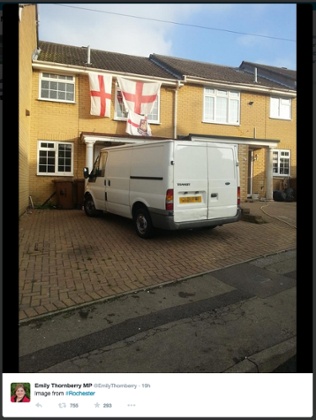
MP Emily Thornberry’s sneer at that St George’s flag – posh Islington looking down its nose on Rochester and Strood – says it all. It was insulting to the normal lives and attitudes of many Labour voters, as Bassetlaw’s Labour MP, John Mann (with whom I usually disagree) rightly said on Radio 4’s Today programme. The cry of snobbery first surfaced in early editions of the Sun – as chippy and cynical as its owner – but on this occasion Thornberry was fair game.
Her “image from Rochester” tweet was indeed a trivial incident. But it articulated eloquently out-of-touch metropolitan attitudes which the now-former shadow attorney general compounded by saying she’d never seen such a flag draped from an upstairs window. Oh, really? Not in Islington? I see such enthusiasm all the time – defiant support for England’s embattled football team, I usually assume – all over the country and walked past such an arrangement 10 minutes from my home only yesterday. Now I come to think of it, Emily, the flag hung from an expensive house, too.
In the wake of Douglas Carswell’s Tory-to-Ukip victory in Clacton on the Essex side of the Thames estuary, Cameron made another strategic mistake in promising to throw the kitchen sink at the second challenge in Kent (Rochester was Ukip’s 271st target seat) when distancing himself from byelection froth – as party leaders did until recently – would have been wiser. MPs and cabinet ministers who traipsed around estates canvassing should have stuck to doing their day job, preferably better.
What drives the Ukip bandwagon? Disaffection of all sorts, as obvious in many advanced democracies after six years – or more – of deep and damaging recession. Pay has been flat or worse, especially for young people, security of employment poor for many of those with jobs. People are aware – how can they not be? – that a huge proportion of jobs created as Britain edges back into growth are being taken by bright, young foreigners.
The awkward truth is that mainstream parties have made a mess of immigration management way beyond what EU rules have imposed on Britain. There’s an upside to it – but not for everyone – and a downside for many. Brussels is the scapegoat and often manages what we must now call “doing a Thornberry” in its own inimitable way.
It all serves to remind me of something I heard at a memorial event last month at Goldsmiths College, University of London. It was staged to honour its former warden, Richard Hoggart, the distinguished academic chronicler of working-class culture who died soon after his son, Simon, this year.
In the audience were all sorts of working-class people, less distinguished than the likes of Alan Bennett and Joan Bakewell, Laurie Taylor and Melvyn Bragg and other contributors whose early lives were touched by Hoggart’s work, but equally fierce in their admiration. One of Hoggart’s core beliefs was that cheap popular culture of the kind we now find everywhere sells the working-class short. It wasn’t an Emily Thornberry perspective: Richard grew up very poor indeed.
And one contributor to the discussion articulated the point when she said working-class voters feel let down. That’s why they’re lashing out in elections. It’s a “sod you all” protest vote, she said. God knows where it will lead us.