I'm in Paris at the Festival d'Automne to see a major project that's coming to London's South Bank in the spring: Edgard Varèse's 360°, a performance of the complete works of the 20th century's most enigmatic iconoclast in just two concerts, nearly all of it with visuals and theatrics by American artist Gary Hill. And just as at the project's original incarnation in Amsterdam earlier this year, there was some festively enthusiastic booing at the Salle Pleyel – but I'll come on to that in a minute.
It's a surprise to realise that Varèse wrote less than classical music's most famous miniaturist, Anton Webern. Despite the monumentalism of Varèse's work, his dreams of a new universe of sonic possibility that takes in everything from ancient mythological arcana to ultramodern electronics, it is possible – just – to cram his entire completed oeuvre (as well as some of it finished after his death in 1965 by his amanuensis, Chou Wen-chung) into just a couple of concerts. A couple of pretty long concerts, mind you: I saw the second performance in the Salle Pleyel, all three hours of it, with Peter Eötvös conducting the Orchestra Philharmonique de la Radio France, the Asko/Schönberg Ensemble and Capella Amsterdam. Musically, it was a triumph. Nobody knows this music better than Eötvös, and the big pieces were magnificent, like Arcana, Déserts and, especially, Ecuatorial, my new favourite Varèse work: the whole two theremins, organ and voices combo is one the 20th century's boldest and bravest sounds, sounding like a church service on Mars, and simultaneously prophesying B-movie soundtracks and Stockhausen at his craziest.
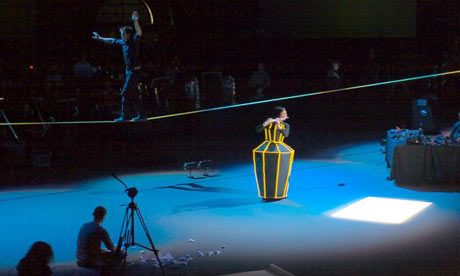
The smaller works were excellently handled, too, like the virtuosic barrage of Ionisation, with its 13 percussionists, or the air from another planet of Density 21.5 for solo flute. But to hear Density, you had to put up with Jeanette Landré performing in a Tron-like get up, a dress that looked in outline like one of those loo-roll holders in third-rate B&Bs, but whose contours were picked out by yellow LEDs. Landré was helped out of her costume by three more Tron-ified minions, and my question was a simple one: why? But watching Gary Hill's visuals over the whole evening, which also included poetic aphorisms by George Quasha projected on to the ceiling and walls of the Salle Pleyel, and live, filmed micro-theatre from Christelle Fillod, Els van Riel and Charles Stein, I finally realised that "Why?" was really the wrong question to ask.
There were connections, sometimes, between what we saw and what we heard, like Stein's mythological menagerie of amulets, charms and symbols, which were projected during Nocturnal and Arcana, or the gradual accumulation of sand over a loudspeaker in Déserts, or the abstract computer-ography of the images for Ionisation. But Hill's point was not to find a particular collection of images as metaphorical resonances for Varèse's music, but rather to conjure up a constantly changing visual improvisation (which he controlled in real time from a vast computer screen) that would sometimes be in sync with the music, and sometimes not. This risky approach often didn't pay off, thanks to the trite pseudo-profundity of Quasha's texts, and the banality of Hill's source material – a computer-rendered image of a brain in a box, some abstract geometry, a shot of rippling water, another of a bubbling hot spring, none of which came close to rhyming with Varèse's elemental music. But in the continual flux and foment of visual information, there were moments of real illumination, especially in the cascading computerised vortices Hill found for Ionisation.
Hill's way of working is the exact opposite of Bill Viola's technique in his film for Dèserts a few years back, in which the brilliance and craft of the visuals had something powerful to say to the music (have a look in not very high YouTube quality here). But Hill's project is the more ambitious, and the more dangerous. And because it's so open-ended, there's time for Hill to develop it again by the time it comes to London in April, when the music will be performed by the London Sinfonietta and the National Youth Orchestra. I'm looking forward to seeing how the ideas change between now and then – by which time, maybe it won't be booed: a devoted claque of anti-Hillites waited patiently until the end of the performance at the Salle Pleyel to boo him passionately. Gamely, Hill came back on stage with his team to boo them back. Fair play both to the audience and to Hill, I say; and 55 years after Varèse was mercilessly barracked by the Parisian public at the first performance of Déserts, proof that his music and its performances can still inspire strong emotions.