Transport secretary Heidi Alexander has given the go-ahead for a second runway at London Gatwick airport.
The controversial £2.2bn project will see the Sussex hub almost double its capacity – which proponents say will increase choice and resilience and help to cut fares. But the minister’s announcement has been condemned by environmentalists, who say they will launch a legal challenge.
The Independent looks at the key questions and answers for Gatwick and the government.

What is the problem that the runway is designed to solve?
London is the world capital of aviation. More people fly in and out of the city’s airports than anywhere on Earth. But because of extreme capacity constraints at both of the capital’s biggest airports, Heathrow and Gatwick, the current arrangements are dysfunctional.
Heathrow is the busiest two-runway airport in the world, and Gatwick has more flights using its single runway than any other airport. There is simply no slack in the system.
While the government has given its backing to an additional runway at Heathrow, that project remains mired in controversy – because of the environmental impact, but also the huge cost, which will total almost £50bn once associated work is taken into account.
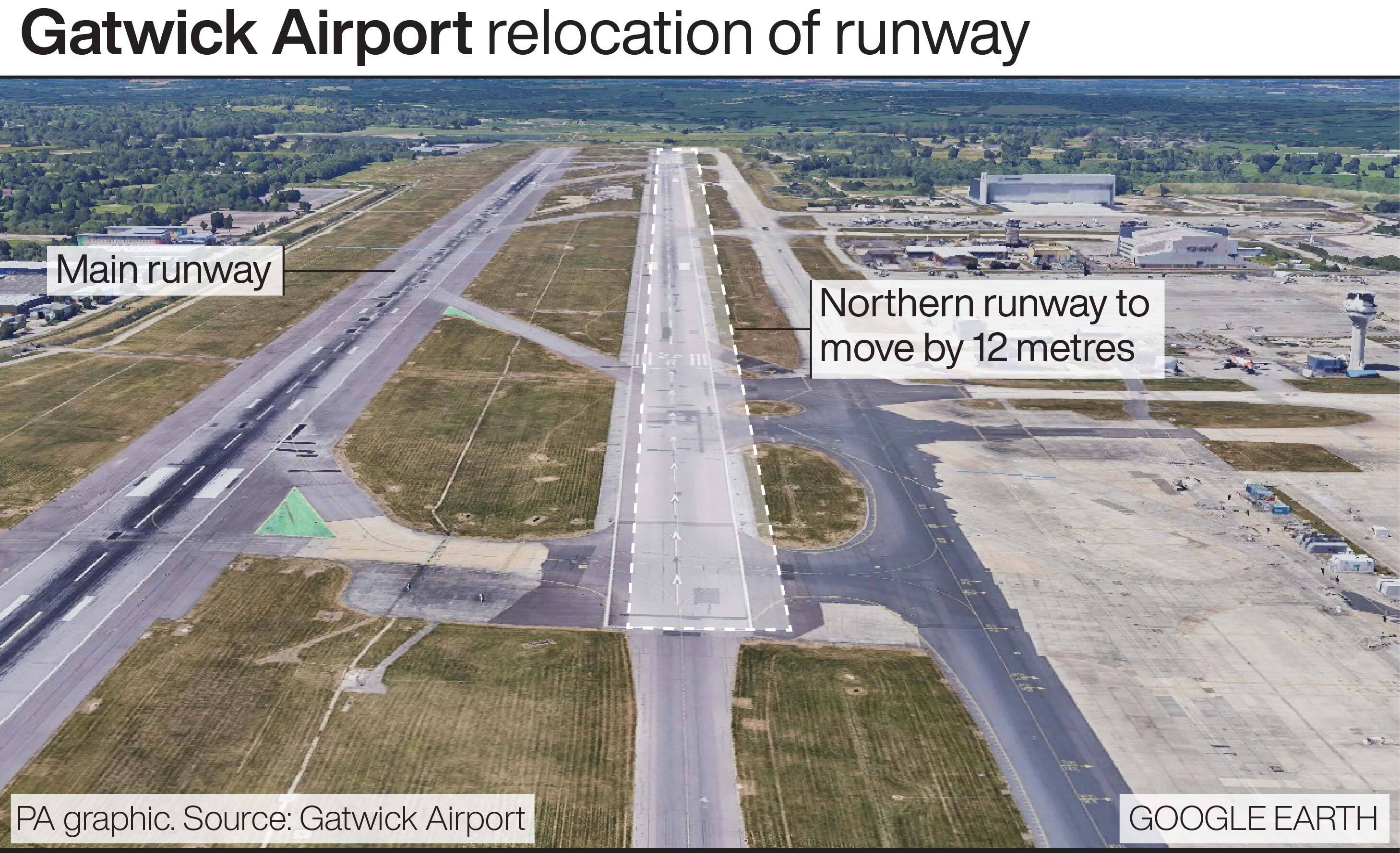
Gatwick has adopted an entirely different approach. Basically: “Here’s one we prepared earlier.” The Sussex airport has a second standby runway already – and by moving it just 12 metres further north and making improvements across the airfield, Gatwick can press it into service for departing holiday flights.
The government has now given its blessing to the scheme.
What will it mean for travellers?
Capacity will steadily rise from the current average of 767 arrivals and departures each day to as many as 1,066 – an increase of 40 per cent. With the mean size of aircraft increasing and more longhaul flights using larger planes, annual passenger numbers could potentially almost double from the current 43 million to as many as 80 million.
At the moment, people travelling to or from London and southeast England do not get the choice they deserve of airlines and destinations, and pay higher fares due to the constraints on the number of flights. For example, Europe’s biggest budget airline, Ryanair, has only a tiny operation at Gatwick because of the lack of attractive slots; it could expand rapidly with more capacity.
A permanent second runway will also improve resilience. When disruption occurs, the absence of slack in the system means schedules unravel fast.
Expansion comes at a cost that will ultimately be met by passengers, but the planned £2.2bn expansion is a tiny fraction of the cost of expanding Heathrow. Over a 10-year spell, The Independent calculates the additional cost would work out at roughly £4 per passenger – around a tenth of the figure for Heathrow.
What is the schedule?
Gatwick’s original target date for using the “new” second runway was the start of the summer season in 2025. But the Covid pandemic – which hit the Sussex airport especially hard – put expansion plans on hold.
The expectation now is that it would be ready by 2030, but Ms Alexander says it could be before the next election – which means by the summer of 2029.
Gatwick’s plan for another permanent runway is far cheaper and less disruptive than Heathrow’s, and can be completed much more quickly. With a mainline railway serving the airport already, increasing the number of passengers who use public transport to the required level of 54 per cent is more achievable.
How would the two runways be used?
You may think the new plan would involve one runway being used for take-offs and another for landings, as it is at Heathrow. But that would not be the case at Gatwick. The additional runway would be used only for departures for narrow-bodied aircraft, like the Boeing 737 and Airbus A320 family – as used by British Airways, easyJet, Ryanair and Wizz Air.
The main runway would continue to be used for all landings and some take-offs.
Is there strong opposition?
Yes. Green Party leader Zack Polanski told BBC Radio 5 live: “The problem here is multimillionaires and billionaires who are flying extremely frequently, who are destroying our planet, who are destroying our environment.
“And now the same big businesses who are behind the aviation industry, who also donate to the Labour government, are the people who the Labour government are now protecting, rather than our children and our grandchildren.
“Where is Ed Miliband, the supposed climate champion? Is he going to stay in the cabinet?”
The pressure group Communities Against Gatwick Noise Emission (CAGNE) said: “This is not over for Gatwick or the government.” The group plans to request a judicial review of the decision. And in a press release headline “See you in court”, the Gatwick Area Conservation Campaign expressed “deep disappointment and alarm”. Its chair, Peter Barclay, said: “This is a profoundly irresponsible decision that flies in the face of climate science, environmental evidence, and the interests of local communities.
“This flawed decision prioritises short-term commercial interests over the long-term environmental and social costs. It will worsen noise pollution, traffic congestion, and carbon emissions – all in an area already under pressure.”
What does Gatwick say?
Stewart Wingate, UK managing director for the airport’s owner, Vinci, said: “We welcome the government’s approval of plans to bring our northern runway into routine use, ahead of the expected deadline.
“This is another important gateway in the planning process for this £2.2bn investment, which is fully funded by our shareholders and will unlock significant growth, tourism and trade benefits for London Gatwick and the UK, and create thousands of jobs.
“As we’ve said previously, it is essential that any planning conditions enable us to realise the full benefits of the project and do not impose unnecessary constraints that make it uneconomic to invest in. We now need to carefully examine the details of the planning consent. Once we have done that, we will be able to comment further.”
What does Gatwick’s expansion mean for other airports?
In her letter to Gatwick approving the plan, Ms Alexander said: “The proposed development is unlikely to affect the ‘hub’ status of Heathrow long term.” The third runway at Heathrow is still planned to go ahead.
Other airports in the London area – notably Luton and Stansted, chasing the same largely low-cost traffic – may be concerned. But such is the growth in demand for air travel that airports are likely to continue to thrive – to the dismay of environmentalists.
Heathrow and European airports suffer fourth day of disruption after cyber attack
Gatwick gets green light for second £2.2bn runway
What caused the cyber attack that crippled major airports including Heathrow?
Thousands hit by disruption after cyberattack on European airport systems
Stowaway rat delays Indigo flight to Delhi by three hours
Trains to use stunning historic rail line for first time in a decade