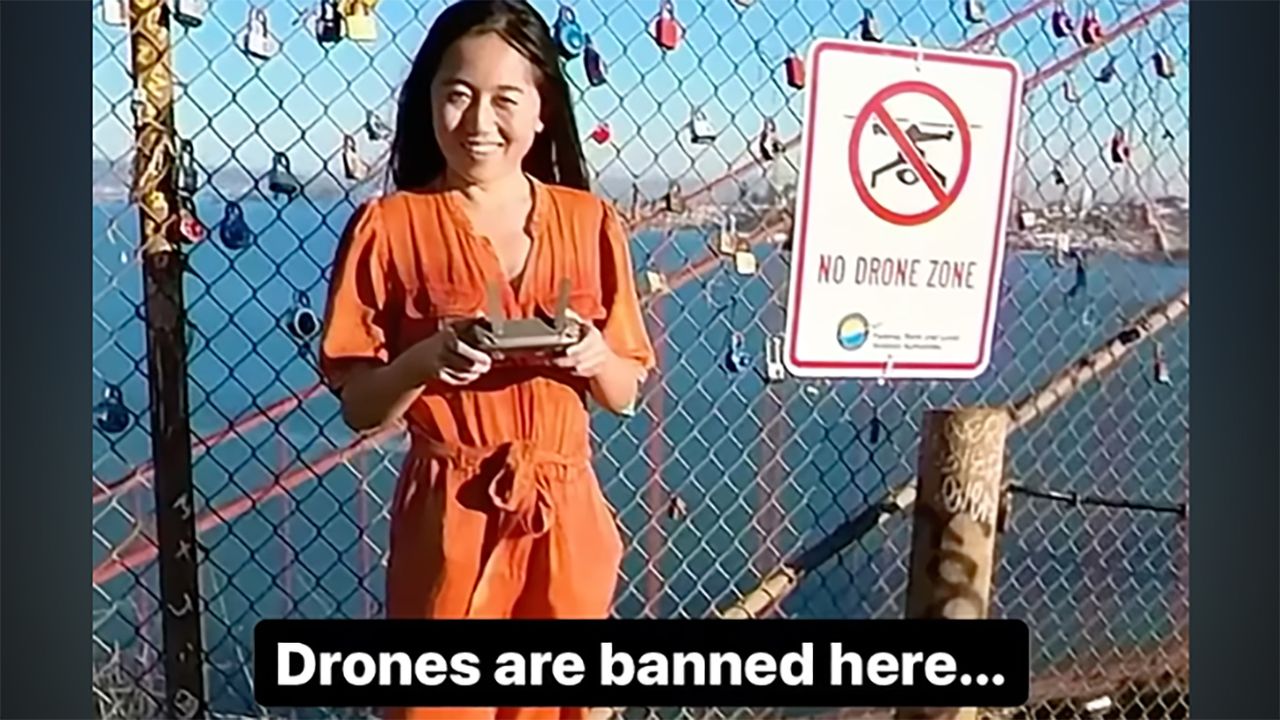
Law-abiding drone creators like me occasionally run into situations we can't use our drones. I've often solved it with a pole, but Youtube creator @karenxcheng has shown that it one of many alternatives.
Karenxcheng is a creator with over a million subscribers, and she hasn't let the rules and regulations stop her from getting aerial shots for her fans, In fact she has come up with more solutions than the one I regularly use.
My solution? Extendible poles. Both DJI and Insta360 offer very long versions of a selfie stick. The Insta360 "Extended Selfie Stick" is made of carbon fibre, has a nice padded handle with the brand in the logo, and extends to 9.8ft.
When I needed to inspect my roof for damage, it was this, and a 360-degree camera, that I turned to because I live too near an airport to use a drone.
The DJI alternative, the DJI Osmo 2.5m Extended Carbon Fibre Selfie Stick, is slightly shorter at 2.5m, but only weighs 428g (1 pound).
Both are lightweight and easy to carry, and both use tripod threads to attach so are actually interchangeable!
- Insta360 Extended Selfie Stick (Insta360 store)
- DJI Osmo 2.5m Extended Carbon Fiber Selfie Stick (DJI Store)
But extension poles are not the only solution. Another that offered more height (though it might depend a little on the weather) is a kite. This can be done by attaching a small, light action camera with some degree of image stabilization – probably one of the best POV cameras.
Another shot she uses a fishing rod to drop an Insta360 X-series camera from the a Bridge (to be clear, the camera is on the line – dropping things from some locations like the Golden Gate Bridge is illegal).
This approach means she can run the footage in reverse and give the impression of a drone lifting up, Thanks to the fact a 360-degree camera offers the capability to choose the exact angle in post, it doesn't really matter if the camera appears to wobble a bit on the fishing line.
The post-processing apps (like Insta360's) also allow you to select a subject and track it with AI during the cropping from 360 video. This makes it look like you had a camera operator keeping the drone's "camera" directly on your subject.
Finally, she uses a similar fishing line approach to create a zip line from the top of a cliff to a friend on the beach below, giving control of the camera's 'flight'.
For law-abiding drone operators with qualifications, it's often also possible to pre-arrange use of a real drone by contacting the local authorities, but most of us have learned from experience that this kind of solution is often quicker and cheaper.
Check out my guide to the best 360-degree camera for those on-a-wire shots!