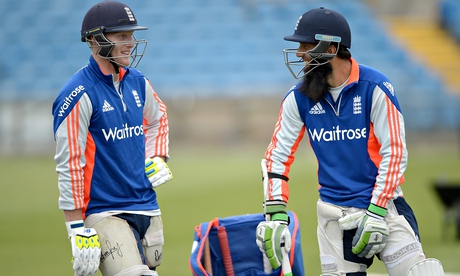
You can never have enough all-rounders in your Test team but you can have too many bits and pieces players. So what is the difference between these two categories, how is an all‑rounder defined and what do England currently have in their team?
Try this definition: for someone to be a true Test all-rounder, one of the disciplines of the player concerned should be good enough to get him into the team even if he does not bat or bowl as well. There is a more exacting statistical scale which is beautifully simple. If someone’s batting average exceeds his bowling average then he is a formidable all-rounder.
Since the war only six England cricketers qualify by this measure (a minimum of 10 Tests required). They are Trevor Bailey (batting average 29, bowling 29 but the decimal point is in his favour), Ted Dexter (47, 34), Basil D’Oliveira (40, 39), Tony Greig (40, 32), Ian Botham (33, 28) and – take a deep breath – Moeen Ali (32, 29).
The most notable absentees are Andrew Flintoff (31, 32), a formidable all-rounder nonetheless, and, given the excitement of the past few days, Ben Stokes (36, 40). In Stokes’ case there is plenty of time for him to join the top five above (Moeen’s career will also be a triumph if he can remain in that company).
Both Stokes and Moeen can currently be classified as all-rounders and for purposes of clarification here is an incomplete list of players, all worthy in their own way, who can be bracketed as bits and pieces Test cricketers: Gavin Hamilton, Mark Ealham, Ronnie Irani, Dermot Reeve, Chris Lewis, David Capel, Chris Cowdrey, plus – sadly and all too briefly – Vic Marks. By and large the bits and pieces men do not last long at the highest level.
Provided the current crop of all-rounders is the real thing, their emergence gives England so much more flexibility. Moreover, it has long been obligatory to have a wicketkeeper who bats properly and Jos Buttler is growing into that role, giving England an engine room in the middle order of much potential. Buttler’s batting average in Test cricket after seven matches is unsustainable – it is currently 55 – but, nonetheless, it is an indication of a special talent. His wicketkeeping, meanwhile, is improving.
Lord’s has become a nightmarish venue for keepers because of the strange capacity of the ball to swing vigorously after it has passed the bat. So there was an embarrassment of byes but there were also two brilliant leg-side catches from Buttler.
Standing back he is a reassuring presence. There is more work to do when standing up. Twice recently he has been nonplussed when Moeen has spun the ball through the gate of right‑handed batsmen. Buttler has to expect every ball. Alan Knott once confided that one of his best efforts for England was when keeping to Derek Underwood for an entire session in Lahore. He said he did not take a single delivery from Underwood “but I expected every one”.
The advent of Stokes and Moeen means the captain can have more bowling options. A four-man pace attack plus a spinner, or the selection of two spinners (though there is a major problem about the identity of the other spinner) can be accommodated without the batting being weakened.
Moeen has adjusted superbly in his Test career. He was a shrewd choice last summer; he spins the ball vigorously and his stock delivery possesses more venom than that of James Tredwell or Joe Root. However, he has wavered with the ball in his past two Test matches. This may not only be a matter of rustiness. In Barbados and in the second innings at Lord’s he bowled poorly. On both occasions Moeen could be cast as the match-winner, quite a burden for someone who has seldom been the prime spinner for Worcestershire let alone England.
There is a peculiar pressure when the ball is turning, especially if you are the solitary spinner in the side. The temptation is to try too hard to spin the ball (not necessary in Moeen’s case), to become impatient, then exasperated instead of sticking to the tried and trusted basics. Currently he bowls better on pitches that are not turning much. Then he supports the pacemen well amid lower expectations. On turning pitches Moeen needs more patience, just as we should patient with him.
The current setup requires him to adjust to batting at No8. This is also foreign territory. Potentially he is the best No8 that England have ever had. However, there is a trap for Moeen, which is to conclude: “If you bat me at No8, I’ll play like an eight.” There was no sign of that at Lord’s but his goal must to be present an irresistible case to rise in the order.
As for Stokes, there are no rules for him at the moment. Give him freedom when he is on the crest of a wave and it may not be too long before his average as a Test batsman exceeds that as a bowler.