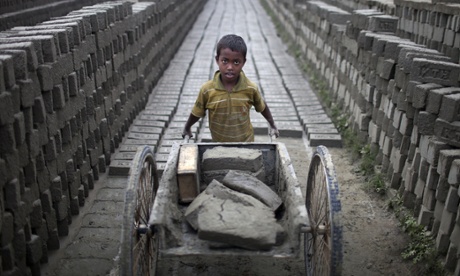
Children are affected in global supply chains in significant ways. More than 168 million children worldwide are engaged in child labour. The sectors in which they often work – such as agriculture, services and manufacturing – can have direct links to the supply chains of multinational companies.
Beyond child labour, however, there is a range of other direct and indirect impacts on children that often receive less attention. Globally, women account for the majority of workers in labour intensive manufacturing industries. In many countries, childcare responsibilities conventionally rest with women, and poor working conditions and lack of maternity rights can therefore directly affect their children’s lives and wellbeing.
While the past decade has seen significant progress on child labour, companies too often fail to understand the range of other ways in which children are affected in supply chains. Crucial aspects such as living wages, length and flexibility of working hours, provisions for breastfeeding and pregnant women, family health care, special needs of migrant workers, parental leave, and childcare facilities rarely feature in supplier codes of conduct and auditing frameworks.
Towards good practice
Addressing children’s rights in supply chains can seem daunting. As more and more countries integrate into the global economy, supply chains can stretch to virtually all parts of the world. In light of their limited control over business partners, what can companies do to promote respect and support for children’s rights in their sourcing activities?
The Children’s Rights and Business principles call on companies to act with human rights due diligence to safeguard the interests of children. They also articulate measures companies are encouraged to take to help support and advance children’s rights.
Human rights due diligence, as outlined by the United Nations Guiding Principles (UNGP), requires the assessment of impacts, implementation of mitigation steps, and monitoring and reporting of progress across the full spectrum of human rights, including those of children. Both the UNGP and the Children’s Rights and Business principles stress that human rights due diligence applies to business relationships in supply chains, and is not limited to a company’s own operations.
Identifying risks to children and understanding impacts on their lives in supply chains is a crucial first step for companies to implement informed mitigation measures. Some companies have already started this process.
Millicom, for example, a global telecommunications company, undertook an assessment of the risks to children in its supply and distribution networks in one of its operating countries. Using a tool developed by UNICEF and the Danish Institute for Human Rights, the assessment included how working conditions for employees affect their children.
Marshalls, a natural stone manufacturer, has teamed up with UNICEFto undertake research in the Indian stone quarrying sector to tackle child labour and create sustainable change for children.
Assessing the range of actual and potential impacts on children needs to go beyond the obvious interactions to be effective. A study by Oxfam and the Ethical Tea Partnership concluded that the lack of childcare facilities in Indian tea estates can force daughters of plantation workers to forego education because they have to look after their younger siblings. Efforts to promote education are therefore unlikely to be successful if they are not accompanied by investment in childcare.
Crucially, tackling the systemic causes that underlie children’s rights violations necessitates a review of a company’s own policies and practices. The impact of living wages and fair purchasing practices can be as important as voluntary contributions to health and education. Companies also have an important role to play in using their leverage and influence to build supplier capacity and reinforce community and government efforts to protect and fulfil children’s rights.
UNICEF’s work with the private sector
UNICEF has a long history of global action (pdf) on child labour in the context of business supply chains. Their partnership with Ikea, for example, began over a decade ago and supported the development of the Ikea Code of Conduct on child labour. It also included a comprehensive programme to address child labour in carpet production in India.
Building on this work, UNICEF will launch a set of innovative projects in 2015 to further promote respect and support for children’s rights in global supply chains. With pilot projects in the agriculture and manufacturing sectors, this work will draw on existing experience and concentrate on the development and testing of innovative concepts and solutions with industry leaders, workers’ organisations, civil society and governments.
In Bangladesh, for example, UNICEF has been working with several corporate partners on a range of issues such as health, nutrition and education. UNICEFis now engaging global fashion retailers and local factories to collaboratively identify and respond to the wide spectrum of adverse impacts of the ready-made garment sector on children – from exploitative working conditions for parents, to the provision of fundamental services in urban slum communities that have grown with and around the factories.
Tackling complex challenges in supply chains requires concerted efforts that empower affected individuals and communities at the local level where adverse impacts occur. By integrating children’s rights into their sustainability frameworks – and developing collaborative solutions with key stakeholders – companies can play a major role in building sustainable supply chains and improving outcomes for children.
Subajini Jayasekaran and Chris Kip work in the corporate social responsibility team at UNICEF and lead the work on children’s rights in global supply chains
More from the UNICEF partner zone:
- The dos and don’ts for business when designing products and services for children - infograph
- Should marketing and advertising to youth via social media be allowed?
- What would you like to say to companies engaging in unethical business practises?
Content on this page is paid for and provided by UNICEF, sponsor of the children’s rights and business hub