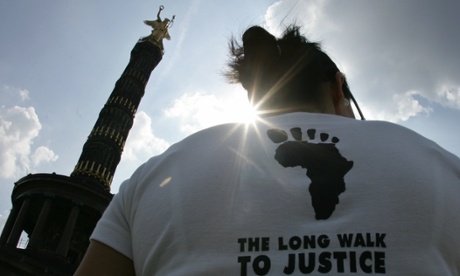
This weekend’s G7 will mark the 10th anniversary of the 2005 Gleneagles G8 summit – a moment that, in retrospect, seems to belong to another age, when progress was possible on a whole different scale.
Back then, more than a dozen countries committed to timetables for spending 0.7% of national income on aid; a landmark deal on multilateral debt relief was secured; a “development round” for trade still seemed possible.
Today, by contrast, it feels as if we’re fiddling around on the edges – look, for instance, at the dim prospects for the finance for development summit in Addis Ababa in July.
What’s gone wrong? It’s partly the continuing fallout of the financial crisis, of course; partly the rise of a more multipolar world and its accompanying “G-zero” dynamic. But perhaps most of all, the intensity of demands for change from ordinary people has waned.
This weekend, an estimated 20,000 people will march in Munich to press the G7 to act on poverty and development. Hardly a number to be sniffed at – but only half the number of people who turned out for the IF campaign in London in 2013, and a small fraction of the number who rallied for Make Poverty History in 2005.
The starkest contrast of all, though, is between the state of development activism on the one hand, and climate activism on the other. Last year’s climate march in New York attracted a staggering 400,000 marchers. Nor was this a one-off; seemingly every week, another large investor capitulates to demands to divest from fossil fuel investments – Oxford University, the Church of England, the French insurance giant Axa, Norway’s gargantuan sovereign wealth fund.
In part, successes today are based on learning from mistakes in the past. In 2009, US-based climate NGOs were stunned by the failure to secure legislation to cap emissions, a win they had assumed was a done deal once it cleared the House of Representatives. In retrospect, they realised their key mistake had been to focus on insider lobbying, whereas their opponents in the Tea Party had focused on building a movement.
Five years on, climate activists are beating the Tea Party at their own game.
To start with, they’ve finally found a story that really resonates. Back in 2009, their messages were technocratic, fact-based, and uninspiring – in stark contrast to the Tea Party’s fiery rhetoric. Now, by contrast, activists are framing climate as a moral issue – a shift that David Roberts explored in detail a few weeks ago in a must-read essay.
Development activists have much to learn here, especially given the acutely technocratic tone of the UN’s sustainable development goals agenda. As I’ve argued elsewhere, the scope of the SDGs is right, but the framing is dreadful. We need a much more resonant storyline if we want to fire people up: one that speaks of a larger us, a longer future, a different good life.
Second, the climate movement has realised that big mobilisations are built out of small groups. Just as the Tea Party is built around local chapters, and just as Barack Obama’s 2008 presidential campaign was built around clusters of activists all over the country, so the US climate divestment movement is rooted in groups of college students across the US.
The development movement used to do this much more than it does today. It was church congregations that provided the real backbone of Jubilee 2000 and Make Poverty History. Nowadays, by comparison, it sometimes feels as though we’ve become too reliant on celebrities to fire us up, and have forgotten about the need to invest in the grassroots.
This leads on to a third point: the power of faith. Progressive activists are often strongly secular in their instincts: as Alastair Campbell put it, we don’t do God. Yet, this is to overlook the extent to which faith groups have been central to so many of the biggest victories of progressive politics: the US civil rights movement, for example, or the abolition of slavery.
And this is another thing the climate movement is getting right. Pope Francis – who will publish a papal encyclical on climate change any day now – is emerging as the world’s most important advocate of radical action to save creation from our ignorance. US climate sceptics are, rightly, terrified.
Fourth, the climate movement knows what it wants. Unlike (say) the Occupy movement, the climate movement has clear, actionable demands – above all, in its call for a global carbon budget that recognises the reality that we can’t burn all the fossil fuels in the ground and still keep to 2 degrees.
At Gleneagles, the development movement knew exactly what it wanted: more and better aid, fair trade, and full debt relief. Today, its demands are much less clear.
Fifth and finally, the climate movement is playing a long game. As Rich Gower and I noted in a recent report we wrote for Tearfund, “political and social change doesn’t unfold in a steady, linear fashion … There is often a long period when our efforts seem to yield few results [but] then comes a tipping point, after which events snowball and things suddenly start to fall into place.”
This is now happening right in front of us on fossil fuel divestment. If development activists want to achieve a similar breakthrough, we too will need to think much more in terms of five- to 10-year change processes – and start now to prepare for where we want to get to in 2020.
Above all, though, what we need is for the climate and development movements to join forces. There is no realistic scenario in which we successfully address climate while ignoring development, or vice versa. So the movement we really need isn’t a climate movement, or a development movement, but a movement that demands a different way of organising our economy – ensuring that we live within environmental limits, that inequality is kept within reasonable limits – and that everyone is able to meet their basic needs.