Jeremy Corbyn has been making yet another provocative comment about Irish republicanism. Now, according to reports at the weekend, he wants to put up a memorial to a violent republican.
Outrageous … no, wait a moment.
It may have been slightly off the point for the new Labour leader to tell his party’s women’s conference that he plans to put up a plaque in his constituency to Britain’s first woman MP, Constance Markievicz – who was in Holloway prison when she was elected to parliament in 1918. But for right-wing papers to claim that her involvement in the 1916 Easter Rising in Dublin makes her, 99 years on, a scandalous icon of violence is ludicrous.
In those turbulent times when revolution and war were shaking the world, Markievicz narrowly escaped execution for taking part in the Easter Rising. Now some British papers are holding her involvement in it against Corbyn. What’s next? “Labour leader defends kingslayer Cromwell?”
It has given me an idea. Put up a plaque to Markievicz by all means. But what Britain really needs is a big memorial to the Easter Rising itself.
The British Museum’s exhibition Celts includes a section on how a statue of the dying Celtic hero Cuchulain was put up outside the Dublin General Post Office to commemorate the martyrs of the 1916 Rising. Perhaps Britain too should use a Celtic motif for a monument to this rebellion aginst British rule. Or perhaps it should be an abstract plinth bearing a quotation from WB Yeats’s poem Easter, 1916: “Too long a sacrifice / Can make a stone of the heart.”
Memorials are all too often put up to commemorate our own and enshrine a self-serving view of history. The Vietnam veterans memorial in Washington, DC only lists Americans who died in the Vietnam war. The poppy display at the Tower of London only commemorated British and Commonwealth deaths in the first world war, as if Germany were still our enemy 100 years later.
1916 is too important to be left to parochial nostalgia. The Irish government is well aware of this. It is very keen to ensure that the inevitably huge commemorations of the Easter Rising in Ireland in 2016 will pay appropriate respect to British soldiers who were killed.
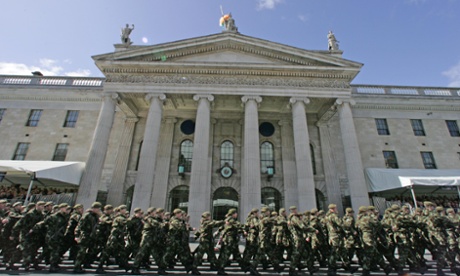
At the same time, a parade will go past the General Post Office in Dublin where the fighting was centred and schools in Ireland will study 1916 just as British schools last year studied 1914. And quite rightly. 1916 was an event that has come to be seen as the symbolic birth of modern Ireland. It is a cherished moment in the history of a great European nation and deserves to be remembered and debated as such.
What could be a better gesture from Britain to mark this centenary than a monument to the Irish revolutionaries and British soldiers who died in the Easter Rising? Such a memorial would acknowledge our own tangled history and help to put the bitterness of the past where it belongs: in the history books.
It seems incredible that British newspapers in 2015 can be raking up 1916 as if it were a shameful, scandalous crime, as if the defining moment of modern Ireland were no more honourable than atrocities carried out much later by the IRA. Those were different times. To demonise the Easter Rising is to demonise Irish nationhood itself.
This is very disturbing. There has been a peace process in Northern Ireland. Memory and forgiveness are at stake in that peace process. If Britain plays politics with Irish history it risks resurrecting some of the longest and darkest of memories. We need to keep healing the old wounds, not scratch at them. That goes for the hard left too, with its student romanticism about terrorists.
A memorial does not have to be a preserver of old grudges. It can be a way of burying them.
This is complicated. The Irish government reportedly rejected an offer for a senior member of the royal family to attend the Easter Rising commemorations next year. Ireland cannot, however, stop Britain putting up a memorial to that important moment in both our histories.
Who on earth in the whole of Great Britain still nurses a grudge against the Easter Rising? What British visitor to Dublin is not a little stirred by a visit to the GPO? Irish history needs to have the poison sucked out of it.
Let’s put up a stone to 1916, not make stones of our hearts.