In the classic 1950s sci-fi serial Quatermass and the Pit (written for the BBC by Nigel Kneale and later remade as a brilliantly lurid Hammer film), a London building site starts turning up prehistoric skulls that lead to a foul encounter with humanity's dark nature. In the original television programmes, the setting is explicitly postwar, with builders working on a West End bomb site.
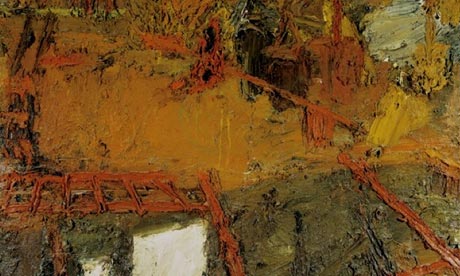
Painter Frank Auerbach gazed at those same huge construction sites in the late 1950s and early 1960s, as bright new modern buildings went up to replace those destroyed in the war. Most spectacularly of all, he painted the huge tangle of red earth and brown girders where the John Lewis departmant store, bombed out in the blitz, was being rebuilt on Oxford Street. And like Kneale's troubled hero, he saw something terrible as he gazed into the pit.
Auerbach's London Building Sites, on view in a compelling exhibition at the Courtauld Gallery, record a city in transition, about to burst from its drab cocoon into the modernity of swinging London. At least, that's how someone else might have seen it, as clean new technocratic architecture rose up to replace old Victorian buildings destroyed by Hitler. But Auerbach's matted, moist, dank and rusted imagination dwells not on the new and the optimistic, but on the startling voids and archaeological excavations of the deep-dug foundations: his eye goes down there, into the mud, the primaeval clay, the ancient London revealed by the builder's preparations. Over the depths hang girders, red as scars.
There is one building site that arrested me in the way these paintings do – and it was Ground Zero in New York. There's a force of rage and memory in Auerbach's paintings, a vision of modern life as a churning, changing and sublimely destructive life force. They are like TS Eliot's image of new life as pain in The Wasteland: "April is the cruellest month ..."