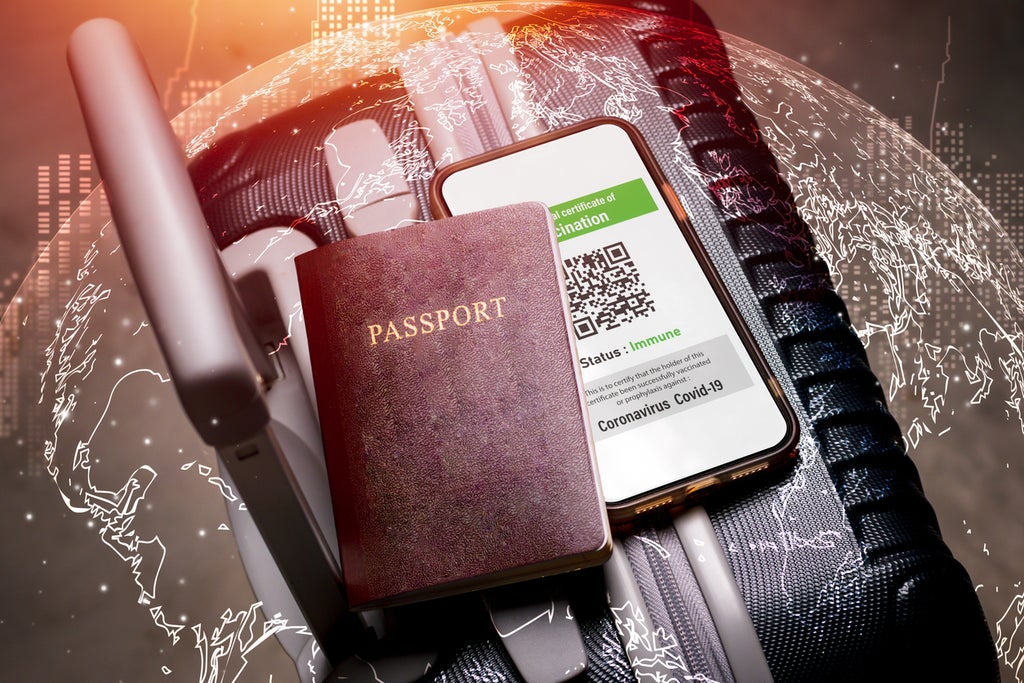
With the scrapping and reintroduction of red lists, PCR tests, lateral flow tests and self-isolation at various points during the last six months, it’s been tough to keep track of the UK’s fluctuating travel rules.
And the line-up has changed once again, following the government’s announcement that it would end all travel testing for fully vaccinated visitors from 11 February.
Transport secretary Grant Shapps called it “a landmark moment for international travel”, saying: “After nearly two years of necessary but complex travel arrangements these changes will make it cheaper and easier for families to travel, taking advantage of the UK’s high levels of vaccination, and keeping us all safe.”
But do vaccinated travellers still need a Passenger Locator Form (PLF), and are there any other surprising bits of admin that might trip us up?
Here’s everything you need to know for travel from 11 February onwards.
Do vaccinated travellers need a Covid test to leave and enter the UK?
The big change is that, from 4am on 11 February, fully vaccinated travellers arriving into the UK no longer need to do a “day two” Covid test. Previously, they had needed to book this before departing for the UK, including a valid order reference number on the PLF.
Those who have had two doses of a recognised vaccine (with the second dose administered at least 14 days prior) will no longer need this test. Vaccinated travellers have also not needed a pre-departure Covid test (before your flight to the UK) since 7 January.
As for testing before your holiday, that is specific to your destination. Many places, such as Dubai, Sri Lanka and Mauritius, require a negative result from a PCR test taken in the two or three days before you travel.
Others, such as the US, will allow a lateral flow test instead of a PCR for vaccinated travellers, but give a shorter time frame (the US’s is 24 hours).
Meanwhile, countries including Spain and Greece are allowing fully vaccinated visitors in without any testing restrictions, requiring only a local health form.
Do vaccinated travellers need a Passenger Locator Form?
Yes. But the lengthy form – which has been widely condemned as cumbersome and confusing – has been slightly simplified for double-jabbed visitors.
Earlier this week, The Independent reported that all British travellers were still being advised to get Covid tests after arrival, even when they’d be entering the UK on or after 11 February, from when the requirement is being scrapped for those who are fully vaccinated.
However, the Department for Transport (DFT) yesterday promised “a simplified Passenger Locator Form (PLF)... ahead of half term”.
Today the form has been slightly simplified, but remains time-consuming at 20 pages long.
Vaccinated travellers must fill in a PLF within the 48 hours before departure for the UK. You’ll need your flight details, passport details, arrival time, destination address and details of any transit destinations or places you’ve visited in the 10 days before your arrival.
Are the travel rules likely to change again for vaccinated people?
Testing rules had previously been simplified last autumn, between the Delta variant of Covid-19 spiking cases in the UK and the arrival of the Omicron variant.
This shows that rules can change at short notice. However, ministers have mentioned “learning to live with Covid-19” amid the current relaxation of rules, including the end of the “Plan B” guidance given during winter.
There is a chance that testing could be reintroduced for vaccinated people if a concerning new variant is detected in the UK or elsewhere, with some experts pointing to the importance of genomic sequencing using PCR tests. More likely is that countries abroad may be added to the red list - currently empty, but kept on standby in case of new variants.
Ministers have indicated that they are hoping to replace hotel quarantine with at-home isolation in the case of countries being re-added to the red list.
Simon Calder, travel correspondent of The Independent, said: “Recent history tells us that rules are subject to sudden change in ways that do not necessarily correlate with circumstances. For example, in mid-March 2020, the UK suddenly lifted all restrictions on international arrivals. Then in June – as infection rates were falling and other countries were opening up – ministers imposed blanket quarantine for all arrivals.
“In addition, we have previously had assurances about opening up from the transport secretary – most notably last October – only to be followed a month later with the return of PCRs and pre-departure tests, plus mandatory quarantine.
“This time, though, things might be different. The positive change, of course, would be to remove the Passenger Locator Form. But bureaucracy has had a good crisis, and history also tells us that governments are quick to impose red tape but slow to take it away.”