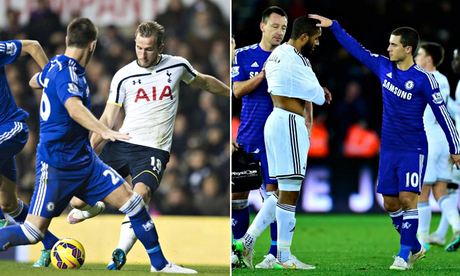
“Recently Chelsea conceded five goals in one match (5-3 defeat to Spurs) and then scored five goals against Swansea (a 5-0 victory). Has any team ever bettered this turnaround by conceding then scoring six or seven, etc?” asked Michael McCarthy last week.
Well, Chelsea’s two results weren’t back-to-back, as they beat Watford 3-0 in the FA Cup and then Newcastle 2-0 in the league in between. But, for keeping things interesting’s sake, let’s pretend that they were.
As a number of you have pointed out, the easiest place to start is the festive period in 1963, when that year’s wheeze was to play a round of fixtures on Boxing Day, then the reverse games two days later. Therefore, we were presented with a number of dramatic turnarounds, notably by Manchester United who travelled to Turf Moor on the 26th and were given a sound paddling by Burnley – Paddy Crerand sent off in a 6-1 win for the Clarets – and when the teams gathered again at Old Trafford shortly afterwards, United gained revenge by skipping to a 5-1 victory.
Elsewhere there were some even more dramatic turnarounds, as Fulham handed out a fearsome hiding to Ipswich on Boxing Day, beating Jackie Milburn’s East Anglian shambles 10-1, with hat-tricks for Graham Leggatt (in four frantic first-half minutes) and Bobby Howfield. However, in the return game the Tractor Boys exacted some small revenge, beating Fulham 4-2, but ultimately it didn’t do them that much good – they finished the season bottom of the table, shipping 121 goals in the process, helped along by 7-2, 6-0 (three times), 9-1 and 6-3 defeats, a humiliation made all the more remarkable considering many of the team had won the title under Alf Ramsey a couple of years earlier.
West Ham managed an impressive turnaround of their own, after having their bottoms handed to them in the shape of an 8-2 embarrassment at home to Blackburn: Fred Pickering and Andy McEvoy helping themselves to trebles, before the return fixture saw the Hammers haul things back with a 3-1 victory at Ewood Park.
Charbel Boujaoude writes: “I would like to mention that bigger turnarounds are aplenty, especially in the early days of the game. A prime example comes from Manchester United’s first season in the Football League, when they were called Newton Heath. On 31 December 1892, they thrashed Derby County 7-1. A week later, they turned up at Stoke City with only 10 men, their goalie having missed the train. The scoreline was reversed - they lost 1-7.”
Jeff Lawrence has a tale from Middlesbrough in 1998: “Against Nottingham Forest on 1 March 1998, Andy Dibble made his second debut for the club, due to an injury to first-choice Mark Schwarzer … we were top at the time, three points and +3 goal difference ahead of Forest in second place but were overtaken thanks to Forest’s 4-0 victory. In our next game, three days later, we were away to QPR who were only four points from the relegation zone at the time. This time we lost 5-0 meaning Dibble had conceded nine goals in two games. He would never play for us again as Schwarzer was fit again for the visit of Steve McMahon’s Swindon Town to the Riverside on 11 March.
“By this time we had dropped to third place as Sunderland had also overtaken us. We were now three points and -5 goal difference behind Forest who were top and this was our game in hand on them. A 5-0 win would return us to first place. We went one better thanks to braces from Marco Branca (his second, and our sixth, being a superb overhead kick), Alun Armstrong and Neil Maddison (who scored another cracker, chesting it down and volleying it in from 25 yards). We ended up getting promoted thanks to finishing in second place, behind Forest but ahead of Sunderland.”
Anyone got any better turnarounds?
FOOTBALLING VANS (PART TWO)
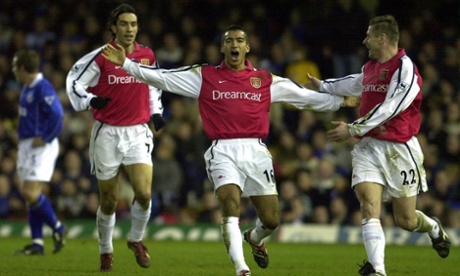
On the few occasions The Knowledge slips, we can always rely on you, our splendid public, to set us right. So when last week we published what we thought was a comprehensive list of all the ‘Vans’ to have played in the Premier League, we were set right in the most emphatic terms by our readers. David Hopkins points out that Mr Robin van der Laan played for Derby County, Dave Lawrence alerts us to the omission of Southampton’s Ulrich van Gobbel (“Appropriately, he was actually the size of a van,” notes Dave. “A large one.”), Linus Turner plays with the notion that Anthony Vanden Borre should be allowed in, while many of you pointed out the glaring omission of Giovanni van Bronckhorst from our list.
Finally, a correction from Linus Turner, who takes issue with the inclusion of one ‘Van’ in our list, namely Dennis van Wijk. Linus writes: “I’ll admit to having to look up the finer details but, after playing in, giving away a penalty (which was saved) and then going home with a winner’s medal in the 1985 Milk Cup final, he added a Division Two champions’ medal to the collection in 1986 and then left for Club Brugge that summer. So … he left six years before the money years of the Premier League arrived.”
A CERTAIN RATIO
“My team, Aston Villa, have scored just 11 goals this season in 23 games but they also have 22 points from those games,” said Conor Thompson last week. “Has any team ever posted a greater points-per-goal ratio?”
A dip into the Knowledge archives helps us out here, as in 2009/10 Aduana Stars waltzed off with the Ghanian Premier League having found the net a measly 19 times in 30 games, amassing 53 points in the process. That means, as fans of maths will tell you, while Villa currently have a shade over two points for every goal scored, the Stars took home 2.79 points for the piffling number of occasions they found the net. Also, Senegal’s top-division title was lifted by goal-shy Jeanne d’Arc in 2000/01, who gathered 47 points from 26 games while scoring just 22 goals – an average of 2.1 points for every goal. That season was notable for every team in the division scoring less than a goal a game, with Jeanne d’Arc actually the second-top scorers of the 14 teams.
With another suggestion, Anders Rokstad writes: “It’s actually quite easy to amass points even with few goals scored as long as you don’t concede. And if you use today’s system of three points for a win, Rosenborg’s 1970 record of 34 points (10-4-4) from 15 goals would beat the Villa team of today when it comes to maximising the value of each goal. If you check the fixtures you will see that every time a team scored in a Rosenborg match they won the match. None of their matches saw both teams scoring! And just to prove Bob Dylan right about the whole changing thing: from April of 1994 to May of 1996 Rosenborg scored in 53 consecutive league games.”
FAMILIARITY BREEDS CONTEMPT
“What is the maximum number of times one Premier League team can play another in the same season?” asks Richard Shaffer.
Now, The Knowledge is nothing if not fallible, so we like to answer questions like this to deliberately trip ourselves up, because inevitably we’ll work it out then someone will point something out we’ve missed. So, assuming we keep it to full games (no abandoned then rearranged encounters) and exclude pre-season friendlies but include the Community Shield (slightly arbitrary but go with it), we think the answer is 11. Probably. But it might be 12. We’re also ruling out the very slight possibility of the Club World Cup being held in England and featuring an English Champions League-winning club and a different English side, since the tournament rules allow for a host nation team.
The potential encounters are: the Community Shield, two league games, an FA Cup tie plus a replay, the two-legged League Cup semi-final, a two-legged European encounter of some description, the European Super Cup and, should the two teams finish absolutely level in a significant league position (to determine relegation, the title etc), a one-game play-off.
This is slightly complicated by the Premier League rule C.17 regarding such a playoff, which states that should two teams finish level ‘on points, goal difference and goals scored, the Clubs concerned shall play off one or more deciding League Matches on neutral grounds, the format, timing and venue of which shall be determined by the Board.’ The Premier League press office confirmed that the wording of that rule is deliberately ambiguous so as to provide some wiggle room for any other unusual circumstance, so technically it could be a play-off with a replay, although one would assume it would be a single game that went to extra-time and penalties, should they be required. So, with that in mind, the answer is 11. Probably. But it might be 12.
Who fancies picking holes in that one?
KNOWLEDGE ARCHIVE
“Is there any evidence that awarding three points for a win has made the game more exciting? Are there less draws than before the change? Would any English championships have been decided differently under the old system?” asked Stuart McGill way, way, way back in 2001.
In 1980-1, the final year the English league used the old two-point system, there were 118 draws in the old First Division. The next year, with the new system introduced, there were 121.
Perhaps they just needed to get used to it. What about the 1994-95 Premiership table, the last time the same number of matches were played? Er, 134 draws.
Whether this is more exciting or not is entirely up to you. But changing the points system made no difference to the destination of any championships post 1982.
However in the 1974-75 season three points for a win would have made a difference. That season Derby County came top with 53 points, ahead of Liverpool and Ipswich with 51. But as Neil Emms points out, Ipswich won 23 games, compared to 21 for Derby and 20 to Liverpool, and under the three points for a win system Bobby Robson’s men would have won the title on goal difference, after finishing level on 74 points with Derby.
CAN YOU HELP?
“I wonder if you could help me out with a query,” asks a very polite Adam Berry. “Since winning on 14 September 1963 (2-1 with goals from Martin Peters and Geoff Hurst) when The Beatles’ She Loves You topped the charts, my team, West Ham, have played Liverpool at Anfield in the league 42 times without winning. Is this a record bogey game? Have any other teams got a worse record at any particular ground?”
“I remember Roy Keane giving up booze in order to prolong his footballing career,” says Jonathan Mare. “But who are other footballers who don’t drink? Or more to the point, what would the best Teetotal XI be? Robert Lewandowski refuses to drink. I think Wenger doesn’t either. So I’ve set up your striker and coach, please fill in the rest.”
“Watching the successful Oscar-bait pic The Theory Of Everything,” writes James Tong, hopefully after having left the cinema. “I was surprised to see World Cup winning defender Frank Leboeuf make a short cameo. As the film received a Best Picture nomination at the Academy Awards, could he be the first footballer to have been part of World Cup winning and Oscar winning teams? Have any other footballers been part of Oscar winning films?”
Send your questions and answers to knowledge@theguardian.com