I love the classic stories but I’ve read most of them already and some of them are a bit too old-fashioned both in the writing and the attitudes of the characters! What do you think are the best sequels and modern retellings of classic children’s books?
Many children’s authors have been inspired to become writers because they so loved reading as children. In fact, all writers say that the best preparation for becoming a writer is to be a good reader. And most can trace the inspirations for their own writing back to a single author.
Piers Torday, winner of the Guardian Children’s fiction prize for The Dark Wild, has cited CS Lewis’s The Chronicles of Narnia novels as a major influence on him because in Lewis’s childhood writing he created a world of talking animals – as Pier’s does in his Wild sequence of stories.
Philip Pullman has frequently said that all writers steal things – just as magpies do. In an interview in the Guardian he said: “I think my dæmon is probably a raven or a rook or a magpie – one of the birds of that family – because she steals things, like ideas for stories, and images, and phrases.”
Being influenced by a story and thieving bits out of it is one way on which authors write books which may relate to the classic stories written by a previous generation. But there are also excellent examples of more direct sequels.
Typically, these books use the same basic idea and then retell it in a modern world with a different set of challenges and opportunities. And there have to be changes to the characters too as no one behaves quite the same today as they would have done one hundred years ago!
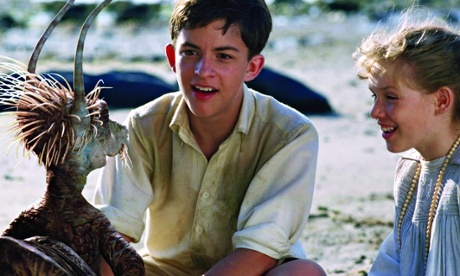
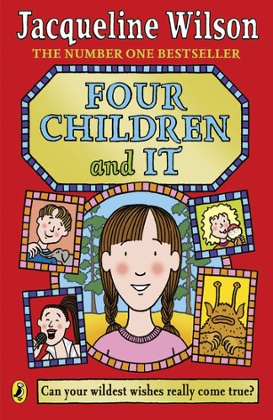
E Nesbit’s Five Children and It was first published in 1902. The story of how a family of children discover a Psammead – a grumpy sand fairy who grants them wishes many of which go horribly wrong – was a success when it was first published and has been popular ever since. As a child, Jacqueline Wilson loved both the magic of the story and Robert, Anthea, Cyril, Jane and their baby brother who is always known as the Lamb , the children whose lives were so enhanced by the magical adventures. As a sequel to it, or a tribute to the kind of story it is, Jacqueline Wilson wrote Four Children and It. Still infused with magic – and with a grumpy creature whose interpretation of wishes is a lot more literal than the children’s own – it features a typically Wilson blended family for whom the magic may be very helpful! Jacqueline Wilson’s familiar realism is brilliantly enhanced by this spoonful of magic.
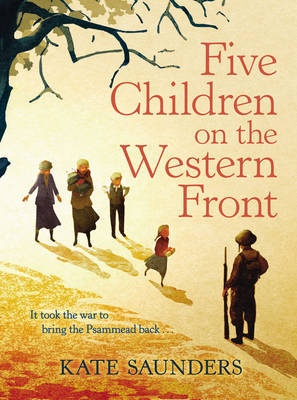
But sequels can take all kinds of direction and Kate Saunders’s Five Children on the Western Front is a completely different kind of “what happens next”. Kate Saunders cleverly keeps to the spirit of the story while also repositioning it during the first world war. In a deeply moving and thought- provoking story she imagines what would have happened to the original children during the war. The Psammead still plays a role and the magic is important but it is the family of children and what happens to them during the first world war that makes this such a wonderful tribute to the original while also providing a welcome way back to E Nesbit’s original characters.
The story of Alice, the girl who falls down the rabbit hole in Lewis Carroll’s classic Alice’s Adventures in Wonderland has inspired writers and illustrators for 150 years. Recently, best-selling Cathy Cassidy’s Looking Glass Girl has drawn on some of the ideas from Carroll’s original in a realistic contemporary story about friendship and the insidious nature of bullying. Her Alice is at a sleepover when she falls down the stairs and hits her head very hard on a mirror. Lying in a hospital bed in a coma following the accident Alice and the so-called friends she was with consider what really happened. Can Alice’s accident help to prevent bullying in the future?
The American classic What Katy Did by Susan Coolidge tells of bright, lively 12-year-old Katy, a free-spirited girl who dreams of doing something “grand” with her life. But, instead of achieving all she hopes for, Katy has a terrible accident which confines her to a wheelchair. Katy is humbled by the experience and learns to be “good” as a result of it. Written in 1872, the deliberately “improving” ending which denies Katy the happiness readers would love her to have has made the book out of step with contemporary fiction and therefore less popular than it might have been given what a feisty girl Katy is at the beginning of the story.
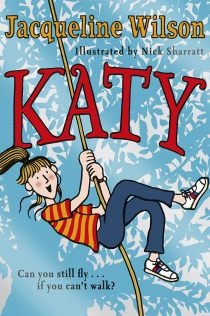
Jacqueline Wilson’s Katy (published at the end of July) is an excellent updating in which a very contemporary Katy, a girl living in a familiar Jacqueline Wilson family, has a similar kind of accident but the effect of it on her and everyone else is very different. Katy is a fine tribute to the original but also a story with something important to say about disability.
Which classics sequels and retellings would you recommend? Which classics need to be retold? Email childrens.books@theguardian.com or get in touch on Twitter @GdnchildrensBks( where you can also ask The Book Doctor a question using #BookDoctor) and we’ll your thoughts this blog!
@GdnChildrensBks The Railway Children could be an incredible basis for a modern-day story- especially if in a more urban setting
— Rebecca Bedding (@MiloAndAlice) July 20, 2015