A day after Iranian Supreme Leader Ayatollah Ali Khamenei was confirmed killed in joint US-Israel strikes, Iran hit back hard. American jets crashed in Kuwait. Saudi Aramco's oil facilities were struck. Missiles and drones swept across Bahrain, Saudi Arabia, Qatar, the UAE, Iraq, and Israel.
The death toll though is the highest in Iran, estimated to be at least 500, apart from 31 in Lebanon, nine in Israel, three American soldiers.
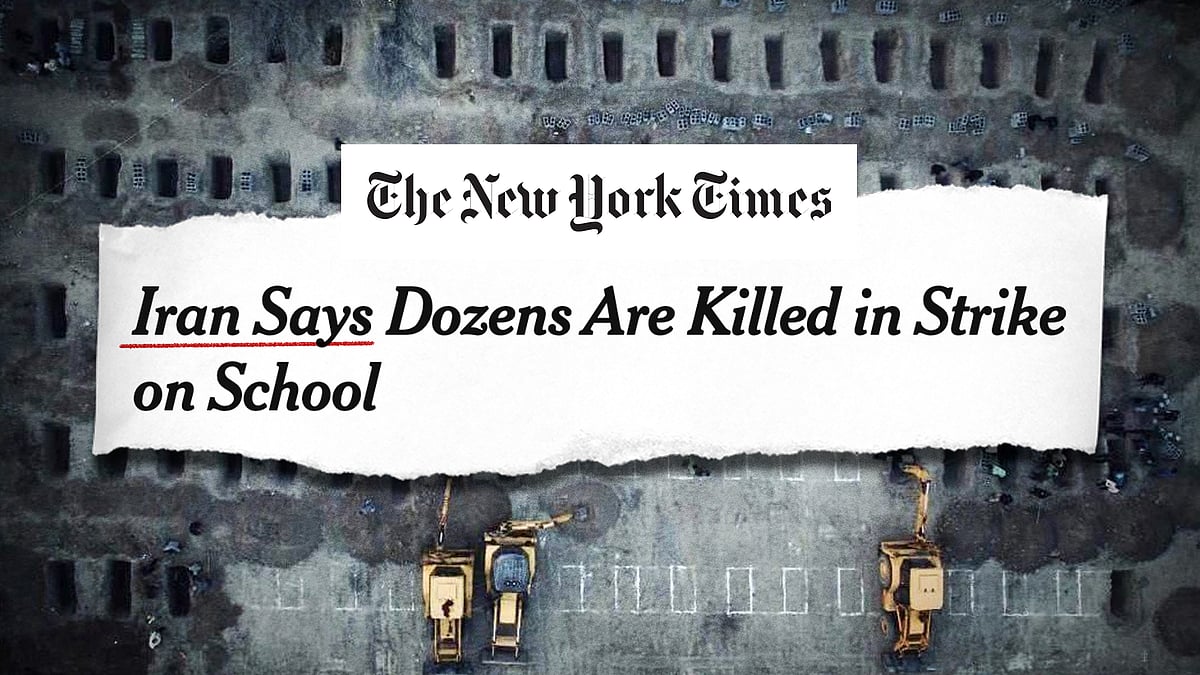
Among the dead: 165 people – most of them girls – killed when an Israeli strike hit an elementary school in Minab, a city in Iran’s Hormozgan province, according to Iranian state media.
And yet, if you were watching Western media outlets, you might have missed who did it.
CNN’s headline on the Minab school attack declined to name Israel as the perpetrator. Its headline on an Iranian missile strike on a residential building in Israel did not extend the same courtesy to Iran – the actor was named, no ambiguity introduced.
The New York Times, meanwhile, stated Iranian casualties as fact when Iran was the actor, but hedged and omitted the perpetrator when Israel was responsible.
The difference is by design. pic.twitter.com/LXarH4zypK
— Assal Rad (@AssalRad) March 2, 2026
Cnn pic.twitter.com/dH4Px3ZU0b
— Qamar Alam (@AlamQamar4493) March 2, 2026
Sky News, covering an Iranian missile that destroyed a synagogue in Beit Shemesh, produced this headline: “The horror story at Beit Shemesh where an Iranian missile evaded Israel's formidable defences.” One waited in vain for similar language about Palestinians in Gaza, who had no defences – formidable or otherwise – against Israel's bombardment.
The BBC gives a leading headline to nine people killed in Israel, while the 148 children killed in Iran remain what they were yesterday, a second-order story lower down the page. pic.twitter.com/BFKooR6hS7
— Media Lens (@medialens) March 1, 2026
The death of 3 US soldiers is in the top headline on the #BBC news website. The death of 153 Iranian schoolchildren is only in the fifth headline. This suggests some very screwed-up priorities.
— Symon Hill (@SymonHill) March 1, 2026
The BBC offered its own variation. When weighing the deaths of three American soldiers against the deaths of 165 Iranian schoolchildren, it was the soldiers who led. Journalist Symon Hill flagged the disparity online.
Also on the BBC, correspondent Clive Myrie, reporting from Tel Aviv, described the US and Israel as forces that “seek to transform Iran”. Jonathan K Cook, a Bristol-based media critic, put the question plainly: could Russia's invasion of Ukraine ever have been described as an effort to “transform Ukraine”? The answer, of course, is no. That framing was reserved for aggressors the West preferred not to name as such.
Remember the western media's constant refrain that Russia's invasion of Ukraine was "unprovoked" – despite years of documented western provocations.
— Jonathan Cook (@Jonathan_K_Cook) March 1, 2026
Iran did nothing to provoke the Israeli-US attack. Yet notice this: not one media outlet has described the attack as "unprovoked"
Cook also raised a more pointed observation: “Remember the western media's constant refrain that Russia’s invasion of Ukraine was ‘unprovoked’ – despite years of documented western provocations. Iran did nothing to provoke the Israeli-US attack. Yet notice this: not one legacy media outlet has described the attack as “unprovoked”.
2025, and the same old propaganda! A 1995 NYT headline warned Iran might build a bomb in 5 years. Decades later, same fearmongering persists. Time to question these recycled narratives. #Iran #Propaganda #MediaBias pic.twitter.com/L3c4vg5JUU
— Yasir Saeed (@yasirsaeed600) June 14, 2025
The fearmongering around Iran’s nuclear programme, it should be noted, has a long pedigree.
A 1995 New York Times headline warned that Iran might build a bomb within five years. The anxiety has been renewed and recycled in various proportions – a floating threat, always imminent, perpetually five years away.
What Bari Weiss has done with the 60 Minutes: Iran has no nuclear weapons, this isn’t something the US or Netanyahu himself even claim. It’s a total fabrication, causally thrown in there by the most trusted name in news. A bargain for the Ellison family at only 2% their net worth https://t.co/MijkOxufgQ pic.twitter.com/5yaTWJOl0x
— Adam Johnson (@adamjohnsonCHI) March 2, 2026
Meanwhile, on CBS, Reza Pahlavi – the former crown prince of Iran – sat down with reporter Scott Pelley to discuss “this pivotal moment for Iran's leadership, whether regime change is coming, and nuclear weapons”. It was a stately, sympathetic platform for a man whose family lost power in a popular revolution 45 years ago.
The choice of guest was not incidental. CBS’s news division has been in the process of being reshaped by Bari Weiss, a former conservative opinion writer and editor for the New York Times and Wall Street Journal, hired last autumn by Paramount's new controlling owner David Ellison amid renewed pressure from the Trump administration.
https://t.co/ecCvDMkzxa pic.twitter.com/aSapjLj1Y5
— Glenn Greenwald (@ggreenwald) March 1, 2026
Sir, we are bombing the shit out of your country: every inch of it. President Trump said this morning that "the bombs will fall everywhere."
— Glenn Greenwald (@ggreenwald) February 28, 2026
What right do you have to attack US military bases near yo that are launching these attacks? WHAT RIGHT DO YOU HAVE TO DO THIS? https://t.co/qtCr36jVOg
CBS reporters on the ground relayed scenes of apparent celebration: Iranians telling them “It’s not ‘death to Israel’ and ‘death to America’. It’s “thank you” and “a new day dawning”. Journalist Glenn Greenwald was quick to post an old New York Times report documenting similar scenes of celebration in Baghdad after American forces reached the capital square. The implication was clear: this is a genre, not a dispatch.
Within America, media champions for a ‘mad king’
There are signs that Trump has no plan.
David Corn wrote in Mother Jones: “Trump, who initiated this attack with Israel without seeking congressional authorization (as the Constitution requires), clearly engaged in little, if any, preparation for what comes following this 'massive' operation, as he termed it…Trump has no plan for Iran. Just blow shit up, kill some people, and hope for the best. It is the war of a Mad King.”
ABC News chief Washington correspondent Jonathan Karl asked Trump in a phone interview on March 1 whether he had insight into what Iran's new leadership might look like. “Yes, we have a very good idea,” Trump said without elaborating. Then, as the conversation continued, his certainty began to dissolve. “The attack was so successful it knocked out most of the candidates,” he told Karl. And then: “It’s not going to be anybody that we were thinking of because they are all dead. Second or third place is dead.”
So: the plan for Iran’s post-war leadership was, in essence, that the plan had been cancelled by the air strikes.
Virginia senator Tim Kaine, writing in the Wall Street Journal, offered context. He traced the full arc of US-Iran relations, including American support for Saddam Hussein during the Iran-Iraq war – a conflict that killed half a million Iranians. He recalled the 2015 nuclear deal, negotiated under Obama with America's European allies, China, and Russia. The first paragraph of that agreement contained a core commitment: “Iran reaffirms that under no circumstances will Iran ever seek, develop or acquire any nuclear weapons.” The deal was working, according to both the parties and the IAEA. Then Trump tore it up in his first term – over the objections of his own secretaries of defense and state – and the two countries returned to hostility.
David Corn’s historical parallel in the Mother Jones piece was apt. The Iraq War – launched by George W Bush, Dick Cheney, and Donald Rumsfeld without a coherent post-invasion plan – resulted in hundreds of thousands of civilian deaths, the rise of ISIS, years of regional instability, and, in a particularly bitter irony, the consolidation of Iranian regional power. If there is a lesson the past 25 years has offered at volume, it is that wars require planning not just for the assault, but for what follows. Trump, characteristically, appears to have skipped that chapter.
On Fox, naturally, a different verdict was delivered. Mark Levin declared Trump a “great president” and “great leader” who would be talked about “for decades and decades, if not centuries”, according to Media Matters for America. Addressing critics, Levin added: “You have to be deaf, dumb, and blind not to understand what they are. In other words, you have to be intentionally trying to undermine our troops and him.”
Trump isn’t starting a war - he’s ending a regime at war with the US & Western Civilization for 47 years. May God rest the souls of the Americans who gave their lives in this noble cause.
— Scott Jennings (@ScottJenningsKY) March 2, 2026
Missiles. Nuclear ambitions. Terrorism. It stops now because Trump had the guts to do it. pic.twitter.com/EWaS6xhTZr
Scott’s not a reporter https://t.co/IFFziADHmA
— Jeremy Barr (@jeremymbarr) February 28, 2026
As criticism of the strikes mounted, CNN pundit Scott Jennings stepped in with a notable piece of advocacy journalism, claiming that “senior Trump Administration officials” had told him that “credible intelligence indicated Iran planned preemptive missile strikes against US military targets in the region, and against civilian targets as well. Failure to act would’ve resulted in mass US casualties”. The Guardian’s media and power reporter Jeremy Barr was quick to note that Jennings is not, in fact, a reporter.
The deeper pattern
Independent journalist Barry Malone, writing in Middle East Eye, went further, tracing the grammar of selective sympathy through the BBC’s Newsnight. On October 9, 2023, Palestinian ambassador Husam Zomlot appeared on the programme having just learned that seven members of his extended family had been killed by Israeli strikes in Gaza. After the briefest acknowledgment of his loss, presenter Kirsty Wark immediately pivoted: "Can I just be clear though? You cannot condone the killing of civilians in Israel, can you? Nor the kidnap of families?"
It was, Malone writes, “a well-worn pattern”. Palestinians were not permitted to speak of their own suffering without first establishing their acceptability. The ritual interrogation – “Do you condemn Hamas?” – preceded any other conversation. And the editorial interjection “But Israel would say” appeared routinely in response to verifiable facts from Palestinian guests, aid workers, and critics of Israeli conduct.
“I have not witnessed any news presenter counter a guest with 'Iran would say' since the protests began,” Malone notes. “Not once. It would be unthinkable”. Compare that, he suggests, to a Newsnight panel convened as war loomed. Trump’s stated pretext – that he wanted to “help” the protesters – was treated earnestly.
A study published by the Al Jazeera Journalism Review noted a similar pattern in the coverage of Afghan and Iranian women versus Gazan women. Western outlets used emotionally charged language – “frightening,” “horror” – for Taliban policies, while the suffering of women in Gaza was often reported without identifying who was responsible, producing what the study called a dehumanising effect through omission.
A paper by scholars Sam Fayyaz and Roozbeh Shirazi examined coverage in Time and Newsweek between 1998 and 2009 and found a structural tendency: certain Iranians were welcomed into Western media’s sympathetic gaze by virtue of their embrace of Western modernity. For example, in a 2002 Time piece, journalist Azadeh Moaveni suggested a Tehran shop selling Victoria's Secret goods – “sexy lingerie that flagrantly violates Islamic notions of modesty, plus a MADE IN THE U.S.A. label” – as evidence of Iranians' yearning for American freedoms. The Iran that wanted blue jeans and lingerie was more legible and loveable.
Novara Live editor Steven Methven, writing weeks before the strikes, amid the riots, was blunter: “Something massive is happening in Iran. What it is, what it ultimately wants, and what its end result will be are currently opaque. But that hasn't stopped western elites, with no skin in the Iranian game, lecturing from the safety of what they take to be the moral high-ground, but which is in fact the intellectual basement.”
The moral high ground. The intellectual basement. The school in Minab, unnamed perpetrator. Choose your headline.
From Manikarnika Ghat to the Kashi Vishwanath Corridor, Banaras is being reshaped in the name of vikas. Our new NL Sena asks who pays the price. Power it here.
Newslaundry is a reader-supported, ad-free, independent news outlet based out of New Delhi. Support their journalism, here.