Ask supporters of most clubs and they will tell you English football kicked off again last weekend. For those of us who follow West Ham United, this season feels as if it has lasted a lifetime already.It is as if the previous one never really ended. One minute we were cheering the yellow cards that kept Everton out of the Europa League and allowed us in under fair play rules instead, the next we were being asked to fork out a tenner a time to watch a team of part-timers from Andorra, a bunch of has-beens from Malta and a collection of may-well-bes from Romania in the qualifying rounds. This was even before we start our home league campaign on Saturday against Leicester City. Whatever happened to summer?
On the plus side the most meaningless competition since the Watney Cup gave Hammers diehards a few more precious weeks to say goodbye to the ground that has been our heart and soul since 1904.
Anyone with the slightest interest in the Premier League will know that West Ham are moving to the Olympic Stadium next year. Apparently a new bright shiny stadium will herald a bright shiny future for the club. But I don’t want to go.
We are told that what is needed is a ground that is more accessible for supporters; will allow bigger crowds to watch the games and enable the club to become a major force in the land. The funny thing is, the case that was put forward to justify uprooting to Stratford sounds remarkably like the one that took us to our present home more than 100 years ago.
At the turn of the 20th century impressively whiskered directors decided that the Memorial Grounds in Canning Town, where West Ham first played after starting life as the factory side Thames Ironworks, was no longer fit for purpose and earmarked a site in the borough of East Ham that would … be more accessible; allow bigger crowds to watch the games and ... enable the club to become a major force in the land.
Other clubs have moved to new stadiums, I know. The trouble is West Ham is not another club. It is my club. And I am not sure how to pack up a lifetime of memories that were fermented in London E13 and ship them off to another postal district.
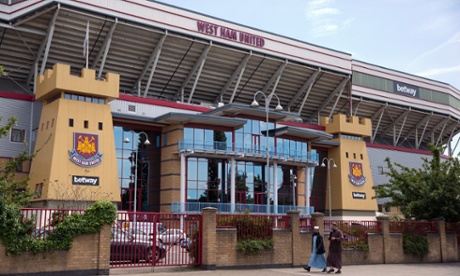
If you are not of the claret and blue persuasion yourself, you may well think the theatre of disturbing dreams where West Ham play their home games is called Upton Park. But Upton Park is the geographical area from which the tube station takes its name. The football stadium is officially the Boleyn Ground – so called in memory of a castle that was not really a castle at all.
The “Boleyn Castle” was a rather strange looking affair, built in 1544 and boasting vague connections with the woman over whom Henry VIII lost his head before he decided she must lose hers. Some romantics say Anne lived there. Others reckon she merely visited from time to time. Sadly they are all wrong – she had been executed eight years before the place was built. However, Green Street House, which stood in the grounds that West Ham had rented from the Catholic Church, became known locally as the Boleyn Castle – hence the name of the stadium.
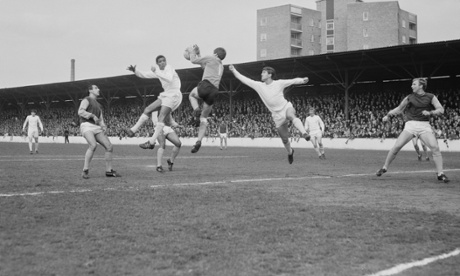
When I first went to the Boleyn Ground, back in the 60s, I stood on the North Bank. It was cheap to get in and allowed you to look like a hard case without ever running the risk of direct confrontation with the opposition hooligans, who were parked at the other end of the ground. No one – and I mean no one – ever “took” the West Ham North Bank. Which meant you could stand up straight and confidently sing that you hated Bill Shankly; you hated the Kop and were prepared to fight Man Utd until you drop. We didn’t give a widdle and we didn’t give a wank – we were the West Ham North Bank! Ah, they just don’t write lyrics like that any more.
This, of course, was many years before Lord Justice Taylor decreed that football grounds had to be all-seater and the North Bank was a concrete terrace, punctuated with metal crash barriers that were there to minimise the danger when the crowd surged forward. What would have minimised the danger even more is if the idiots at the back had refrained from setting off a nerve-jangling human tidal wave by shoving the people in front of them simply for the fun of it. But I suppose folk had to make their own entertainment in those days.
There were other problems involved with standing on the terraces – not least the waterfall of urine that started at half-time and was sometimes still trickling underfoot at the final whistle. But there were advantages, too. You could congregate with your mates, for one thing. And, if you did not have any mates, you could at least get together with a group of like-minded individuals who wanted to sing their hearts out in the name of West Ham United, and tell the world that east London is wonderful, with the reasons why (I will not go into those here because they are somewhat offensive).
These days, as a grey-beard season ticket holder, I sit in the East Stand, which is now dwarfed by the rest of the stadium and looks rather sorry for itself. It was quite the thing in its day, though. This was built in those heady times when England were world champions, Harold Wilson was prime minister, the Beatles dominated the charts, and Moore, Hurst and Peters played in claret and blue.
Of all the stands this was the loudest and the funniest. What made it different was the razor-sharp humour that emanated from the terraced lower tier that was to become, in West Ham folklore, a legend in its own right: the Chicken Run. (In the interests of accuracy, I should probably point out that the original Chicken Run was an old wooden construction surrounded by fine-mesh wire that was knocked down to make way for the new East Stand. But a name that good should not be allowed to die when we move to the Olympic Stadium. There has to be room for Chicken Run III.)
Now the East Stand, along with the rest of the ground, awaits its own appointment with the bulldozer. But, before the Boleyn Ground goes the same way as poor old Anne, I intend to make the most of every minute we have left at our true home. It is going to be a long and emotional swansong. Be warned: for anyone with a soft spot for West Ham, there is every chance it will all end in tears.
Brian Williams is a Guardian journalist and author of Nearly Reach The Sky – A Farewell to Upton Park, published by Biteback and available to buy here.