AHMEDABAD: With about 21 lakh population as per Census 2011, the western city parts (West, North-West and South-West Zones), account for 37% of the population of Ahmedabad.
But when it comes to consuming water, these areas guzzle 51% of the 1,117 million litres per day (MLD) water consumed by the city daily, indicates a study carried out by CEPT University.
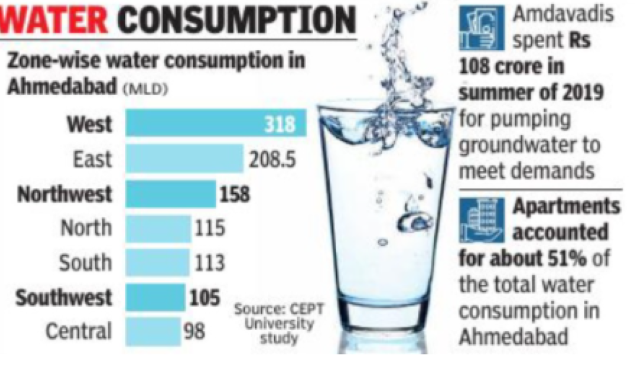
The study, which was part of the CEPT University’s City Studio initiative, indicated that the West zone accounted for 318 MLD, Northwest 158 MLD and Southwest 105 MLD daily water consumption.
Experts said that the study is primarily about domestic water consumption, and thus if one adds industries, both the halves of the city may be consuming the same amount.
‘Set up water meters’
The difference primarily comes from rapidly-developing fringes of the city and higher water consumption lifestyle compared to their eastern counterparts, they added.
March 21 is celebrated as World Water Day and this year’s theme is ‘Groundwater, making the invisible visible’. The study stated that despite the city getting Narmada water, high consumption leads to groundwater exploitation. Amdavadis still extract 36% of its demand from groundwater.
Prof Subhrangsu Goswami, assistant provost of CEPT University, who led the project, said that the western and eastern fringes – the developing areas of the city – depend heavily on groundwater. “But the difference is about haves and have-nots. While one section can afford the cost of extracting groundwater leading to more use of water per capita, for others the water supplied might not be adequate. Groundwater is a shared resource and should be monitored closely,” he said.
A study by AMC last year also indicated that the Northwest zone guzzled the maximum water per capita at 309 litres daily compared to 213 in the north and 233 litres in the south zone of the city.
The Cept study indicated that apartments accounted for about 51% of the city's water consumption. Prof Rutul Joshi, lead of City Studio initiative, said the study also highlights the need for water meters. “AMC can opt for not charging for water, but metering will provide us a fair idea of water consumption by the household,” he said.