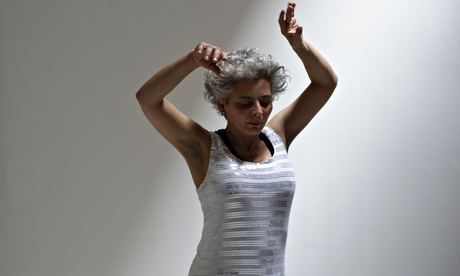
I seem to be suffering from genre anxiety. Thirty years ago, when I started making work, it was funded and sold under the umbrella of dance. It still gets funded and programmed as such at dance venues even though I've increasingly been mixing it up. In my last few pieces, I reckon that the ratio of movement to other formats (text, bad jokes, video and sound) is about 40/60, sometimes 30/70. Probably not enough to be wholeheartedly embraced under another form such as theatre, poetry, comedy or cabaret, but seldom strictly enough to warrant being called dance.
No one has sued me yet for misrepresentation, but I do hear enough of those "That wasn't dance" comments after performances to make me worry about being done by the Trade Descriptions Act. When I go to the theatre, I seldom hear people say afterwards, "That wasn't theatre."
I don't want to disappoint audiences who come with their own expectations, but I do want to broaden the audience for my work. Recent regional touring has taught me that a dance solo performed by an ageing woman struggles to get an audience, and I am wondering exactly which of those words – dance, ageing, woman – might be the biggest problem. My guess is that age plus dance plus woman equals mild panic or possible repulsion from some.
I am always keen to reassure people there are some jokes in my work, but then the jokes are quite esoteric for an audience used to standup comedy. Recently for a performance at the South Bank we struggled to come up with a tempting but honest genre description, but whatever we came up with it wasn't enough: not poetic enough to be poetry, not quite comic enough for comedy, not dancey enough for dance. Lots of "nots" really. It's hard to entice people in with negatives.
When I'm making a new show I can't stop the voice in my head that niggles away saying, "There isn't enough dance yet in this piece for the funding I am getting." I recall my friend Nigel Charnock being "sent to Drama" years ago because he wasn't dancing enough in his shows. But Drama didn't want him because Dance had thrown him out and he briefly became an itinerant caught in a set of forms tightly guarding their borders. So far no funding body has complained at the lack of dance in my shows, but it is constantly in my mind that one day they might.
I don't think this kind of border control really exists in mainland Europe. But in the UK borders seem more jealously guarded, in more ways than one. I've noticed ripples of anxiety in the dance world over the upcoming Move: Choreographing You exhibition at the Hayward. I've heard people ask why the art world is "appropriating" movement into its orbit without – as dancers might see it – doing the time.
I wonder if this "doing the time" attitude leads to a policing of forms and a feeling from artists that they have to stay in the art form in which they belong and not cross genres. How something is framed affects how people read something, how impatient they get while watching it, but most importantly, who might want or go to see it at all.
It's not just a question of how to market and sell the work but also how the idea of borders can impinge on an average day in the studio working. When I'm making, the parrot on my shoulder squawks in a critical voice that seems to use the language of an immigration officer, asking: "Why are you talking if it's a dance piece? You call that dance? You can't call that theatre! What are you when you're at home?" Maybe even asking: "Why is this blog under theatre when it should be over on the dance blog." You understand my problem?
• Wendy Houstoun performs Pact With Pointlessness at the Place, in London, on 6-7 October
• Wendy Houstoun: the death that made me question everything